

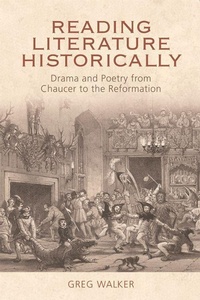
Reading Literature Historically
Drama and Poetry from Chaucer to the Reformation
Will be published approx. on 6. February 2013
Book
Hardback
216 pages
978-0-7486-8101-3 (ISBN)
Description
Pioneer of early-modern literary historicism reads Medieval & early Tudor drama & poetry historically
How far should we try to read medieval and early modern texts historically? Does the attempt to uncover how such texts might have been received by their original readers and audiences uncover new, hitherto unexpected contemporary resonances in them? Or does it flatten works of art into mere 'secondary sources' for historical analysis? This book makes the case for the study of literature in context. It demonstrates the value of historical and cultural analysis alongside traditional literary scholarship for enriching our understanding of plays and poems from the medieval and early Tudor past and of the cultures which produced and received them. It equally accepts the risks involved in that kind of study.
Key Features
Makes the case for reading medieval and early Tudor literature historicallyCase studies of the interaction between literature and politics, from Chaucer to the reign of Henry VIIIDetailed analysis of key medieval and Renaissance texts, Chaucer's Miller's Tale, Sir Gawain and Green Knight, Sir David Lyndsay's A Satire of the Three EstatesTurns a spotlight on hitherto neglected texts that reveal the challenges, rewards and potential pitfalls of reading literature historically
How far should we try to read medieval and early modern texts historically? Does the attempt to uncover how such texts might have been received by their original readers and audiences uncover new, hitherto unexpected contemporary resonances in them? Or does it flatten works of art into mere 'secondary sources' for historical analysis? This book makes the case for the study of literature in context. It demonstrates the value of historical and cultural analysis alongside traditional literary scholarship for enriching our understanding of plays and poems from the medieval and early Tudor past and of the cultures which produced and received them. It equally accepts the risks involved in that kind of study.
Key Features
Makes the case for reading medieval and early Tudor literature historicallyCase studies of the interaction between literature and politics, from Chaucer to the reign of Henry VIIIDetailed analysis of key medieval and Renaissance texts, Chaucer's Miller's Tale, Sir Gawain and Green Knight, Sir David Lyndsay's A Satire of the Three EstatesTurns a spotlight on hitherto neglected texts that reveal the challenges, rewards and potential pitfalls of reading literature historically
More details
Language
English
Place of publication
Edinburgh
United Kingdom
Target group
Professional and scholarly
Product notice
sewn/stitched
Cloth over boards
Dimensions
Height: 236 mm
Width: 157 mm
Thickness: 20 mm
Weight
499 gr
ISBN-13
978-0-7486-8101-3 (9780748681013)
Copyright in bibliographic data and cover images is held by Nielsen Book Services Limited or by the publishers or by their respective licensors: all rights reserved.
Schweitzer Classification
Other editions
Additional editions
E-Book
02/2013
Edinburgh University Press
€0.00
Available for download
Person
Greg Walker is Regius Professor of Rhetoric and English Literature at the University of Edinburgh. Among his publications are John Skelton and the Politics of the 1520s (Cambridge UP, 1988, pbk, 2002), Plays of Persuasion: Drama and Politics at the Court of Henry VIII (CUP, 1991, pbk, 2009.), The Politics of Performance in Early Renaissance Drama (CUP, 1998, pbk, 2006), Medieval Drama: An Anthology (Blackwell, pbk, 2000), Alexander Korda, The Private Life of Henry VIII (1933) (I.B. Tauris, 2003), Writing Under Tyranny: English Literature and the Henrician Reformation (Oxford UP, 2005, pbk and on-line editions, 2007), The Oxford Handbook of Medieval Literature in English (co-edited with E.M. Treharne, OUP, 2010), The Oxford Handbook of Tudor Drama (co-edited with Thomas Betteridge, OUP, 2012), and over fifty articles and essays in journals and edited collections.
Content
Acknowledgements; Introduction: Literature and History: the Risks of Conversation; SECTION 1: DRAMA; 1. Tudor Drama and the Arts of Resistance; 2. 'To Speak before the King, it is no Child's Play': Godly Queen Hester in 1529; 3. Flytyng in the Face of Convention: Protest and Innovation in Lindsay's Satyre of the Thrie Estaitis; SECTION 2: POETRY; 4. Courtesy and Chivalry in Sir Gawain and the Green Knight; 5. The Plowman's Tale and the Politics of 1532: A Cautionary Tale?; 6. Rough Girls and Squeamish Boys: The Trouble with Absolon in The Miller's Tale.