

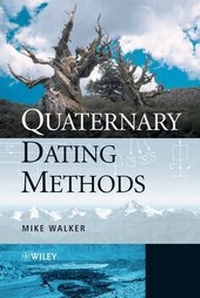
Quaternary Dating Methods
An Introduction
Published on 25. April 2005
Book
Paperback/Softback
306 pages
978-0-470-86927-7 (ISBN)
Description
This introductory textbook introduces the basics of dating, the range of techniques available and the strengths and limitations of each of the principal methods.
Coverage includes:
* the concept of time in Quaternary Science and related fields
* the history of dating from lithostratigraphy and biostratigraphy
* the development and application of radiometric methods
* different methods in dating: radiometric dating, incremental dating, relative dating and age equivalence
Presented in a clear and straightforward manner with the minimum of technical detail, this text is a great introduction for both students and practitioners in the Earth, Environmental and Archaeological Sciences.
Reviews / Votes
"This book is a must for any Quaternary scientist." (South African Geographical Journal, September 2006) "...very well organized, clearly and straightforwardly written and provides a good overview on the wide field of Quaternary dating methods..."(Journal of Quaternary Science, January 2007)More details
Edition
1. Auflage
Language
English
Place of publication
New York
United States
Target group
Professional and scholarly
Product notice
Paperback (trade)
Unsewn / adhesive bound
Dimensions
Height: 244 mm
Width: 170 mm
Thickness: 17 mm
Weight
532 gr
ISBN-13
978-0-470-86927-7 (9780470869277)
Schweitzer Classification
Other editions
New editions

Additional editions
Book
04/2005
Wiley
Unfortunately, price unknown
Article exhausted; check for reprint
Person
Mike Walker is a highly experienced, script writer of drama and documentary for film, radio and television. He has won several Sony Awards for Best Play as well as a Royal Television Society Gold Medal and other awards including ones from the Society of Authors and Writers Guild. He has also written several novels and non-fiction works and teaches creative writing at Morley College London.
Content
Preface.
1 Introduction to Quaternary Dating.
1.1 Introduction.
1.2 The development of Quaternary dating.
1.3 Precision and accuracy in dating.
1.4 Atomic structure, radioactivity and radiometric dating.
1.5 The Quaternary: stratigraphic framework and terminology.
1.6 The scope and content of the book.
Notes.
2 Radiometric Dating 1: Radiocarbon Dating.
2.1 Introduction.
2.2 Basic principles.
2.3 Radiocarbon measurement.
2.4 Sources of error in radiocarbon dating.
2.5 Some problematic dating materials.
2.6 Calibration of the radiocarbon timescale.
2.7 Applications of radiocarbon dating.
Notes.
3 Radiometric Dating 2: Dating using Long-lived and Short-lived Isotopes.
3.1 Introduction.
3.2 Potassium argon and Argon argon dating.
3.3 Uranium series dating.
3.4 Cosmogenic nuclide dating.
3.5 Dating using short-lived isotopes.
Notes.
4 Radiometric Dating 3: Radiation Exposure Dating.
4.1 Introduction.
4.2 Luminescence dating.
4.3 Electron spin resonance dating.
4.4 Fission track dating.
Notes.
5 Dating using Annually-Banded Records
5.1 Introduction.
5.2 Dendrochronology.
5.3 Varve chronology.
5.4 Lichenometry.
5.5 Annual layers in glacier ice.
5.6 Other media dated by annual banding.
Notes.
6 Relative Dating Methods.
6.1 Introduction.
6.2 Rock surface weathering.
6.3 Obsidian hydration dating.
6.4 Pedogenesis.
6.5 Relative dating of fossil bone.
6.6 Amino-acid geochronology.
Notes.
7 Techniques for Establishing Age Equivalence.
7.1 Introduction.
7.2 Oxygen isotope chronstratigraphy.
7.3 Tephrochronology.
7.4 Palaeomagnetism.
7.5 Palaeosols.
Notes.
8 Dating the future
8.1 Introduction.
8.2 Radiometric dating.
8.3 Annually-banded records.
8.4 Age Equivalence.
8.5 Biomolecular dating.
Notes.
References.
Index.