

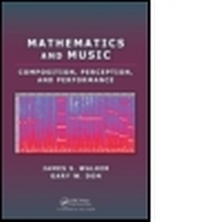
Mathematics and Music
Composition, Perception, and Performance
1st Edition
Published on 12. April 2013
Book
Paperback/Softback
342 pages
978-1-4398-6709-9 (ISBN)
Description
At first glance, mathematics and music seem to be from separate worlds-one from science, one from art. But in fact, the connections between the two go back thousands of years, such as Pythagoras's ideas about how to quantify changes of pitch for musical tones (musical intervals). Mathematics and Music: Composition, Perception, and Performance explores the many links between mathematics and different genres of music, deepening students' understanding of music through mathematics.
In an accessible way, the text teaches the basics of reading music and explains how various patterns in music can be described with mathematics. The authors extensively use the powerful time-frequency method of spectrograms to analyze the sounds created in musical performance. Numerous examples of music notation assist students in understanding basic musical scores. The text also provides mathematical explanations for musical scales, harmony, and rhythm and includes a concise introduction to digital audio synthesis.
Along with helping students master some fundamental mathematics, this book gives them a deeper appreciation of music by showing how music is informed by both its mathematical and aesthetic structures.
Web Resource
On the book's CRC Press web page, students can access videos of many of the spectrograms discussed in the text as well as musical scores playable with the free music software MuseScore. An online bibliography offers many links to free downloadable articles on math and music. The web page also provides links to other websites related to math and music, including all the sites mentioned in the book.
In an accessible way, the text teaches the basics of reading music and explains how various patterns in music can be described with mathematics. The authors extensively use the powerful time-frequency method of spectrograms to analyze the sounds created in musical performance. Numerous examples of music notation assist students in understanding basic musical scores. The text also provides mathematical explanations for musical scales, harmony, and rhythm and includes a concise introduction to digital audio synthesis.
Along with helping students master some fundamental mathematics, this book gives them a deeper appreciation of music by showing how music is informed by both its mathematical and aesthetic structures.
Web Resource
On the book's CRC Press web page, students can access videos of many of the spectrograms discussed in the text as well as musical scores playable with the free music software MuseScore. An online bibliography offers many links to free downloadable articles on math and music. The web page also provides links to other websites related to math and music, including all the sites mentioned in the book.
Reviews / Votes
"... a valuable addition to the literature and an important piece of pedagogical material. The exercises and answers make this work immediately valuable to any college-level (or advanced high school) instructor. An enlightened music department might count a course based on the book toward an undergraduate mathematics requirement. However it might be used, the authors have done a service to mathematicians and musicians alike."-Robert Rowe, Journal of Mathematics and the Arts, 2014
"Although this book is structured like a textbook (with exercises and extra material at the textbook website), it is much more. ... And there is some fascinating music trivia scattered throughout, like the fact that Mozart never used the iii to IV chord progression, the fact that the Beatles' Eleanor Rigby is a multi-modal composition, and the interesting remix story of the Beatles' Strawberry Fields Forever. If you have at least a moderate background in both music and mathematics, there is some great fun here."
-Donald L. Vestal, MAA Reviews, January 2014
"This book strikes an interesting balance between theoretical development and practical, concrete material. A companion website contains audio, video and score files for many of the examples; supplementary reading; and many external links."
-David Warren Bulger, Mathematical Reviews, November 2013
More details
Language
English
Place of publication
Washington
United States
Target group
College/higher education
Undergraduate students in liberal arts or mathematics; professional in mathematics and physics; advanced high school students.
Illustrations
8-pg, 16 fig color insert follows page 144, 343 s/w Abbildungen, 15 s/w Tabellen
8-pg, 16 fig color insert follows page 144; 15 Tables, black and white; 343 Illustrations, black and white
Dimensions
Height: 254 mm
Width: 178 mm
Weight
710 gr
ISBN-13
978-1-4398-6709-9 (9781439867099)
Copyright in bibliographic data and cover images is held by Nielsen Book Services Limited or by the publishers or by their respective licensors: all rights reserved.
Schweitzer Classification
Other editions
New editions
Book
02/2023
2nd Edition
Chapman & Hall/CRC
€93.20
Shipment within 10-20 days
Book
06/2021
2nd Edition
CRC Press
€85.60
The article will not be published
Additional editions
Book
07/2017
1st Edition
CRC Press
€222.84
Article exhausted; check for reprint
Persons
Content
Pitch, Frequency, Musical Scales
Pitch and Frequency
Overtones, Pitch Equivalence, and Musical Scales
The 12-tone equal-tempered scale
Musical Scales within the Chromatic Scale
Logarithms
Basic Musical Notation
Staff Notation, Clefs, Note Positions
Time Signatures and Tempo
Key Signatures and The Circle of Fifths
Some Music Theory
Intervals and Chords
Diatonic Music
Diatonic Transformations-Scale Shifts
Diatonic Transformations-Inversions, Retrograde
Chromatic Transformations
Web Resources
Spectrograms and Musical Tones
Musical Gestures in Spectrograms
Mathematical Model for Musical Tones
Modeling Instrumental Tones
Beating and Dissonance
Estimating Amplitude and Frequency
Windowing the Waveform: Spectrograms
A Deeper Study of Amplitude Estimation
Spectrograms and Music
Singing
Instrumentals
Compositions
Analyzing Pitch and Rhythm
Geometry of Pitch Organization and Transpositions
Geometry of Chromatic Inversions
Cyclic Rhythms
Rhythmic Inversion
Construction of Scales and Cyclic Rhythms
Comparing Musical Scales and Cyclic Rhythms
Serialism
A Geometry of Harmony
Riemann's Chromatic Inversions
A Network of Triadic Chords
Embedding Pitch Classes within the Tonnetz
Other Chordal Transformations
Audio Synthesis in Music
Creating New Music from Spectrograms
Phase Vocoding
Time Stretching and Time Shrinking
MIDI Synthesis
A Exercise Solutions
B Music Software
C Amplitude and Frequency Results
D Glossary
E Permissions
Bibliography
Index
Pitch and Frequency
Overtones, Pitch Equivalence, and Musical Scales
The 12-tone equal-tempered scale
Musical Scales within the Chromatic Scale
Logarithms
Basic Musical Notation
Staff Notation, Clefs, Note Positions
Time Signatures and Tempo
Key Signatures and The Circle of Fifths
Some Music Theory
Intervals and Chords
Diatonic Music
Diatonic Transformations-Scale Shifts
Diatonic Transformations-Inversions, Retrograde
Chromatic Transformations
Web Resources
Spectrograms and Musical Tones
Musical Gestures in Spectrograms
Mathematical Model for Musical Tones
Modeling Instrumental Tones
Beating and Dissonance
Estimating Amplitude and Frequency
Windowing the Waveform: Spectrograms
A Deeper Study of Amplitude Estimation
Spectrograms and Music
Singing
Instrumentals
Compositions
Analyzing Pitch and Rhythm
Geometry of Pitch Organization and Transpositions
Geometry of Chromatic Inversions
Cyclic Rhythms
Rhythmic Inversion
Construction of Scales and Cyclic Rhythms
Comparing Musical Scales and Cyclic Rhythms
Serialism
A Geometry of Harmony
Riemann's Chromatic Inversions
A Network of Triadic Chords
Embedding Pitch Classes within the Tonnetz
Other Chordal Transformations
Audio Synthesis in Music
Creating New Music from Spectrograms
Phase Vocoding
Time Stretching and Time Shrinking
MIDI Synthesis
A Exercise Solutions
B Music Software
C Amplitude and Frequency Results
D Glossary
E Permissions
Bibliography
Index