

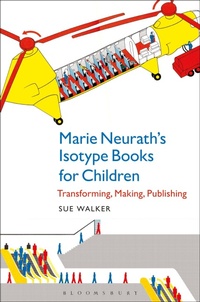
Marie Neurath's Isotype Books for Children
Description
After the end of the Second World War, Marie Neurath and her team at the Isotype Institute in London produced some of the most visually striking and innovative information books of the twentieth century. Neurath's books for young people were illustrated and designed using the principles of Isotype to inspire the curiosity and engagement of children.
This book draws on the Otto and Marie Neurath Isotype Collection that was given by Marie Neurath to the University of Reading in the early 1970s. Including draft texts with annotations from the editorial team, page layouts, illustration sketches and developed drawings, print production details and proofs, the collection provides considerable insight into how the books were designed and produced.
A fascinating exploration of Neurath's workings and correspondence, this book explores the challenges Neurath encountered as a woman émigré designer in London, and charts how her ground-breaking books were made.
The eBook editions of this book are available open access under a CC BY-NC-ND 4.0 licence on bloomsburycollections.com. Open access was funded by the University of Reading, UK.
More details
Person
Content
1 Origins of the Isotype children's books
2 Textbooks and children's books: Isotype Institute and Adprint 1943-1950
3 Publishing context: information books for young people
4 'A visual language... with rather strict rules': organising images and text
5 A 'little factory' making books
6 Three books start to finish
7 Co-editions and re-use of images
8 Unpublished work and other materials
9 Legacy