

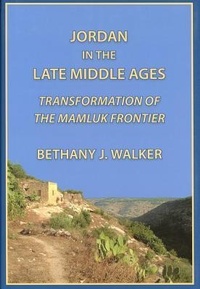
Jordan in the Late Middle Ages
Transformation of the Mamluk Frontier
Published on 31. December 2011
Book
Hardback
348 pages
978-0-9708199-7-0 (ISBN)
Description
The decline of the Mamluk Sultanate from the late fourteenth century is an important component of the larger transformation of the late medieval Levant. In this centralized state, the Mamluks political culture has traditionally been defined by that of the imperial capital of Cairo. The political decline of the sultanate in Cairo has, then, come to define the many-faceted transformations of the entire region with the waning of the medieval era. The dynamics of change far from Cairo, in remote settlements on the imperial frontier, are, by contrast, relatively unknown.
This book explores the transformation of the Mamluk state from the perspective of the Jordanian frontier, considering the actions of local people in molding both the state and their own societies in the post-plague era. Through a critical analysis of a wide range of economic and legal documents of the late Mamluk and early Ottoman periods, as well as data on rural society generated by recent archaeological research, the work documents the complex, dialectical relationships that always existed between the Mamluk state and the tribal societies of Jordan, as well as the flexible strategies pursued by both to adapt to changing circumstances during the late medieval period. It is ultimately a provincial perspective on imperial decline, reform, and rebirth that sheds new light on the mechanisms of socio-political and economic change through the experiences of ordinary people living on the margins of empire.
The book is illustrated with more than two dozen photographs and 6 maps.
This book explores the transformation of the Mamluk state from the perspective of the Jordanian frontier, considering the actions of local people in molding both the state and their own societies in the post-plague era. Through a critical analysis of a wide range of economic and legal documents of the late Mamluk and early Ottoman periods, as well as data on rural society generated by recent archaeological research, the work documents the complex, dialectical relationships that always existed between the Mamluk state and the tribal societies of Jordan, as well as the flexible strategies pursued by both to adapt to changing circumstances during the late medieval period. It is ultimately a provincial perspective on imperial decline, reform, and rebirth that sheds new light on the mechanisms of socio-political and economic change through the experiences of ordinary people living on the margins of empire.
The book is illustrated with more than two dozen photographs and 6 maps.
Reviews / Votes
More details
Series
Language
English
Place of publication
IL
United States
Target group
College/higher education
Product notice
Laminated cover
Dimensions
Height: 233 mm
Width: 155 mm
Thickness: 18 mm
Weight
725 gr
ISBN-13
978-0-9708199-7-0 (9780970819970)
Copyright in bibliographic data and cover images is held by Nielsen Book Services Limited or by the publishers or by their respective licensors: all rights reserved.
Schweitzer Classification
Person
Bethany Walker is Associate Professor of Middle Eastern History at Missouri State University. She has published widely on Mamluk and Ottoman socio-economic history and material culture in primarily American and French journals. A historian and archaeologist, she directs two archaeological projects in Jordan and for the last twenty years has been doing fieldwork at sites throughout the eastern Mediterranean. Her edited work Reflections of Empire: Archaeological and Ethnographic Studies on the Pottery of the Ottoman Levant was published by the American Schools of Oriental Research in 2009.
Content
List of Illustrations
Acknowledgments
Chapter One: A Medieval "Global Moment"
Chapter Two: Mamluk Administration of Jordan
Chapter Three: Structure and Character of Jordanian Society
Chapter Four: Jordan's Economy at the Turn of the Fifteenth Century
Chapter Five: Ottoman Jordan and the Mamluk Legacy
Bibliography
Index
Acknowledgments
Chapter One: A Medieval "Global Moment"
Chapter Two: Mamluk Administration of Jordan
Chapter Three: Structure and Character of Jordanian Society
Chapter Four: Jordan's Economy at the Turn of the Fifteenth Century
Chapter Five: Ottoman Jordan and the Mamluk Legacy
Bibliography
Index