

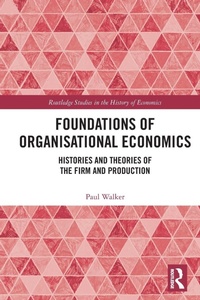
Foundations of Organisational Economics
Histories and Theories of the Firm and Production
1st Edition
Published on 26. September 2022
Book
Paperback/Softback
186 pages
978-0-367-72249-4 (ISBN)
Description
Foundations of Organisational Economics: Histories and Theories of the Firm and Production delves into a range of key topics to do with the history of the mainstream approach to the theory of production and the theory of the firm. This includes the frameworks used to analyse production, the division of labour and its application to the firm and the development of the neoclassical model of production.
The first topic explored is the change from a normative approach to a largely positive approach to the analysis of the theory of production, which occurred around the seventeenth century. The next topic is an examination of the relationship (or the lack of a relationship) between the division of labour and the theory of the ?rm. In the fourth chapter, the focus is on the development of the proto-neoclassical approach to production. Here, the development of the theories of monopoly, oligopoly and perfect competition are discussed, as well as the theory of input utilisation. Chapter 5 looks at Marshall's idea of the representative firm, which was the main early neoclassical approach to the theory of industry-level production. The penultimate chapter considers the criticisms made of the neoclassical model between 1940 and 1970.
This work is an illuminating reference for students and researchers of the history of economic thought, industrial organisation, microeconomic theory and organisational studies.
The first topic explored is the change from a normative approach to a largely positive approach to the analysis of the theory of production, which occurred around the seventeenth century. The next topic is an examination of the relationship (or the lack of a relationship) between the division of labour and the theory of the ?rm. In the fourth chapter, the focus is on the development of the proto-neoclassical approach to production. Here, the development of the theories of monopoly, oligopoly and perfect competition are discussed, as well as the theory of input utilisation. Chapter 5 looks at Marshall's idea of the representative firm, which was the main early neoclassical approach to the theory of industry-level production. The penultimate chapter considers the criticisms made of the neoclassical model between 1940 and 1970.
This work is an illuminating reference for students and researchers of the history of economic thought, industrial organisation, microeconomic theory and organisational studies.
More details
Series
Language
English
Place of publication
London
United Kingdom
Publishing group
Taylor & Francis Ltd
Target group
College/higher education
Adult education
Postgraduate
Illustrations
13 s/w Abbildungen, 13 s/w Zeichnungen
13 Line drawings, black and white; 13 Illustrations, black and white
Dimensions
Height: 234 mm
Width: 156 mm
Thickness: 11 mm
Weight
310 gr
ISBN-13
978-0-367-72249-4 (9780367722494)
Copyright in bibliographic data and cover images is held by Nielsen Book Services Limited or by the publishers or by their respective licensors: all rights reserved.
Schweitzer Classification
Other editions
Additional editions
Paul Walker
Foundations of Organisational Economics
Histories and Theories of the Firm and Production
Book
03/2021
1st Edition
Routledge
€206.10
Shipment within 15-20 days
Paul Walker
Foundations of Organisational Economics
Histories and Theories of the Firm and Production
E-Book
03/2021
1st Edition
Routledge
€59.49
Available for download
Paul Walker
Foundations of Organisational Economics
Histories and Theories of the Firm and Production
E-Book
03/2021
1st Edition
Routledge
€59.49
Available for download
Person
Paul Walker is an economist based in Christchurch, New Zealand. He received his PhD in economics from the University of Canterbury, Christchurch, New Zealand. His research is mainly to do with the history of economic thought and the theory of the firm. He is author of The Theory of the Firm: An Overview of the Economic Mainstream and A Brief Prehistory of the Theory of the Firm, both published by Routledge.
Content
1 Introduction; 2 Normative versus positive analysis in the history of the theory of production; 3 The division of labour and the theory of the firm; 4 Proto-neoclassicals and the theory of production; Appendix: a very brief history of perfect competition; 5 The representative firm; 6 The neoclassical model under fire 1940-1970; 7 Conclusion