

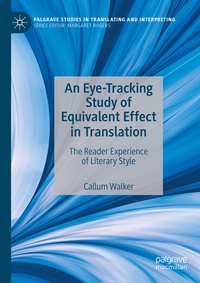
An Eye-Tracking Study of Equivalent Effect in Translation
Description
This book provides a detailed example of an eye-tracking method for comparing the reading experience of a literary source text readers with readers of a translation at stylistically marked points. Drawing on principles, methods and inspiration from fields including translation studies, cognitive psychology, and language and literary studies, the author proposes an empirical method to investigate the notion of stylistic foregrounding, with 'style' understood as the distinctive manner of expression in a particular text. The book employs Raymond Queneau's Zazie dans le métro (1959) and its English translation Zazie in the Metro (1960) as a case study to demonstrate the proposed methods. This book will be of particular interest to students and scholars of translation studies, as well as those interested in literary reception, stylistics and related fields.
Reviews / Votes
"This book is an excellent, innovative contribution to Translation Studies. It fills a recognised lacuna in the empirical analysis of the effects of literary translation and the cognitive processing involved in readers' reception of translations. Walker demonstrates in an exceptional way how eye tracking methodology can be rigorously applied to the analysis of translation stylistics. The book will serve as an essential reference work for scholars who wish to build knowledge and methodological know-how." -- Sharon O'Brien , Dublin City University, Ireland"Walker's work is a unique and stimulating contribution to the discipline and its future. He expertly brings together diverse and complementary literatures, approaches, and cutting-edge methods in a compelling study that provides valuable and unprecedented empirical evidence of cognitive equivalence and readers' cognitive experience of style. This is a refreshing and inspiring read for experienced and new scholars alike." -- Stephen Doherty , University of New South Wales, Australia
"This book is a thoughtful and engaging attempt to develop a theoretically cogent and empirically innovative method for investigating readers' experience of literary style. It brings a much needed reader-oriented perspective to cognitive translation studies, and its interdisciplinary synthesis of ideas and methods from different fields lays the groundwork for exciting new directions in cognitively oriented translation reception studies." -- Haidee Kotze , Utrecht University, Netherlands
More details
Other editions
Additional editions
Person
Callum Walker is a lecturer in translation technology at the University of Leeds and an honorary research fellow at University College London. His research focuses on how biometric methods can be employed to gauge stylistic and phenomenological equivalence between a source text and its translation, with a particular focus on language varieties.