

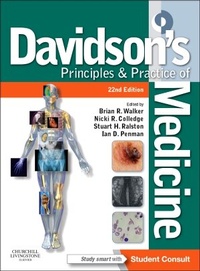
Davidson's Principles and Practice of Medicine
With STUDENT CONSULT Online Access
22nd Edition
Published on 4. February 2014
Book
Paperback/Softback
1392 pages
978-0-7020-5035-0 (ISBN)
Description
More than two million medical students, doctors and other health professionals from around the globe have owned a copy of Davidson's Principles and Practice of Medicine since it was first published. Today's readers rely on this beautifully illustrated text to provide up-to-date detail of contemporary medical practice, presented in a style that is concise and yet easy to read. Davidson's provides the factual knowledge required to practise medicine, explaining it in the context of underlying principles, basic science and research evidence, and shows how to apply this knowledge to the management of patients who present with problems rather than specific diseases. The book has won numerous prizes including being highly commended in the British Medical Association book awards.
Davidson's global perspective is enhanced by the input of an international team of authors and a distinguished International Advisory Board from 17 countries. Building on the foundations laid down by its original editor, Davidson's remains one of the world's leading and most respected textbooks of medicine.
The underlying principles of medicine are described concisely in the first part of the book, and the detailed practice of medicine within each sub-specialty is described in later system-based chapters.
Most chapters begin with a two-page overview of the important elements of the clinical examination, including a manikin to illustrate the key steps in the examination of the relevant system.
A practical, problem-based clinical approach is described in the 'Presenting Problems' sections, to complement the detailed descriptions of each disease.
The text is extensively illustrated, with over 1000 diagrams, clinical photographs, and radiology and pathology images.
1350 text boxes present information in a way suitable for revision, including 150 clinical evidence boxes summarising the results of systematic reviews and randomised controlled trials and 65 'In Old Age' boxes highlighting important aspects of medical practice in the older population.
A combined index and glossary of medical acronyms contains over 10 000 subject entries. The contents can also be searched comprehensively as part of the online access to the whole book on the StudentConsult platform.
Access over 500 self-testing questions with answers linked to the book's content for further reading.
The text uses both SI and non-SI units to make it suitable for readers throughout the globe.
A new chapter specifically on Stroke Disease recognises the emergence of Stroke Medicine as a distinct clinical and academic discipline.
A rationalisation of the 1350 boxes used throughout the book gives a simpler and clearer presentation of the various categories.
New 'In Adolescence' boxes recognise the fact that many chronic disorders begin in childhood and become the responsibility of physicians practising adult medicine. These boxes acknowledge the overlap 'transitional' phase and highlight the key points of importance when looking after young people.
The regular introduction of new authors and editors maintains the freshness of each new edition. On this occasion Dr Ian Penman has joined the editorial team and 18 new authors bring new experience and ideas to the content and presentation of the textbook.
An expanded International Advisory Board of 38 members includes new members from several different countries.
Davidson's global perspective is enhanced by the input of an international team of authors and a distinguished International Advisory Board from 17 countries. Building on the foundations laid down by its original editor, Davidson's remains one of the world's leading and most respected textbooks of medicine.
The underlying principles of medicine are described concisely in the first part of the book, and the detailed practice of medicine within each sub-specialty is described in later system-based chapters.
Most chapters begin with a two-page overview of the important elements of the clinical examination, including a manikin to illustrate the key steps in the examination of the relevant system.
A practical, problem-based clinical approach is described in the 'Presenting Problems' sections, to complement the detailed descriptions of each disease.
The text is extensively illustrated, with over 1000 diagrams, clinical photographs, and radiology and pathology images.
1350 text boxes present information in a way suitable for revision, including 150 clinical evidence boxes summarising the results of systematic reviews and randomised controlled trials and 65 'In Old Age' boxes highlighting important aspects of medical practice in the older population.
A combined index and glossary of medical acronyms contains over 10 000 subject entries. The contents can also be searched comprehensively as part of the online access to the whole book on the StudentConsult platform.
Access over 500 self-testing questions with answers linked to the book's content for further reading.
The text uses both SI and non-SI units to make it suitable for readers throughout the globe.
A new chapter specifically on Stroke Disease recognises the emergence of Stroke Medicine as a distinct clinical and academic discipline.
A rationalisation of the 1350 boxes used throughout the book gives a simpler and clearer presentation of the various categories.
New 'In Adolescence' boxes recognise the fact that many chronic disorders begin in childhood and become the responsibility of physicians practising adult medicine. These boxes acknowledge the overlap 'transitional' phase and highlight the key points of importance when looking after young people.
The regular introduction of new authors and editors maintains the freshness of each new edition. On this occasion Dr Ian Penman has joined the editorial team and 18 new authors bring new experience and ideas to the content and presentation of the textbook.
An expanded International Advisory Board of 38 members includes new members from several different countries.
More details
Edition
22nd Revised edition
Language
English
Place of publication
London
United Kingdom
Publishing group
Elsevier Health Sciences
Target group
College/higher education
Edition type
Revised edition
Illustrations
Approx. 1015 illustrations (825 in full color)
ISBN-13
978-0-7020-5035-0 (9780702050350)
Copyright in bibliographic data and cover images is held by Nielsen Book Services Limited or by the publishers or by their respective licensors: all rights reserved.
Schweitzer Classification
Other editions
New editions
Mark W.J. Strachan | Stuart H. Ralston | Neeraj Dhaun
Davidson's Principles and Practice of Medicine
Book
06/2026
25th Edition
Churchill Livingstone
€73.50
Shipment within 15-20 days
Stuart H. Ralston | Ian D. Penman | Mark W. J. Strachan
Davidson's Principles and Practice of Medicine
Book
04/2018
23rd Edition
Elsevier
€89.32
Article exhausted; check for reprint
Previous edition
Nicki R. Colledge | Brian R. Walker | Stuart H. Ralston
Davidson's Principles and Practice of Medicine: With STUDENT CONSULT Online Access
With STUDENT CONSULT Online Access
Book
03/2010
21st Edition
Churchill Livingstone
€85.60
Article exhausted; check for reprint
Persons
Content
Part 1 - Principles of medicine
Good medical practice Therapeutics and good prescribing
Molecular and genetic factors in disease Immunological factors in disease Environmental and nutritional factors in disease
Principles of infectious disease Ageing and disease Part 2 - Practice of medicine
Critical illness Poisoning
Medical psychiatry Oncology Palliative care and pain Infectious disease
HIV infection and AIDS Sexually transmitted infections Clinical biochemistry and metabolism Kidney and urinary tract disease Cardiovascular disease Respiratory disease Endocrine disease Diabetes mellitus Alimentary tract and pancreatic disease Liver and biliary tract disease Blood disease Rheumatology and bone disease Neurological disease
Stroke disease Skin disease Laboratory reference ranges
Good medical practice Therapeutics and good prescribing
Molecular and genetic factors in disease Immunological factors in disease Environmental and nutritional factors in disease
Principles of infectious disease Ageing and disease Part 2 - Practice of medicine
Critical illness Poisoning
Medical psychiatry Oncology Palliative care and pain Infectious disease
HIV infection and AIDS Sexually transmitted infections Clinical biochemistry and metabolism Kidney and urinary tract disease Cardiovascular disease Respiratory disease Endocrine disease Diabetes mellitus Alimentary tract and pancreatic disease Liver and biliary tract disease Blood disease Rheumatology and bone disease Neurological disease
Stroke disease Skin disease Laboratory reference ranges