

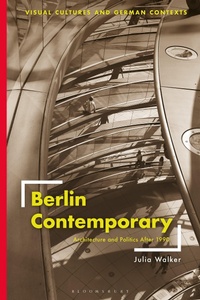
Berlin Contemporary
Architecture and Politics After 1990
Published on 2. December 2021
Book
Hardback
264 pages
978-1-5013-6752-6 (ISBN)
Description
For years following reunification, Berlin was the largest construction site in Europe, with striking new architecture proliferating throughout the city in the 1990s and early 2000s. Among the most visible and the most contested of the new projects were those designed for the national government and its related functions.
Berlin Contemporary explores these buildings and plans, tracing their antecedents while also situating their iconic forms and influential designers within the spectacular world of global contemporary architecture. Close studies of these sites, including the Reichstag, the Chancellery, and the reconstruction of the Berlin Stadtschloss (now known as the Humboldt Forum), demonstrate the complexity of Berlin's political and architectural "rebuilding"-and reveal the intricate historical negotiations that architecture was summoned to perform.
Berlin Contemporary explores these buildings and plans, tracing their antecedents while also situating their iconic forms and influential designers within the spectacular world of global contemporary architecture. Close studies of these sites, including the Reichstag, the Chancellery, and the reconstruction of the Berlin Stadtschloss (now known as the Humboldt Forum), demonstrate the complexity of Berlin's political and architectural "rebuilding"-and reveal the intricate historical negotiations that architecture was summoned to perform.
Reviews / Votes
"Walker writes about contemporary architecture not as a critic but as a sharp-eyed, thought-provoking historian. Berlin Contemporary is a meticulously researched book that raises the bar for the study of recent urbanism; Walker's luscious, flowing prose makes for effortless reading, despite the seriousness of the subject. A formidable achievement." * Carla Yanni, Distinguished Professor of Art History, Rutgers, The State University of New Jersey, USA * "A deeply researched book on a city that has, in the course of its reconstruction, arguably become the cultural capital of Europe, Berlin Contemporary grapples with issues of architecture, politics, the public sphere, and memory that have implications for cities around the world." * Elizabeth Otto, Professor of Modern & Contemporary Art History, State University of New York at Buffalo, USA * "The words 'Reunification of Germany' seem to indicate a singular event. In reality, it is hardly a done deal even today. Approaching the topic in a way that is both sensitive and provocative, Walker's book, interblending history and criticism, helps us see how architecture operates within complex political, geo-political, and cultural environments." * Mark Jarzombek, Professor of the History & Theory of Architecture, Massachusetts Institute of Technology, USA *More details
Series
Language
English
Place of publication
London
United Kingdom
Publishing group
Bloomsbury Publishing PLC
Target group
College/higher education
Product notice
sewn/stitched
Cloth over boards
With dust jacket
Illustrations
112 bw illus
Dimensions
Height: 235 mm
Width: 155 mm
Thickness: 21 mm
Weight
698 gr
ISBN-13
978-1-5013-6752-6 (9781501367526)
Copyright in bibliographic data and cover images is held by Nielsen Book Services Limited or by the publishers or by their respective licensors: all rights reserved.
Schweitzer Classification
Other editions
Additional editions
E-Book
11/2021
1st Edition
Bloomsbury Visual Arts
€33.49
Available for download
Person
Julia Walker is Associate Professor of Art History at The State University of New York in Binghamton, USA. Her research focuses on modern and contemporary architecture, emphasizing the persistence and transformation of modernist ideas within contemporary practice-and the ways in which this modernist inheritance informs, inflects, and destabilizes claims to political meaning. Her current projects examine the underrepresentation of women in architectural practice and explore the history of architectural criticism as a genre.
Content
Introduction: Berlin, the Contemporary Capital
Chapter 1: Bridging and Breaking-Master Planning the Spreebogen
Chapter 2: The Reichstag's New Lightness of Being
Chapter 3: Monumental Modernism-The Chancellery as Future Ruin
Chapter 4: Palaces of Doubt
Conclusion: No One Intends to Open an Airport
Chapter 1: Bridging and Breaking-Master Planning the Spreebogen
Chapter 2: The Reichstag's New Lightness of Being
Chapter 3: Monumental Modernism-The Chancellery as Future Ruin
Chapter 4: Palaces of Doubt
Conclusion: No One Intends to Open an Airport