

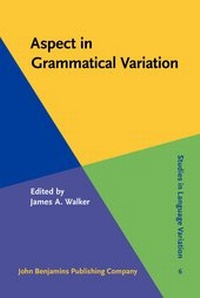
Aspect in Grammatical Variation
1st Edition
Published on 17. November 2010
Book
Hardback
150 pages
978-90-272-3486-5 (ISBN)
Description
The articles in this edited volume represent a range of approaches to studying the role of verbal aspect in grammatical variation. Issues addressed include: defining the variable context; operationalizing aspectual distinctions as factors conditioning linguistic variation; and the appropriate number of aspectual distinctions and levels. Apart from bringing to light various methodological and analytical issues, this volume gathers together a unique collection of original research, based on spoken- and written-language corpora, of an array of languages and linguistic varieties: African American Vernacular English, Caribbean English and English-based creole, Indian English, Newfoundland English, Canadian French, Brazilian Portuguese, Ecuadorian Spanish, Mexican Spanish, and Peninsular Spanish. This volume should not only benefit research on grammatical variation but also be of interest more generally to the study of verbal aspect.
More details
Series
Language
English
Place of publication
Amsterdam
Netherlands
Target group
Professional and scholarly
Dimensions
Height: 245 mm
Width: 164 mm
Weight
460 gr
ISBN-13
978-90-272-3486-5 (9789027234865)
Copyright in bibliographic data and cover images is held by Nielsen Book Services Limited or by the publishers or by their respective licensors: all rights reserved.
Schweitzer Classification
Other editions
Additional editions
James A. Walker
Aspect in Grammatical Variation
E-Book
11/2010
1st Edition
John Benjamins Publishing Company
€118.99
Available for download
Person
Content
1. Chapter 1. Introduction (by Walker, James A.); 2. Chapter 2. Grammaticalization paths as variable contexts in weak complementarity in Spanish (by Schwenter, Scott A.); 3. Chapter 3. Aspectual periphrases and syntactic variation in Brazilian Portuguese (by Mendes, Ronald Beline); 4. Chapter 4. Aspect and the English Present Perfect: What can be coded? (by Herk, Gerard Van); 5. Chapter 5. Coding compositional aspect in French (by LeBlanc, Carmen); 6. Chapter 6. Breaking old habits: Syntactic constraints underlying habitual effects in Newfoundland English (by Childs, Becky); 7. Chapter 7. Affairs of state: Defining and coding stativity in English and English-based Creole (by Walker, James A.); 8. Chapter 8. A new methodology for the study of aspect in contact: Past and progressive in Indian English (by Sharma, Devyani); 9. Chapter 9. Expressing tense and aspect: The case of adult Chinese-Spanish speakers in Ecuador (by Biehl, Hsiao-Ping); 10. Index