

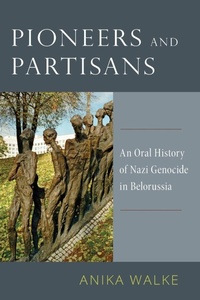
Pioneers and Partisans
An Oral History of Nazi Genocide in Belorussia
Published on 12. July 2018
Book
Paperback/Softback
352 pages
978-0-19-088883-1 (ISBN)
Description
The Nazi regime and local collaborators killed 800,000 Belorussian Jews, many of them parents or relatives of young Jews who survived the war. Thousands of young girls and boys were thus orphaned and struggled for survival on their own. This book is the first systematic account of young Soviet Jews' lives under conditions of Nazi occupation and genocide.
These orphans' experiences and memories are rooted in the 1930s, when Soviet policies promoted and sometimes actually created interethnic solidarity and social equality. This experience of interethnic solidarity provided a powerful framework for the ways in which young Jews survived and, several decades after the war, represented their experience of violence and displacement.
Through oral histories with several survivors, video testimonies, and memoirs, Anika Walke reveals the crucial roles of age and gender in the ways young Jews survived and remembered the Nazi genocide, and shows how shared experiences of trauma facilitated community building within and beyond national groups.
Pioneers and Partisans uncovers the repeated transformations of identity that Soviet Jewish children and adolescents experienced, from Soviet citizens in the prewar years, to a target of genocidal violence during the war, to a barely accepted national minority in the postwar Soviet Union.
These orphans' experiences and memories are rooted in the 1930s, when Soviet policies promoted and sometimes actually created interethnic solidarity and social equality. This experience of interethnic solidarity provided a powerful framework for the ways in which young Jews survived and, several decades after the war, represented their experience of violence and displacement.
Through oral histories with several survivors, video testimonies, and memoirs, Anika Walke reveals the crucial roles of age and gender in the ways young Jews survived and remembered the Nazi genocide, and shows how shared experiences of trauma facilitated community building within and beyond national groups.
Pioneers and Partisans uncovers the repeated transformations of identity that Soviet Jewish children and adolescents experienced, from Soviet citizens in the prewar years, to a target of genocidal violence during the war, to a barely accepted national minority in the postwar Soviet Union.
Reviews / Votes
One of the five best books on the Soviet home front in World War II * Wendy Z. Goldman, Wall Street Journal * This book offers a rich, multilayered look at that region and era, also bringing to light the part played by women and children. Recommended for academic Holocaust collections. * Hallie Cantor, Association of Jewish Libraries * outstanding ... Pioneers and Partisans is an excellent contribution to the history and memory of the Holocaust in the Soviet Union, a book whose author has pondered thoughtfully the ethical and political implications of her scholarship. It addresses complex theoretical concerns without sacrificing narrative flow. That is a difficult task for any author, and Anika Walke has accomplished it beautifully. * Emil Kerenji, Holocaust and Genocide Studies * This book offers a rich, multilayered look at that region and era, also bringing to light the part played by women and children. Recommended for academic Holocaust collections. * Hallie Cantor, Association of Jewish Libraries * Anika Walke's book is an important contribution to the study of the Holocaust in Eastern Europe and the history of Belarusian Jewry. * Andrej Kotljarchuk, H-Net * The biggest strength of Anila Walke's work is her detailed analysis of the interaction between experience and memory in a context that, in terms of the politics of memory, is highly charged. She manages to embed the experience of the Holocaust in the overall life story of her interviewees and places it in a distinct geographical space. At the same time, she manages to give a voice to precisely those victims, whose traumatic experiences and losses had been marginalized in their home country for decades. * Kerstin Baur, Sehepunkte * Walke's study...is an important contribution to the history of one of the largest ghettos in Eastern Europe...Walke shows herself to be a sensitive interviewer and an inquisitive oral historian. The book advances our understanding of the work of memory, its sociocultural context, and silencing mechanisms...Pioneers and Partisans has great potential to become required reading on the Jewish history of the Soviet Union...The book can be recommended for oral historians and anthropologists who wish to strengthen their methodology, since it gives a fascinating example of how interviews may be used. Pioneers and Partisans will also be of interest to a broader audience, as it is a highly professional account with a significant emotional component. * Volha Bartash, The Oral History Review * Walke's study is a valuable contribution to the social history of the Holocaust. * The American Historical Review * In the best traditions of oral history, Pioneers and Partisans is the only book that bringsto life the totality of the Soviet Jewish experience * from the utopian, internationalist
hopes of the early Soviet period and the utter destruction of Nazi occupation to postwar
Soviet silencing and then post-Soviet memory creationfrom the perspective of
those who lived it.David Shneer, Louis P. Singer Chair in Jewish History, University of Colorado, and author of Through Soviet Jewish Eyes: Photography, War, and the Holocaust * In this gripping and intimate history, Anika Walke provides one of the first studies of
Nazi genocide of Jews in the former Soviet Union. The Soviet state celebrated Soviet
Jewish partisans as anti-fascist fighters, yet it erased the genocide of the Jews from its
official narrative of the war. Using interviews and archives, Walke reconstructs a prewar
life of socialist promise, Nazi mass murder, the partisan struggle, and the shaping of
memory in the postwar Soviet Union. With deep empathy and grace, she reconstructs
the lives of the survivors and the meanings they gave to their own history. * Wendy Z. Goldman, Professor of History, Carnegie Mellon University * Pioneers and Partisans draws on the life histories of now-elderly child survivors to
show how the Nazi occupation and genocide in Belorussia disrupted and ultimately
reconfigured Jewish and Soviet identities and communities. With remarkable sensitivity
and methodological sophistication, Walke attends to hesitations and inconsistencies in
interviews and oral testimonies, tracing the effects of age and gender on women's and
men's memories of their prewar childhoods, their wartime struggles to survive and
resist, and their postwar lives. * Lisa A. Kirschenbaum, author of Legacy of the Siege of Leningrad, 1941-1945: Myth, Memories, and Monuments *
More details
Series
Language
English
Place of publication
New York
United States
Target group
Professional and scholarly
Product notice
Paperback (trade)
Unsewn / adhesive bound
Illustrations
20 illus.
Dimensions
Height: 236 mm
Width: 156 mm
Thickness: 25 mm
Weight
507 gr
ISBN-13
978-0-19-088883-1 (9780190888831)
Copyright in bibliographic data and cover images is held by Nielsen Book Services Limited or by the publishers or by their respective licensors: all rights reserved.
Schweitzer Classification
Other editions
Additional editions
Book
08/2015
Oxford University Press Inc
€151.50
Shipment within 15-20 days
Person
Anika Walke is an Assistant Professor in the Department of History at Washington University in St. Louis.
Content
Preface
Acknowledgments
Note on Transliteration and Geopolitical Terminology
Maps
Introduction
1. On Methodology: Oral History and the Nazi Genocide
2. Between Tradition and Transformation: Soviet Jews in the 1930s
3. The End of Childhood: Young Soviet Jews in the Minsk Ghetto
4: Suffering and Survival: The Destruction of Jewish Communities in Eastern Belorussia
5. Fighting for Life and Victory: Refugees from the Ghettos and the Soviet Partisan Movement
6. Of Refuge and Resistance: Labor for Survival in the "Zorin Family Unit"
Conclusion: Soviet Internationalism, Judaism, and the Nazi Genocide in Oral Histories
Notes
Sources
Index
Acknowledgments
Note on Transliteration and Geopolitical Terminology
Maps
Introduction
1. On Methodology: Oral History and the Nazi Genocide
2. Between Tradition and Transformation: Soviet Jews in the 1930s
3. The End of Childhood: Young Soviet Jews in the Minsk Ghetto
4: Suffering and Survival: The Destruction of Jewish Communities in Eastern Belorussia
5. Fighting for Life and Victory: Refugees from the Ghettos and the Soviet Partisan Movement
6. Of Refuge and Resistance: Labor for Survival in the "Zorin Family Unit"
Conclusion: Soviet Internationalism, Judaism, and the Nazi Genocide in Oral Histories
Notes
Sources
Index