

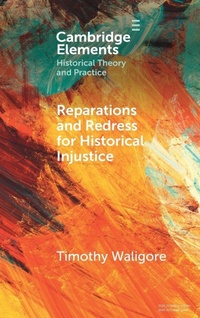
Reparations and Redress for Historical Injustice
Will be published approx. on 31. July 2026
Book
Hardback
75 pages
978-1-009-70924-8 (ISBN)
Description
This Element introduces various justifications for reparations and redress for historical injustice discussed in political theory and philosophy. It examines multiple real-world cases to illustrate and test theories. It is accessible to students and scholars unfamiliar with the field, while providing new arguments for experts in the field, and organizing the debate around reparations in new ways. The Element is divided into four main sections. The first three sections examine different temporal orientations of justice: backward-looking, forward-looking, and structural injustice over time. The fourth section examines Indigenous perspectives and settler colonial theory, which complicate and problematize the temporal orientations and arguments from the other sections. The discussion in this Element is organized around two recurring theses. First, approaches relying on primarily forward-looking justifications could be made more plausible and compelling by incorporating backward-looking elements (and vice versa). Second, past injustice can change what should (publicly) count as justice.
More details
Series
Language
English
Place of publication
Cambridge
United Kingdom
Target group
College/higher education
Illustrations
Worked examples or Exercises
ISBN-13
978-1-009-70924-8 (9781009709248)
Copyright in bibliographic data and cover images is held by Nielsen Book Services Limited or by the publishers or by their respective licensors: all rights reserved.
Schweitzer Classification
Other editions
Additional editions
Timothy Waligore
Reparations and Redress for Historical Injustice
Book
approx. 07/2026
Cambridge University Press
€22.50
Not yet published
Person
Content
Introduction; 1. Backward-looking approaches to reparations; 2. Forward-looking approaches to reparations; 3. Structural injustice and reparations; 4. Indigenous perspectives and settler colonialism; 5. Conclusion: moving forward to repair the past; References.