

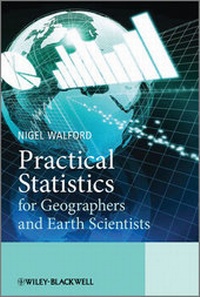
Practical Statistics for Geographers and Earth Scientists
Published on 7. January 2011
Book
Hardback
440 pages
978-0-470-84914-9 (ISBN)
Description
Practical Statistics for Geographers and Earth Scientists is a text that all students can work through, regardless of their geography or earth science stream degree pathway and their existing mathematical knowledge. The text demystifies the mathematical component of statistics and presents these techniques in an easy-to-understand fashion. Case studies that illustrate the workings of each technique through photographs and diagrams will help students visualize some of the processes involved. Also covered in the book is a clear explanation of how statistical software packages work.
Reviews / Votes
"Overall, this is potentially a very useful, reader-friendly book for its target audience." (Soil Use and Management, 1 December 2013)More details
Other editions
Additional editions
E-Book
07/2011
Wiley
€40.99
Available for download
Book
01/2011
Wiley
€50.00
Article exhausted; check for reprint
E-Book
10/2010
Wiley
€40.99
Available for download
Person
Nigel Walford has taught Geographical Information Systems courses at Kingston University for 12 years and previously worked in the Data Archive at Essex University. He graduated from the University of Sussex and did his postgraduate work at the University of London. His thematic research interests relate mainly to rural issues and include agriculture, land use planning and population. Recent book publications include Geographical Data Analysis and Reshaping the Countryside: Perceptions and Processes of Rural Change as well as several journal articles in Health and Place, Geography, Planning Practice and Research, Applied Geography and International Journal of Population Geography.
Content
Preface.
Acknowledgements.
Glossary.
Section 1 First principles.
1 What's in a number?
Learning outcomes.
1.1 Introduction to quantitative analysis.
1.2 Nature of numerical data.
1.3 Simplifying mathematical notation.
1.4 Introduction to case studies and structure of the book.
2 Geographical data: quantity and content.
Learning outcomes.
2.1 Geographical data.
2.2 Populations and samples.
2.3 Specifying attributes and variables.
3 Geographical data: collection and acquisition.
Learning outcomes.
3.1 Originating data.
3.2 Collection methods.
3.3 Locating phenomena in geographical space.
4 Statistical measures (or quantities).
Learning outcomes.
4.1 Descriptive statistics.
4.2 Spatial descriptive statistics.
4.3 Central tendency.
4.4 Dispersion.
4.5 Measures of skewness and kurtosis for nonspatial data.
4.6 Closing comments.
5 Frequency distributions, probability and hypotheses.
Learning outcomes.
5.1 Frequency distributions.
5.2 Bivariate and multivariate frequency distributions.
5.3 Estimation of statistics from frequency distributions.
5.4 Probability.
5.5 Inference and hypotheses.
5.6 Connecting summary measures, frequency distributions and probability.
Section 2 Testing times.
6 Parametric tests.
Learning outcomes.
6.1 Introduction to parametric tests.
6.2 One variable and one sample.
6.3 Two samples and one variable.
6.4 Three or more samples and one variable.
6.5 Con3 dence intervals.
6.6 Closing comments.
7 Nonparametric tests.
Learning outcomes.
7.1 Introduction to nonparametric tests.
7.2 One variable and one sample.
7.3 Two samples and one (or more) variable(s).
7.4 Multiple samples and/or multiple variables.
7.5 Closing comments.
Section 3 Forming relationships.
8 Correlation.
Learning outcomes.
8.1 Nature of relationships between variables.
8.2 Correlation techniques.
8.3 Concluding remarks.
9 Regression.
Learning outcomes.
9.1 Specifcation of linear relationships.
9.2 Bivariate regression.
9.3 Concluding remarks.
10 Correlation and regression of spatial data.
Learning outcomes.
10.1 Issues with correlation and regression of spatial data.
10.2 Spatial and temporal autocorrelation.
10.3 Trend surface analysis.
10.4 Concluding remarks.
References.
Further Reading.
Index.
Plate section: Statistical Analysis Planner and Checklist falls between pages 172 and 173.