

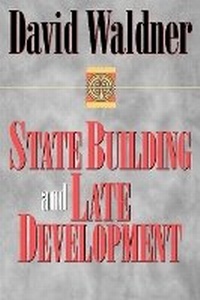
State Building and Late Development
Published on 19. January 1999
Book
Hardback
256 pages
978-0-8014-3554-6 (ISBN)
Description
Why does state building sometimes promote economic growth and in other cases impede it? Through an analysis of political and economic development in four countries-Turkey, Syria, Korea, and Taiwan-this book explores the origins of political-economic institutions and the mechanisms connecting them to economic outcomes.
David Waldner extends our understanding of the political underpinnings of economic development by examining the origins of political coalitions on which states and their institutions depend. He first provides a political model of institutional change to analyze how elites build either cross-class or narrow coalitions, and he examines how these arrangements shape specific institutions: state-society relations, the nature of bureaucracy, fiscal structures, and patterns of economic intervention. He then links these institutions to economic outcomes through a bargaining model to explain why countries such as Korea and Taiwan have more effectively overcome the collective dilemmas that plague economic development than have others such as Turkey and Syria. The latter countries, he shows, lack institutional solutions to the problems that surround productivity growth.
The first book to compare political and economic development in these two regions, State Building and Late Development draws on, and contributes to, arguments from political sociology and political economy. Based on a rigorous research design, the work offers both a finely drawn comparison of development and a compellingly argued analysis of the character and consequences of "precocious Keynesianism," the implementation of Keynesian demand-stimulus policies in largely pre-industrial economies.
David Waldner extends our understanding of the political underpinnings of economic development by examining the origins of political coalitions on which states and their institutions depend. He first provides a political model of institutional change to analyze how elites build either cross-class or narrow coalitions, and he examines how these arrangements shape specific institutions: state-society relations, the nature of bureaucracy, fiscal structures, and patterns of economic intervention. He then links these institutions to economic outcomes through a bargaining model to explain why countries such as Korea and Taiwan have more effectively overcome the collective dilemmas that plague economic development than have others such as Turkey and Syria. The latter countries, he shows, lack institutional solutions to the problems that surround productivity growth.
The first book to compare political and economic development in these two regions, State Building and Late Development draws on, and contributes to, arguments from political sociology and political economy. Based on a rigorous research design, the work offers both a finely drawn comparison of development and a compellingly argued analysis of the character and consequences of "precocious Keynesianism," the implementation of Keynesian demand-stimulus policies in largely pre-industrial economies.
Reviews / Votes
David Waldner's book is an impressive contribution to the debate over economic growth and development in late-developing countries.- Derek Hall (Millennium: Journal of International Studies) Waldner demonstrates in a masterly way the benefits of genuine comparative inquiry; contributes to our understanding of the painful results of economic development in the Middle East; and uses Middle Eastern cases to advance our understanding of the complicated and mediated linkage between state formation and economic development. This ambitious book deserves a wide audience.
- Michael Barnett, University of Wisconsin, Madison (International Journal of Middle East Studies) Waldner's book makes an important contribution to Middle East area studies and the literature on development in general, thanks to its elegant rebuttal of monocausal arguments.... This book provides an important step forward in the study of comparative politics. It is a rare attempt to combine multiple variables into a sophisticated yet eloquent model that addresses important issues in the Middle East and developing world.
- Saime Ozcurumez, McGill University (Canadian Journal of Political Science) A compelling argument... Clearly written and carefully argued.
(Choice) This is an ambitious project; it tells of the origins of institutions and success of strategies for economic development.... The argument is provocative, erudite, and wide-ranging; it will appeal to social scientists interested in learning more about how Middle East countries look in comparison to those of East Asia.
- Ellis Goldberg, Princeton University (Political Science Quarterly)
More details
Language
English
Place of publication
Ithaca
United States
Target group
College/higher education
Professional and scholarly
Product notice
Paper over boards
Dimensions
Height: 235 mm
Width: 155 mm
Thickness: 25 mm
Weight
907 gr
ISBN-13
978-0-8014-3554-6 (9780801435546)
Copyright in bibliographic data and cover images is held by Nielsen Book Services Limited or by the publishers or by their respective licensors: all rights reserved.
Schweitzer Classification
Other editions
Additional editions
David Waldner
State Building and Late Development
E-Book
05/2018
1st Edition
Cornell University Press
€162.99
Available for download
Person
David Waldner is Assistant Professor in the Department of Government and Foreign Affairs at the University of Virginia.