

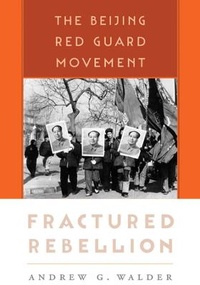
Fractured Rebellion
The Beijing Red Guard Movement
Published on 5. March 2012
Book
Paperback/Softback
416 pages
978-0-674-06413-3 (ISBN)
Description
Fractured Rebellion is the first full-length account of the evolution of China's Red Guard Movement in Beijing, the nation's capital, from its beginnings in 1966 to its forcible suppression in 1968. Andrew Walder combines historical narrative with sociological analysis as he explores the radical student movement's crippling factionalism, devastating social impact, and ultimate failure.
Most accounts of the movement have portrayed a struggle among Red Guards as a social conflict that pitted privileged "conservative" students against socially marginalized "radicals" who sought to change an oppressive social and political system. Walder employs newly available documentary evidence and the recent memoirs of former Red Guard leaders and members to demonstrate that on both sides of the bitter conflict were students from comparable socioeconomic backgrounds, who shared similar-largely defensive-motivations. The intensity of the conflict and the depth of the divisions were an expression of authoritarian political structures that continued to exert an irresistible pull on student motives and actions, even in the midst of their rebellion.
Walder's nuanced account challenges the main themes of an entire generation of scholarship about the social conflicts of China's Cultural Revolution, shedding light on the most tragic and poorly understood period of recent Chinese history.
Most accounts of the movement have portrayed a struggle among Red Guards as a social conflict that pitted privileged "conservative" students against socially marginalized "radicals" who sought to change an oppressive social and political system. Walder employs newly available documentary evidence and the recent memoirs of former Red Guard leaders and members to demonstrate that on both sides of the bitter conflict were students from comparable socioeconomic backgrounds, who shared similar-largely defensive-motivations. The intensity of the conflict and the depth of the divisions were an expression of authoritarian political structures that continued to exert an irresistible pull on student motives and actions, even in the midst of their rebellion.
Walder's nuanced account challenges the main themes of an entire generation of scholarship about the social conflicts of China's Cultural Revolution, shedding light on the most tragic and poorly understood period of recent Chinese history.
Reviews / Votes
An impressive and important work of scholarship which will join a small set of major books on the Cultural Revolution. -- Jeffrey N. Wasserstrom, University of California, Irvine An analysis that will alter the view of one of the seminal events in the history of the People's Republic of China. -- Frederick C. Teiwes, the University of Sydney A truly extraordinary scholarly achievement. Never has the immensely important puzzle of the Red Guard Movement ever been rendered in such rich, clarifying empirical detail as Walder gives us here. -- Doug McAdam, Stanford University Better than anything else I have read, Andrew Walder's Fractured Rebellion explains how and why the Beijing students in the first two years of the Cultural Revolution became so sharply, bitterly, and fatally divided. An absorbing work of research and synthesis. -- Jonathan Spence, author of <i>The Search for a Modern China</i> The book masterfully combines historical case studies with sociological methodology and fundamentally changes our understanding of Red Guard factionalism...The book is without doubt one of the greatest breakthroughs in research on the Cultural Revolution published during the past three decades and should be read by anyone interested in the history of mass movements and modern Chinese history in general. -- Daniel Leese * China Quarterly * Too little research has been conducted about the fascinating, confusing upheavals that shook China during the Great Proletarian Cultural Revolution of 1966-68. Now, four decades after the mass fighting was suppressed, Andrew Walder helps to fill important gaps in our knowledge...Fractured Rebellion: The Beijing Red Guard Movement makes an important contribution to our knowledge of an extraordinary, tumultuous period in recent Chinese history. -- Jonathan Unger * China Journal * While not minimizing either the violence or Mao's responsibility, Walder presents a less stereotyped and more diverse picture of Red Guard attitudes to violence--as far as I know for the first time at this length in Western scholarship. -- John Gittings * The China Beat * Revealing...Walder's book, the first on the Beijing Red Guards, concentrates entirely on the movement in the capital's universities and schools and the conflicts among them, mighty subjects in themselves. -- Jonathan Mirsky * New York Review of Books * Walder's volume is a remarkable piece of scholarship of intellectual honesty and rigor...It is precisely because Walder consistently refuses to simplify that his powerful account of Beijing's Red Guard movement captures its unpredictability, its volatility, and, above all, its internal complexity...Walder's fine contribution pushes us to reevaluate what we thought we knew about this pivotal period in modern Chinese history and, perhaps, to reflect again on the scope and breadth of its lingering irresolution. -- Patricia Thornton * Journal of Asian Studies *More details
Language
English
Place of publication
Cambridge, Mass
United States
Target group
Professional and scholarly
US School Grade: College Graduate Student
Illustrations
12 tables
Dimensions
Height: 235 mm
Width: 156 mm
ISBN-13
978-0-674-06413-3 (9780674064133)
Copyright in bibliographic data and cover images is held by Nielsen Book Services Limited or by the publishers or by their respective licensors: all rights reserved.
Schweitzer Classification
Person
Andrew G. Walder is Denise O'Leary and Kent Thiry Professor of Sociology at Stanford University. His previous books include Fractured Rebellion, which won the Barrington Moore Book Award, and China Under Mao (both from Harvard). A member of the American Academy of Arts and Sciences and a Guggenheim fellow, Walder has received grants from the National Science Foundation, the National Academy of Science, and the Ford Foundation.