

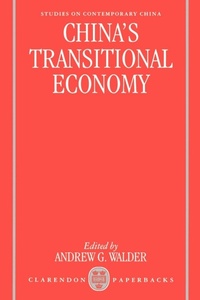
China's Transitional Economy
Published on 17. October 1996
Book
Paperback/Softback
234 pages
978-0-19-829097-1 (ISBN)
Description
China's post-Mao economic reforms have generated and sustained economic growth, unprecedented rises in real income and living standards, and have transformed a long-time insular economy into a major trading nation. China now figures prominently in international policy debates about what is to be done to transform the stagnating economies of Eastern Europe. As a gradual rather than an abrupt transition to the market, with public industry protected rather than subject to privatization, China's reform path has confounded the widespread and deeply held belief that gradual reform and public ownership simply cannot work.
The contributions to this volume draw out the policy and theoretical implications of China's transitional economy. They lay out the notable features of China's reform path, analyse the successes and failures of the reform, and discuss whether they can be sustained, or whether the uncertain leadership transition, growing potential for social instability, and continuing problems of unemployment, uprooted rural populations, deepening political corruption, and declining central power point to a future fraught with risk and instability.
After an introduction and overview by the editor, the first two chapters ask whether China enjoyed advantages that may have made its reform path easier than those of Eastern European countries. The next four chapters examine various dimensions of China's economy: agricultural commerce, property rights, foreign trade, and macroeconomic stability. Two subsequent chapters examine the role of political institutions, and the final chapter, synthesising the lessons of China's reforms, critiques the dogmatism of some economic analysis and calls for greater institutional and historical realism.
The contributions to this volume draw out the policy and theoretical implications of China's transitional economy. They lay out the notable features of China's reform path, analyse the successes and failures of the reform, and discuss whether they can be sustained, or whether the uncertain leadership transition, growing potential for social instability, and continuing problems of unemployment, uprooted rural populations, deepening political corruption, and declining central power point to a future fraught with risk and instability.
After an introduction and overview by the editor, the first two chapters ask whether China enjoyed advantages that may have made its reform path easier than those of Eastern European countries. The next four chapters examine various dimensions of China's economy: agricultural commerce, property rights, foreign trade, and macroeconomic stability. Two subsequent chapters examine the role of political institutions, and the final chapter, synthesising the lessons of China's reforms, critiques the dogmatism of some economic analysis and calls for greater institutional and historical realism.
Reviews / Votes
The book is essentially a discussion of China by China specialists ... it will be an exceptionally useful work for readers wanting a detailed overview of the most recent events in China, and who are willing to make their own comparisons. A particular strength of the contributions is their drawing together of the extensive literature on the Chinese economy. * Journal of Development Studies *More details
Series
Language
English
Place of publication
Oxford
United Kingdom
Target group
Professional and scholarly
Illustrations
line figures, tables
Dimensions
Height: 229 mm
Width: 152 mm
Thickness: 14 mm
Weight
390 gr
ISBN-13
978-0-19-829097-1 (9780198290971)
Copyright in bibliographic data and cover images is held by Nielsen Book Services Limited or by the publishers or by their respective licensors: all rights reserved.
Schweitzer Classification