

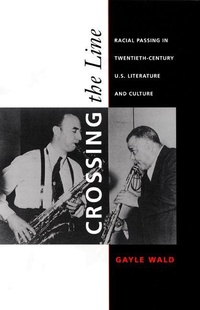
Crossing the Line
Racial Passing in Twentieth-Century U.S. Literature and Culture
Published on 24. July 2000
Book
Paperback/Softback
272 pages
978-0-8223-2515-4 (ISBN)
Description
As W. E. B. DuBois famously prophesied in The Souls of Black Folk, the fiction of the color line has been of urgent concern in defining a certain twentieth-century U.S. racial "order." Yet the very arbitrariness of this line also gives rise to opportunities for racial "passing," a practice through which subjects appropriate the terms of racial discourse. To erode race's authority, Gayle Wald argues, we must understand how race defines and yet fails to represent identity. She thus uses cultural narratives of passing to illuminate both the contradictions of race and the deployment of such contradictions for a variety of needs, interests, and desires.
Wald begins her reading of twentieth-century passing narratives by analyzing works by African American writers James Weldon Johnson, Jessie Fauset, and Nella Larsen, showing how they use the "passing plot" to explore the negotiation of identity, agency, and freedom within the context of their protagonists' restricted choices. She then examines the 1946 autobiography Really the Blues, which details the transformation of Milton Mesirow, middle-class son of Russian-Jewish immigrants, into Mezz Mezzrow, jazz musician and self-described "voluntary Negro." Turning to the 1949 films Pinky and
Lost Boundaries, which imagine African American citizenship within class-specific protocols of race and gender, she interrogates the complicated representation of racial passing in a visual medium. Her investigation of "post-passing" testimonials in postwar African American magazines, which strove to foster black consumerism while constructing "positive" images of black achievement and affluence in the postwar years, focuses on neglected texts within the archives of black popular culture. Finally, after a look at liberal contradictions of John Howard Griffin's 1961 auto-ethnography Black Like Me, Wald concludes with an epilogue that considers the idea of passing in the context of the recent discourse of "color blindness."
Wald's analysis of the moral, political, and theoretical dimensions of racial passing makes Crossing the Line important reading as we approach the twenty-first century. Her engaging and dynamic book will be of particular interest to scholars of American studies, African American studies, cultural studies, and literary criticism.
Wald begins her reading of twentieth-century passing narratives by analyzing works by African American writers James Weldon Johnson, Jessie Fauset, and Nella Larsen, showing how they use the "passing plot" to explore the negotiation of identity, agency, and freedom within the context of their protagonists' restricted choices. She then examines the 1946 autobiography Really the Blues, which details the transformation of Milton Mesirow, middle-class son of Russian-Jewish immigrants, into Mezz Mezzrow, jazz musician and self-described "voluntary Negro." Turning to the 1949 films Pinky and
Lost Boundaries, which imagine African American citizenship within class-specific protocols of race and gender, she interrogates the complicated representation of racial passing in a visual medium. Her investigation of "post-passing" testimonials in postwar African American magazines, which strove to foster black consumerism while constructing "positive" images of black achievement and affluence in the postwar years, focuses on neglected texts within the archives of black popular culture. Finally, after a look at liberal contradictions of John Howard Griffin's 1961 auto-ethnography Black Like Me, Wald concludes with an epilogue that considers the idea of passing in the context of the recent discourse of "color blindness."
Wald's analysis of the moral, political, and theoretical dimensions of racial passing makes Crossing the Line important reading as we approach the twenty-first century. Her engaging and dynamic book will be of particular interest to scholars of American studies, African American studies, cultural studies, and literary criticism.
Reviews / Votes
"Crossing the Line offers a superbly well-developed analysis of narratives of racial passing and a strategy for engaging such narratives. It will set the standard for subsequent treatments of racial passing."-Dana Nelson, author of National Manhood: Capitalist Citizenship and the Imagined Fraternity of White Men "Deeply engaging, well-researched, and effective, Crossing the Line is a fine multidisciplinary study not only of passing narratives but of the social, political, and economic struggles that they negotiate in racial terms."- Priscilla Wald, author of Constituting Americans: Cultural Anxiety and Narrative FormMore details
Series
Language
English
Place of publication
North Carolina
United States
Target group
Professional and scholarly
Product notice
Paperback (trade)
Illustrations
12 b&w photographs
Dimensions
Height: 233 mm
Width: 152 mm
Thickness: 20 mm
Weight
449 gr
ISBN-13
978-0-8223-2515-4 (9780822325154)
Copyright in bibliographic data and cover images is held by Nielsen Book Services Limited or by the publishers or by their respective licensors: all rights reserved.
Schweitzer Classification
Other editions
Additional editions
Gayle Wald | Donald E. Pease
Crossing the Line
Racial Passing in Twentieth-Century U.S. Literature and Culture
E-Book
07/2000
1st Edition
De Gruyter
€198.99
Available for download
Person
Gayle Wald is Assistant Professor of English at George Washington University.
Content
Preface
Acknowledgments
Introduction: Race, Passing, and Cultural Representation
1. Home Again: Racial Negotiations in Modernist African American Passing Narratives
2. Mezz Mezzrow and the Voluntary Negro Blues
3. Boundaries Lost and Found: Racial Passing and Cinematic Representation, circa 1949
4. "I'm Through with Passing": Postpassing Narratives in Black Popular Literary Culture
5. "A Most Disagreeable Mirror": Reflections on White Identity in Black Like Me
Epilogue: Passing, "Color Blindness," and Contemporary Discourses of Race and Identity
Notes
Bibliography
Index
Acknowledgments
Introduction: Race, Passing, and Cultural Representation
1. Home Again: Racial Negotiations in Modernist African American Passing Narratives
2. Mezz Mezzrow and the Voluntary Negro Blues
3. Boundaries Lost and Found: Racial Passing and Cinematic Representation, circa 1949
4. "I'm Through with Passing": Postpassing Narratives in Black Popular Literary Culture
5. "A Most Disagreeable Mirror": Reflections on White Identity in Black Like Me
Epilogue: Passing, "Color Blindness," and Contemporary Discourses of Race and Identity
Notes
Bibliography
Index