

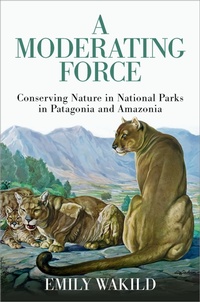
A Moderating Force
Conserving Nature in National Parks in Patagonia and Amazonia
Published on 20. April 2026
Book
Paperback/Softback
256 pages
978-0-19-765402-6 (ISBN)
Description
Over the past century, landscapes across South American fundamentally changed. As forests were felled, cities and highways built, and agricultural land was managed, national governments set aside protected landscapes in certain charismatic places. These areas- which include some of the most iconic nature reserves on the planet, from Amazonian forests to Patagonian ice fields. -have direct bearing on the world's climate system, the regulation of carbon in the atmosphere, and the protection of species. They are home to hundreds of thousands of Native peoples and millions of mixed-race and European settlers. Today, more than a quarter of South America lies within conservation areas.
In A Moderating Force, award-winning Latin American environmental historian Emily Wakild relates a transnational comparative history of two paradigmatic regions-the temperate southern third of South America known as Patagonia and the tropical expanse known as Amazonia. Wakild traces the development of national parks in Argentina, Chile, Peru, and Brazil from the nineteenth to the twenty-first century, explaining the historical processes that led to nature conservation at the national level. She explores the many different perspectives and priorities that contribute to deciding what makes the "best" park and for whom- wild animals, Indigenous residents, national heritage, tourism, or climate resiliency. As the parks were built, they served as a moderating force softening national power by imposing compromises on diverse landscapes. From these sites, politically powerful, scientifically trained, and dedicated resident conservationists navigated new professional platforms and launched studies of flora and fauna that prioritized expertise to be gained in the field. This wide-ranging study sheds new light on exploration, state-making, scientific practice, economic development, and nature conservation in the past to inform what this history means for our future.
In A Moderating Force, award-winning Latin American environmental historian Emily Wakild relates a transnational comparative history of two paradigmatic regions-the temperate southern third of South America known as Patagonia and the tropical expanse known as Amazonia. Wakild traces the development of national parks in Argentina, Chile, Peru, and Brazil from the nineteenth to the twenty-first century, explaining the historical processes that led to nature conservation at the national level. She explores the many different perspectives and priorities that contribute to deciding what makes the "best" park and for whom- wild animals, Indigenous residents, national heritage, tourism, or climate resiliency. As the parks were built, they served as a moderating force softening national power by imposing compromises on diverse landscapes. From these sites, politically powerful, scientifically trained, and dedicated resident conservationists navigated new professional platforms and launched studies of flora and fauna that prioritized expertise to be gained in the field. This wide-ranging study sheds new light on exploration, state-making, scientific practice, economic development, and nature conservation in the past to inform what this history means for our future.
More details
Language
English
Place of publication
New York
United States
Product notice
Paperback (trade)
Unsewn / adhesive bound
Illustrations
34 b/w illustrations
Dimensions
Height: 231 mm
Width: 155 mm
Thickness: 15 mm
Weight
360 gr
ISBN-13
978-0-19-765402-6 (9780197654026)
Copyright in bibliographic data and cover images is held by Nielsen Book Services Limited or by the publishers or by their respective licensors: all rights reserved.
Schweitzer Classification
Other editions
Additional editions

Book
01/2026
Oxford University Press Inc
€151.50
Shipment within 15-20 days
Person
Emily Wakild is the Cecil D. Andrus Endowed Chair for the Environment and Public Lands and Professor of History and Environmental Studies at Boise State University. She is the author of the award-winning Revolutionary Parks: Conservation, Social Justice, and Mexico's National Parks, the co-author of A Primer for Teaching Environmental History, and the co-editor of The Nature State: Rethinking the History of Conservation.
Author
Cecil D. Andrus Endowed Chair for the Environment and Public Lands, Professor of History and Environmental Studies, School of the EnvironmentCecil D. Andrus Endowed Chair for the Environment and Public Lands, Professor of History and Environmental Studies, School of the Environment, Boise State University
Content
Acknowledgments Introduction: A Moderating Force 1. Nahuel Huapi (1934): Geographic Storytelling and Nationalizing Argentine Nature 2. Torres del Paine (1959): Extinction and Invasion in Chilean Landscapes 3. Manu (1973): Doing Tropical Field Biology in a Peruvian Rain Forest
4. Jau (1980): Refuges by Design in Brazilian Scientific Communities 5. The Processes of Conserving Nature in Patagonia and Amazonia Epilogue: Towards a Future of National Parks Appendix A: Animal Names from Torrealba Map, 1904 Notes Bibliography Index
4. Jau (1980): Refuges by Design in Brazilian Scientific Communities 5. The Processes of Conserving Nature in Patagonia and Amazonia Epilogue: Towards a Future of National Parks Appendix A: Animal Names from Torrealba Map, 1904 Notes Bibliography Index