

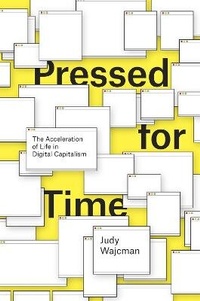
Pressed for Time
The Acceleration of Life in Digital Capitalism
Published on 1. December 2014
Book
Hardback
224 pages
978-0-226-19647-3 (ISBN)
Description
The technologically tethered, iPhone-addicted figure is an image we can easily conjure. Most of us complain that there aren't enough hours in the day and too many e-mails in our thumb-accessible inboxes. This widespread perception that life is faster than it used to be is now ingrained in our culture, and smartphones and the Internet are continually being blamed. But isn't the sole purpose of the smartphone to give us such quick access to people and information that we'll be free to do other things? Isn't technology supposed to make our lives easier? In Pressed for Time, Judy Wajcman lets technology off the hook, arguing that it does not simply cause time pressure or the inexorable acceleration of everyday life. She argues that the very same devices that make us feel harried also enable us to take more control of our time and can enrich our relationships. We are not mere hostages to communications technologies, and the experience of always being rushed is the result of the priorities and parameters we ourselves set rather than the machines that help us set them. Indeed, being busy and having action-packed lives has become valorized by our culture.
Wajcman offers a bracing historical perspective, exploring the commodification of clock time, and how the speed of the industrial age became identified with progress. She also delves into the ways time-use differs for diverse groups in modern societies, showing how changes in work patterns, family arrangements, and parenting all affect time stress. Bringing together empirical research on time use and theoretical debates about dramatic digital developments, this accessible and engaging book will leave readers better versed in how to use technology to navigate life's fast lane.
Wajcman offers a bracing historical perspective, exploring the commodification of clock time, and how the speed of the industrial age became identified with progress. She also delves into the ways time-use differs for diverse groups in modern societies, showing how changes in work patterns, family arrangements, and parenting all affect time stress. Bringing together empirical research on time use and theoretical debates about dramatic digital developments, this accessible and engaging book will leave readers better versed in how to use technology to navigate life's fast lane.
Reviews / Votes
"Across her books, Wajcman has chosen issues and problematics that needed to be addressed, examined, and re-interpreted. All her books share an intense engagement with major conditions that affect many of us. In this book she gives us her kind of analysis of time - its presences and absences, its visible and invisible vectors." -Saskia Sassen, author of Expulsions: Brutality and Complexity in the Global EconomyMore details
Language
English
Place of publication
Chicago
United States
Publishing group
The University of Chicago Press
Target group
College/higher education
Professional and scholarly
Dimensions
Height: 24 mm
Width: 16 mm
Thickness: 2 mm
Weight
482 gr
ISBN-13
978-0-226-19647-3 (9780226196473)
Copyright in bibliographic data and cover images is held by Nielsen Book Services Limited or by the publishers or by their respective licensors: all rights reserved.
Schweitzer Classification
Other editions
Additional editions
E-Book
12/2022
University of Chicago Press
€18.18
Available for download
Person
Judy Wajcman is the Anthony Giddens Professor of Sociology at the London School of Economics and the author of The Social Shaping of Technology, TechnoFeminism, and The Politics of Working Life.
Content
Preface Acknowledgments Introduction. Tools for Time Chapter 1. High-Speed Society: Is the Pace of Life Accelerating? Chapter 2. Time and Motion: Machines and the Making of Modernity Chapter 3. The Time-Pressure Paradox Chapter 4. Working with Constant Connectivity Chapter 5. Doing Domestic Time Chapter 6. Time to Talk: Intimacy through Technology Chapter 7. Finding Time in a Digital Age Notes Index