

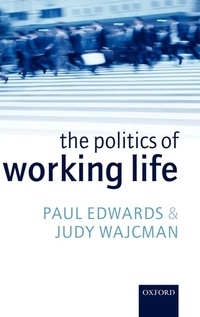
The Politics of Working Life
Published on 15. September 2005
Book
Hardback
336 pages
978-0-19-927190-0 (ISBN)
Description
How does the politics of working life shape modern organizations? Is our desire for meaningful, secure work increasingly at odds with corporate behaviour in a globalized economy? Does the rise of performance management culture represent an intensification of work, or create opportunities for the freewheeling individual career?
This timely and engaging book, by leading authorities in the field, adopts the standpoint of the 'questioning observer'. It is for those who need an informed account of work that is accessible without being superficial. The book is unique in its multi-dimensional approach, weaving together analysis of individual work experience, political processes in organizations, and the wider context of the social structuring of markets.
The book identifies central questions about working experience and answers them in a direct and lively manner. It has a strong analytical foundation based on a political economy framework, giving particular weight to the contradictory character of organizations. These contradictions turn on the competing demands placed on organizations and the different political projects of groups within them. This perspective integrates the chapters, and permits numerous scholarly debates to be addressed - including those on identity projects, gender and work, power and participation, escalation in decision-making, and the meaning of corporate social responsibility.
This book is suitable for undergraduate and graduate classes in Organizational Behaviour, Business Strategy and the Sociology of Work and Employment. It will also appeal to the general reader interested in grappling with the complexity of the changing environment of work.
This timely and engaging book, by leading authorities in the field, adopts the standpoint of the 'questioning observer'. It is for those who need an informed account of work that is accessible without being superficial. The book is unique in its multi-dimensional approach, weaving together analysis of individual work experience, political processes in organizations, and the wider context of the social structuring of markets.
The book identifies central questions about working experience and answers them in a direct and lively manner. It has a strong analytical foundation based on a political economy framework, giving particular weight to the contradictory character of organizations. These contradictions turn on the competing demands placed on organizations and the different political projects of groups within them. This perspective integrates the chapters, and permits numerous scholarly debates to be addressed - including those on identity projects, gender and work, power and participation, escalation in decision-making, and the meaning of corporate social responsibility.
This book is suitable for undergraduate and graduate classes in Organizational Behaviour, Business Strategy and the Sociology of Work and Employment. It will also appeal to the general reader interested in grappling with the complexity of the changing environment of work.
Reviews / Votes
This well-written book highlights some of the more interesting developments in the changing nature of work and provides good case studies and other illustrative material to aid the reader. As a sociological account of the politics and culture of working life, it is a good addition to any organisational behaviour bookshelf. * Times Higher Education Supplement *More details
Language
English
Place of publication
Oxford
United Kingdom
Target group
Professional and scholarly
Illustrations
Numerous boxes
Dimensions
Height: 240 mm
Width: 161 mm
Thickness: 23 mm
Weight
669 gr
ISBN-13
978-0-19-927190-0 (9780199271900)
Copyright in bibliographic data and cover images is held by Nielsen Book Services Limited or by the publishers or by their respective licensors: all rights reserved.
Schweitzer Classification
Other editions
Additional editions
Paul Edwards And Judy Wajcman
Politics of Working Life
E-Book
09/2005
1st Edition
Oxford University Press
€324.37
Available for download
Judy Wajcman | Paul Edwards
The Politics of Working Life
Book
09/2005
Oxford University Press
€63.50
Shipment within 15-20 days
Persons
Paul Edwards is Professor of Industrial Relations, Warwick Business School, University of Warwick. Elected a Fellow of the British Academy in 1998, he has conducted research for bodies including the Department of Trade and Industry and the Chartered Institute of Personnel and Development, and his publications include Industrial Relations (Blackwell, 2003) and Managers in the Making (with John Storey and Keith Sisson, Sage, 1997). He is a Fellow of the Advanced Institute of Management.
Judy Wajcman is Professor of Sociology in the Demography and Sociology Program, Australian National University. She is also a Centennial Professor in the Gender Institute and Sociology at the London School of Economics, and an Associate Fellow of the Industrial Relations Research Unit, University of Warwick Business School. She has previously held posts in Cambridge, Edinburgh, Manchester, Sydney, Vienna, Warwick and Zurich. Her publications include Managing Like a Man: Women and Men in Corporate Management (Policy, 1998) and TechnoFeminism (Polity, 2004).
Judy Wajcman is Professor of Sociology in the Demography and Sociology Program, Australian National University. She is also a Centennial Professor in the Gender Institute and Sociology at the London School of Economics, and an Associate Fellow of the Industrial Relations Research Unit, University of Warwick Business School. She has previously held posts in Cambridge, Edinburgh, Manchester, Sydney, Vienna, Warwick and Zurich. Her publications include Managing Like a Man: Women and Men in Corporate Management (Policy, 1998) and TechnoFeminism (Polity, 2004).
Content
Preface ; 1. Introduction: Why and How Should We Think About Work? ; 2. What is Happening to Jobs? ; 3. Has it Become Harder to Balance Work and Family Life? ; 4. Is the Organizational Career and Out-dated Concept? ; 5. How is Performance Defined, Measured, and Rewarded? ; 6. Why is Empowerment Hard to Achieve? ; 7. Why do Disasters Happen? ; 8. Is Decision-making a Rational Process? ; 9. How are Markets Constructed? ; 10. How is Globalization Affecting Work? ; 11. What are the Opportunities and Responsibilities of Organizational Life?