

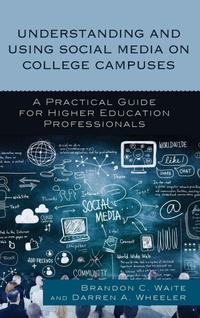
Understanding and Using Social Media on College Campuses
A Practical Guide for Higher Education Professionals
Published on 12. August 2016
Book
Hardback
124 pages
978-1-4758-2693-7 (ISBN)
Description
The purpose of this book is to help higher education professionals approach social media initiatives strategically. It presents a framework for systematically thinking about the Internet Technology Environments (ITE) in which faculty, staff, and administrators operate. By foregoing a one-size-fits-all approach to social media use on campuses for one that is based upon structured inquiry, individuals can discern their unique campus environment and prepare for the challenges and opportunities they are likely to encounter. In addition to explaining why social media use on college campuses is glaringly inconsistent, the book highlights the approaches faculty and staff might take when designing and implementing social media initiatives, given the type of environment in which they work. It also introduces strategies these actors and administrators can utilize to strengthen their ITEs, ultimately facilitating the successful incorporation of social media technology into campus communications.
Reviews / Votes
Every academic department and university now needs strategies and policies for the use of social media. This book provides a clear guide to the issues as well as practical guidelines for determining appropriate actions and policies, based on the authors' own experience and their deep understanding of university culture. This is a 'must read' for every academic. -- Tony Bates, Distinguished Visiting Professor, Ryerson University, Toronto ON "Social media has become part of the fabric of most people's lives in the United States. It's as ubiquitous and common as is television, music, and use of the telephone. In Understanding and Using Social Media on College Campuses, Dr. Waite and Dr. Wheeler discuss the need for including social media as a major component of institutional and departmental communication and for instructional practices in higher education learning environments. They then describe a framework and model for examining and improving on social media use as a means for communication and as an educational tool that has value for policy makers, administrators, and faculty in higher education institutions. Especially impressive is their discussion of developing a Social Media Ethos, where social media initiatives are encouraged, supported, and rewarded. For any higher education personnel who has an interest in social media use within their institutions, this practical guide is a must read." -- Jackie Gerstein, Online Faculty for Boise State, American InterContinental, and Western Governors' UniversitiesMore details
Language
English
Place of publication
United States
Publishing group
Bloomsbury Publishing Plc
Target group
Professional and scholarly
Dimensions
Height: 235 mm
Width: 157 mm
Thickness: 12 mm
Weight
345 gr
ISBN-13
978-1-4758-2693-7 (9781475826937)
Copyright in bibliographic data and cover images is held by Nielsen Book Services Limited or by the publishers or by their respective licensors: all rights reserved.
Schweitzer Classification
Other editions
Additional editions
Brandon C. Waite | Darren A. Wheeler
Understanding and Using Social Media on College Campuses
A Practical Guide for Higher Education Professionals
E-Book
08/2016
1st Edition
Rowman & Littlefield Publishers
€26.99
Available for download
Brandon C. Waite | Darren A. Wheeler
Understanding and Using Social Media on College Campuses
A Practical Guide for Higher Education Professionals
E-Book
08/2016
1st Edition
Rowman & Littlefield Publishers
€26.99
Available for download
Persons
Brandon Waite is an Associate Professor of Political Science at Ball State University where his teaching, research, and service activities focus the use of online technologies for campaigning and organizational communication. He regularly gives presentations about social media to nonprofit organizations and candidates for office on behalf of the Bowen Center for Public Affairs.
Darren Wheeler is an Associate Professor of Political Science at Ball State University where his teaching and research interests include judicial politics, terrorism and homeland security, and social media. He has been teaching online classes at colleges and universities for over ten years.
Darren Wheeler is an Associate Professor of Political Science at Ball State University where his teaching and research interests include judicial politics, terrorism and homeland security, and social media. He has been teaching online classes at colleges and universities for over ten years.
Content
Dedication
Preface
Chapter 1: Introduction: Web 2.0 and Higher Education
History of Web 1.0
Web 2.0 Characteristics
Key Players in the Social Media Landscape
Social Media On College Campuses
Organizational Culture and Higher Education
The Internet Technology Environment
Chapter Outlines
Chapter 2: Social Media Initiatives: Institutional-Level Issues
Character and Identity
Resources
Compensation and Recognition
Policies
Conclusion
Chapter 3: Social Media Initiatives: Department-Level Issues
Academic Departments
Character and Identity
Resources
Compensation and Recognition
Policies
Conclusion
Chapter 4: Case Study: The Ball State University Political Science Facebook Page
Institutional-Level ITE
Departmental-Level ITE
Social Media and the Political Science at BSU
The Ball State University Political Science Department Facebook Page
Conclusion
Chapter 5: Putting It All Together
Behavior Strategies for Faculty and Staff: Social Media Ethos
Strategies for Administrators
Keys to Web 2.0 Success
Conclusion
Bibliography
Index
About the Authors
Preface
Chapter 1: Introduction: Web 2.0 and Higher Education
History of Web 1.0
Web 2.0 Characteristics
Key Players in the Social Media Landscape
Social Media On College Campuses
Organizational Culture and Higher Education
The Internet Technology Environment
Chapter Outlines
Chapter 2: Social Media Initiatives: Institutional-Level Issues
Character and Identity
Resources
Compensation and Recognition
Policies
Conclusion
Chapter 3: Social Media Initiatives: Department-Level Issues
Academic Departments
Character and Identity
Resources
Compensation and Recognition
Policies
Conclusion
Chapter 4: Case Study: The Ball State University Political Science Facebook Page
Institutional-Level ITE
Departmental-Level ITE
Social Media and the Political Science at BSU
The Ball State University Political Science Department Facebook Page
Conclusion
Chapter 5: Putting It All Together
Behavior Strategies for Faculty and Staff: Social Media Ethos
Strategies for Administrators
Keys to Web 2.0 Success
Conclusion
Bibliography
Index
About the Authors