

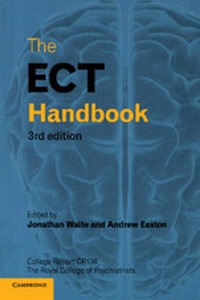
The ECT Handbook
3rd Edition
Published on 1. May 2013
Book
Paperback/Softback
288 pages
978-1-908020-58-1 (ISBN)
Description
This book presents the latest clinical guidelines on the prescription and practical administration of electroconvulsive therapy (ECT). It clarifies the place of ECT in contemporary practice and reviews the evidence for its efficacy. The ECT Handbook is an essential reference manual for all psychiatrists, for anaesthetists and nurses who work in ECT clinics, for everyone professionally involved in caring for patients for whom ECT may be recommended, and for second-opinion appointed doctors working for the Care Quality Commission. The book has been ubstantially revised to take account of new research, and covers issues of capacity and consent. The third edition has new chapters on the mode of action of ECT, cognitive adverse effects, dental effects, other brain stimulation techniques and patient and carer perspectives, and new evidence is presented of the benefits and risks of unilateral versus bilateral electrode placement.
More details
Edition
3rd Revised edition
Language
English
Place of publication
London
United Kingdom
Target group
Professional and scholarly
Edition type
Revised edition
Product notice
Paperback (trade)
Illustrations
Worked examples or Exercises
Dimensions
Height: 235 mm
Width: 155 mm
Thickness: 15 mm
Weight
500 gr
ISBN-13
978-1-908020-58-1 (9781908020581)
Copyright in bibliographic data and cover images is held by Nielsen Book Services Limited or by the publishers or by their respective licensors: all rights reserved.
Schweitzer Classification
Other editions
New editions
I. Nicol Ferrier | Jonathan Waite
The ECT Handbook
Book
07/2019
4th Edition
Cambridge University Press
€78.30
Shipment within 3-4 weeks
Persons
About the editors:
Dr Jonathan Waite - Consultant Psychiatrist, Queens Medical Centre, Nottingham.
Dr Andrew Easton - Consultant Forensic Psychiatrist, Newsam Centre, Seacroft Hospital, Leeds.
Dr Jonathan Waite - Consultant Psychiatrist, Queens Medical Centre, Nottingham.
Dr Andrew Easton - Consultant Forensic Psychiatrist, Newsam Centre, Seacroft Hospital, Leeds.
Content
Abbreviations; List of figures, tables and boxes; List of contributors; Preface Jonathan Waite and Andrew Easton; Introduction: the role of ECT in contemporary psychiatry Royal College of Psychiatrists' Special Committee on ECT and Related Therapies; 1. Mechanism of action of ECT Ian M. Anderson and Grace M. Fergusson; 2. The ECT suite Chris P. Freeman and Grace M. Fergusson; 3. Anaesthesia for ECT Simon C. Walker, C. John Bowley and Heather A. C. Walker; 4. ECT prescribing and practice Ross A. Dunne and Declan M. McLoughlin; 5. Psychotropic drug treatment during and after ECT Michael Dixon and Angelica Santiago; 6. Monitoring a course of ECT Allan I. F. Scott and Jonathan Waite; 7. Non-cognitive adverse effects of ECT Susan M. Benbow and Jonathan Waite; 8. Cognitive adverse effects of ECT Chris P. Freeman; 9. Dental issues related to ECT Denis Martin; 10. Training, supervision and professional development: achieving competency Grace M. Fergusson, Daniel M. Bennett and Susan M. Benbow; 11. Nursing guidelines for ECT Linda Cullen, Stephen Finch and Eammon Heaney; 12. Inspection of ECT clinics Chris P. Freeman, Joanne Cresswell, Grace M. Fergusson and Linda Cullen; 13. Other brain stimulation treatments Sarah Browne, David Christmas, Douglas Steele, M. Sam Eljamel and Keith Matthews; 14. The use of ECT in the treatment of depression Heinrich C. Lamprecht, I. Nicol Ferrier, Alan G. Swann and Jonathan Waite; 15. The use of ECT in the treatment of mania Andrew M. Whitehouse and Jonathan Waite; 16. The use of ECT in the treatment of schizophrenia and catatonia Christopher F. Fear, Ross A. Dunne and Declan M. McLoughlin; 17. The use of ECT in neuropsychiatric disorders Ennapadam S. Krishnamoorthy; 18. The use of ECT in people with intellectual disability Peter Cutajar, Jo Jones and Walter J. Muir; 19. Safe ECT practice in people with a physical illness Susan M. Benbow and Jonathan Waite; 20. ECT for older adults Susan M. Benbow; 21. The use of ECT as continuation or maintenance treatment Richard Barnes; 22. Consent, capacity and the law Jonathan Waite, Richard Barnes, Daniel M. Bennett, Donald Lyons, Declan M. McLoughlin and Hugh Series; 23. Patients' and carers' perspectives on ECT Jonathan Waite; Appendix 1. Out-patient declaration form; Appendix 2. ECT competencies for doctors Appendix 3. Example of a job description for an ECT nurse specialist; Appendix 4. Example of a job description for an ECT nurse/ECT coordinator; Appendix 5. Information for patients and carers; Appendix 6. Example of a consent form; Appendix 7. Useful contacts Appendix 7. Example of a certificate of incapacity; Index.