

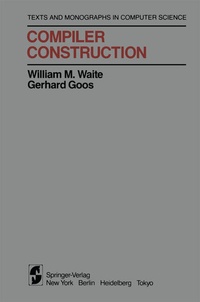
Compiler Construction
Published on 24. May 2013
Book
Paperback/Softback
XIV, 447 pages
978-1-4612-9731-4 (ISBN)
Description
Compilers and operating systems constitute the basic interfaces between a programmer and the machine for which he is developing software. In this book we are concerned with the construction of the former. Our intent is to provide the reader with a firm theoretical basis for compiler construction and sound engineering principles for selecting alternate methods, imple menting them, and integrating them into a reliable, economically viable product. The emphasis is upon a clean decomposition employing modules that can be re-used for many compilers, separation of concerns to facilitate team programming, and flexibility to accommodate hardware and system constraints. A reader should be able to understand the questions he must ask when designing a compiler for language X on machine Y, what tradeoffs are possible, and what performance might be obtained. He should not feel that any part of the design rests on whim; each decision must be based upon specific, identifiable characteristics of the source and target languages or upon design goals of the compiler. The vast majority of computer professionals will never write a compiler. Nevertheless, study of compiler technology provides important benefits for almost everyone in the field . It focuses attention on the basic relationships between languages and machines. Understanding of these relationships eases the inevitable tran sitions to new hardware and programming languages and improves a person's ability to make appropriate tradeoft's in design and implementa tion .
More details
Series
Edition
Softcover reprint of the original 1st ed. 1984
Language
English
Place of publication
New York
United States
Target group
Lower undergraduate
Illustrations
XIV, 447 p.
Dimensions
Height: 235 mm
Width: 155 mm
Thickness: 25 mm
Weight
698 gr
ISBN-13
978-1-4612-9731-4 (9781461297314)
DOI
10.1007/978-1-4612-5192-7
Schweitzer Classification
Other editions
Additional editions
William M. Waite | Gerhard Goos
Compiler Construction
Book
11/1985
Springer
€85.55
Article exhausted; check different version
Persons
Content
1 Introduction and Overview.- 1.1 Translation and Interpretation.- 1.2 The Tasks of a Compiler.- 1.3 Data Management in a Compiler.- 1.4 Compiler Structure.- 1.5 Notes and References.- 2 Properties of Programming Languages.- 2.1 Overview.- 2.2 Data Objects and Operations.- 2.3 Expressions.- 2.4 Control Structures.- 2.5 Program Environments and Abstract Machine States.- 2.6 Notes and References.- 3 Properties of Real and Abstract Machines.- 3.1 Basic Characteristics.- 3.2 Representation of Language Elements.- 3.3 Storage Management.- 3.4 Mapping Specifications.- 3.5 Notes and References.- 4 Abstract Program Representations.- 4.1 Intermediate Languages.- 4.2 Global Tables.- 4.3 Notes and References.- 5 Elements of Formal Systems.- 5.1 Descriptive Tools.- 5.2 Regular Grammars and Finite Automata.- 5.3 Context-Free Grammars and Pushdown Automata.- 5.4 Notes and References.- 6 Lexical Analysis.- 6.1 Modules and Interfaces.- 6.2 Construction.- 6.3 Notes and References.- 7 Parsing.- 7.1 Design.- 7.2 LL(1) Parsers.- 7.3 LR Parsers.- 7.4 Notes and References.- 8 Attribute Grammars.- 8.1 Basic Concepts of Attribute Grammars.- 8.2 Traversal Strategies.- 8.3 Implementation Considerations.- 8.4 Notes and References.- 9 Semantic Analysis.- 9.1 Description of Language Properites via Attribute Grammars.- 9.2 Implementation of Semantic Analysis.- 9.3 Notes and References.- 10 Code Generation.- 10.1 Memory Mapping.- 10.2 Target Attribution.- 10.3 Code Selection.- 10.4 Notes and References.- 11 Assembly.- 11.1 Internal Address Resolution.- 11.2 External Address Resolution.- 11.3 Instruction Encoding.- 11.4 Notes and References.- 12 Error Handling.- 12.1 General Principles.- 12.2 Compiler Error Recovery.- 12.3 Run-Time Errors.- 12.4 Notes and References.- 13 Optimization.- 13.1 The Computation Graph.- 14.2 Local Optimization.- 13.3 Global Optimization.- 13.4 Efficacy and Cost.- 14 Implementing the Compiler.- 14.1 Implementation Decisions.- 14.2 Case Studies.- 14.3 Notes and References.- Appendix A: Sample Programming Language LAX.- A.1 Basic Symbols.- A.2 Program Structure.- A.3 Declarations.- A.4 Expressions.- Appendix B: Useful Algorithms for Directed Graphs.- B.1 Terminology.- B.2 Directed Graphs as Data Structures.- B.3 Partitioning Algorithms.- B.4 Notes and References.