

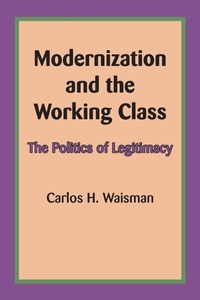
Modernization and the Working Class
The Politics of Legitimacy
Published on 1. February 1982
Book
Paperback/Softback
256 pages
978-0-292-76946-5 (ISBN)
Description
This is a fascinating inquiry into the factors that determine the acceptance or rejection of capitalism by the industrial working class. Combining classical social theory, historical evidence, and survey data, Waisman explores the relationship between the degree of modernization and the legitimacy of the capitalist social order.
Propositions about the interaction between established elites and emerging working classes are illustrated with three typical cases: Disraelian Britain, Bismarckian Germany, and Peronist Argentina. From the contrasting theories of Marx and Bakunin, the author derives hypotheses concerning the position of the working class in the economy and the consequences this has for legitimacy. He finds that countries at middle levels of industrial development-mostly latecomers to industrialization in Southern Europe and advanced areas of Latin America-have the greatest difficulty in establishing capitalism as a legitimate social order. They are advanced enough to have a large working class, yet underdeveloped enough to have a dissatisfied one.
Propositions about the interaction between established elites and emerging working classes are illustrated with three typical cases: Disraelian Britain, Bismarckian Germany, and Peronist Argentina. From the contrasting theories of Marx and Bakunin, the author derives hypotheses concerning the position of the working class in the economy and the consequences this has for legitimacy. He finds that countries at middle levels of industrial development-mostly latecomers to industrialization in Southern Europe and advanced areas of Latin America-have the greatest difficulty in establishing capitalism as a legitimate social order. They are advanced enough to have a large working class, yet underdeveloped enough to have a dissatisfied one.
Reviews / Votes
An important and rigorously executed theoretical and historical study that merits careful reading. (American Journal of Sociology)More details
Language
English
Place of publication
Austin, TX
United States
Target group
Professional and scholarly
Dimensions
Height: 229 mm
Width: 152 mm
Thickness: 15 mm
Weight
424 gr
ISBN-13
978-0-292-76946-5 (9780292769465)
Copyright in bibliographic data and cover images is held by Nielsen Book Services Limited or by the publishers or by their respective licensors: all rights reserved.
Schweitzer Classification
Person
Carlos H. Waisman is Professor Emeritus of Sociology at the University of California, San Diego.
Content
Preface
Introduction
1. The Problem
Part I. Outcomes, Collective Action, and Structural Correlates
2. Outcomes of the Process of Incorporation
3. A Conceptual Framework for the Analysis of Collective Political Action
4. Three Cases: Disraelian Britain, Bismarckian Germany, and Peronist Argentina
5. Structural Correlates of Outcomes
Part II. Structural Properties and Forms of Political Action
6. Structural Properties
7. Structural Properties in Classical Revolutionary Theories
8. Two Studies of the Argentine Working Class
9. Structural Modernization and Forms of Political Action: A Diachronic View
10. The Effects of Integration and Centrality
11. The Effects of Deprivation and Marginalization
Conclusion
12. The Working Class and the Legitimacy of Capitalism
Appendix
Notes
Index
Introduction
1. The Problem
Part I. Outcomes, Collective Action, and Structural Correlates
2. Outcomes of the Process of Incorporation
3. A Conceptual Framework for the Analysis of Collective Political Action
4. Three Cases: Disraelian Britain, Bismarckian Germany, and Peronist Argentina
5. Structural Correlates of Outcomes
Part II. Structural Properties and Forms of Political Action
6. Structural Properties
7. Structural Properties in Classical Revolutionary Theories
8. Two Studies of the Argentine Working Class
9. Structural Modernization and Forms of Political Action: A Diachronic View
10. The Effects of Integration and Centrality
11. The Effects of Deprivation and Marginalization
Conclusion
12. The Working Class and the Legitimacy of Capitalism
Appendix
Notes
Index