

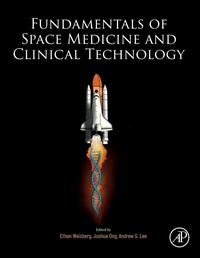
FUNDAMENTALS SPACE MEDICINE CLINICA
Will be published approx. on 1. December 2025
Book
Paperback/Softback
300 pages
978-0-443-32904-3 (ISBN)
Description
Fundamentals of Space Medicine and Clinical Technology is a comprehensive guide that delves into the advanced technologies utilized in space medicine today. The book is structured into three sections: an introduction to the physiology of space medicine, a detailed overview of various space medicine technologies, and the application of these technologies on Earth. Authored by leading experts in the field, it aims to bridge the gap between space medicine physiology and technological advancements, offering valuable insights. Additionally, the book serves as a useful resource for doctors, engineers, commercial industries, and governments, highlighting the significance of translational applications of space medicine technologies.
This is a pivotal read for anyone interested in the intersection of space exploration and medical science.
This is a pivotal read for anyone interested in the intersection of space exploration and medical science.
More details
Language
English
Place of publication
San Diego
United States
Publishing group
Elsevier Science Publishing Co Inc
Target group
Professional and scholarly
Dimensions
Height: 212 mm
Width: 277 mm
Thickness: 34 mm
Weight
1540 gr
ISBN-13
978-0-443-32904-3 (9780443329043)
Copyright in bibliographic data and cover images is held by Nielsen Book Services Limited or by the publishers or by their respective licensors: all rights reserved.
Schweitzer Classification
Other editions
Additional editions
Ethan Waisberg MB BCh BAO | Joshua Ong MD | Andrew G. Lee MD
Fundamentals of Space Medicine and Clinical Technology
E-Book
12/2025
Elsevier
€153.99
Available for download
Persons
Dr. Ethan Waisberg is an Academic Foundation Doctor at the University of Cambridge, in the UK. He conducts research in Spaceflight Associate Neuro-Ocular Syndrome, is a member of of NASA's Artificial Intelligence and Machine Learning Working Group and has co-published leading papers in space medicine, neuro-ophthalmology, extended reality, and artificial intelligence. Joshua Ong, MD is a resident physician with a passion for protecting astronaut health. He has conducted research on several space medicine research projects, including a project that launched into space. He has presented at the National Aeronautics and Space Administration (NASA) Human Research Program Investigators' Workshop and strives to continue his lifelong journey in ophthalmology and space medicine. Dr. Lee began his academic career in 1994 as an Instructor in the Department of Ophthalmology, Neurology, and Neurosurgery at Baylor College of Medicine, becoming an Associate Professor in 1998. In 2000, he joined the University of Iowa as an Associate Professor and later became a full Professor. He serves on the editorial boards of 12 journals, including the American Journal of Ophthalmology, and is the Editor in Chief of the Journal of Academic Ophthalmology. A recipient of multiple awards from the American Academy of Ophthalmology, Dr. Lee has a strong interest in resident training and has published extensively on teaching methods in ophthalmology residency programs. In 2009, he joined Houston Methodist Hospital and Research Institute, where he currently serves as Chair of the Blanton Eye Institute and is a Professor at Weill Cornell Medical College.
Editor
Department of Medical Genetics, University of Cambridge, UK
School of Medicine, University of Pittsburgh, Pittsburgh, Pennsylvania, USA
Chair of the Blanton Eye Institute, Houston Methodist Hospital, Houston, TX, USA; Professor of Ophthalmology, Neurology, and Neurosurgery, Weill Cornell Medical College, New York, NY, USA
Content
SECTION 1:
1. Problems of Humans in Space
2. Countermeasures
SECTION 2:
3. Space Suit
4. Lower Body Negative Pressure
5. Dive and Hyperbaric Technology
6. Wearable Technologies
7: Robot-assisted Surgery
8. Ultrasound
9. Light Emitting Diodes (LEDs)
10. Balance Disorders Assessment and Treatment
11. Space Genomics - with NASA GeneLab authors
12. Virtual and Augmented Reality in Space
13. Artificial Intelligence in Space
SECTION 3:
14. Applications of Space Medicine Technologies on Earth
15. Future Directions
1. Problems of Humans in Space
2. Countermeasures
SECTION 2:
3. Space Suit
4. Lower Body Negative Pressure
5. Dive and Hyperbaric Technology
6. Wearable Technologies
7: Robot-assisted Surgery
8. Ultrasound
9. Light Emitting Diodes (LEDs)
10. Balance Disorders Assessment and Treatment
11. Space Genomics - with NASA GeneLab authors
12. Virtual and Augmented Reality in Space
13. Artificial Intelligence in Space
SECTION 3:
14. Applications of Space Medicine Technologies on Earth
15. Future Directions