

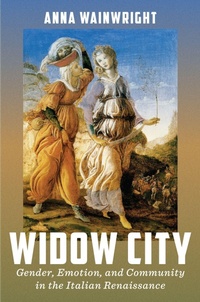
Widow City
Gender, Emotion, and Community in the Italian Renaissance
Published on 13. May 2025
Book
Hardback
218 pages
978-1-64453-360-4 (ISBN)
Description
Widow City: Gender, Emotion, and Community in Renaissance Italy investigates the ever-evolving role of the widow in medieval and early modern Italian literature, from canonical authors such as Dante, Petrarch, and Boccaccio, to the numerous widowed writers who rose to prominence in the sixteenth century-including Vittoria Colonna, Veronica Gambara, and Francesca Turina-and radically changed the conversation on public mourning. Engaging with broader intellectual discussions around gender, the history of emotions, the politics of mourning, and the construction of community, Widow City argues that widows served as key models demonstrating to readers not just how to mourn, but how to live well after devastating loss. At the same time, widows were figures of great anxiety: their status as unattached women, and the public performance of their grief, were viewed as very real threats to the stability of the social order. They are thus key to broader intellectual understandings of community and civic life in the Italian Middle Ages and Renaissance.
Reviews / Votes
"Widow City is an impressive study of the significance of widowhood in Italian Renaissance literature. Through subtle analyses of canonical authors such as Dante, Petrarch, and Boccaccio, who constructed a rich poetic vocabulary around widowhood, to the numerous widowed writers such as Vittoria Colonna and Francesca Turina, who rose to prominence in the sixteenth century and drastically changed the conversation on public mourning, Wainwright singles out the evolution of a remarkably powerful discourse. What she convincingly labels as "poetics of widowhood" becomes nothing but a key to a broad intellectual understanding of literature, community, and civic life in early modern Italy." - Unn Falkeid, University of Oslo"In Widow City Anna Wainwright analyzes the evolving role of widow from subject to author in late medieval and early modern Italian literature. Wainwright probes the boundaries of gender in the poetics of widowhood as she moves from the tre corone to the radical reframing performed by Italian Renaissance women authors, many widowed, whose efforts led to a boom in women's writing unmatched elsewhere in Europe. This book does honor to those women, as Wainwright brilliantly illuminates the story of widows and widowhood in Italian letters." - Teodolinda Barolini, Columbia University
More details
Series
Language
English
Place of publication
United States
Target group
College/higher education
Professional and scholarly
US School Grade: College Freshman and over, Interest Age: From 18 to 99 years
Product notice
sewn/stitched
Cloth over boards
Illustrations
2 color and 2 B-W images
Dimensions
Height: 238 mm
Width: 156 mm
Thickness: 20 mm
Weight
417 gr
ISBN-13
978-1-64453-360-4 (9781644533604)
Copyright in bibliographic data and cover images is held by Nielsen Book Services Limited or by the publishers or by their respective licensors: all rights reserved.
Schweitzer Classification
Person
Anna Wainwright is an associate professor of Italian studies and core faculty in women's and gender studies at the University of New Hampshire. She is coeditor of the volumes Innovation in the Italian Counter-Reformation (Delaware, 2020, with Shannon McHugh), Teaching Race in the European Renaissance: A Classroom Guide (2023, with Matthieu Chapman), and The Legacy of Birgitta of Sweden: Women, Politics and Reform in Renaissance Italy (2023, with Unn Falkeid).
Content
Acknowledgments
Introduction
Part I: Widowhood and the tre corone
1 Dante, Petrarch, and the Ethics of Widowhood
2 Boccaccio's Many Merry Widows
Part II: Context: Model Widows, Holy and Historical
3 Sacred Role Models from Judith and Anna to Birgitta of Sweden
4 Dido, Death, and Exemplarity: Public Widowhood from Petrarch to Vittoria Colonna
Part III: The Widow's Voice
5 Widowed Verse: Christine de Pizan, Vittoria Colonna, and Francesca Turina
6 "Widowhood for its Own Sake": Widows in Two Dialogues of the Counter-Reformation
Epilogue
Notes
Bibliography
Index
Introduction
Part I: Widowhood and the tre corone
1 Dante, Petrarch, and the Ethics of Widowhood
2 Boccaccio's Many Merry Widows
Part II: Context: Model Widows, Holy and Historical
3 Sacred Role Models from Judith and Anna to Birgitta of Sweden
4 Dido, Death, and Exemplarity: Public Widowhood from Petrarch to Vittoria Colonna
Part III: The Widow's Voice
5 Widowed Verse: Christine de Pizan, Vittoria Colonna, and Francesca Turina
6 "Widowhood for its Own Sake": Widows in Two Dialogues of the Counter-Reformation
Epilogue
Notes
Bibliography
Index