

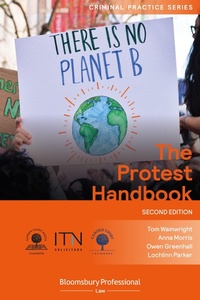
The Protest Handbook
2nd Edition
Published on 1. December 2020
Book
Paperback/Softback
528 pages
978-1-5265-1400-4 (ISBN)
Description
"A book like this that sets out the law relevant to protest is essential for campaigners and activists. But it's not just a guide to legal rights when protesting, it's also a handbook for the defence of civil disobedience and non-violent direct action in our democracy. That makes it essential reading for us all."
Caroline Lucas MP, in her Foreword to the Second Edition
The Protest Handbook, Second Edition is a clear and accessible guide to protest law, which brings together both the criminal and civil aspects of this area of law and explains complex legal issues in a user-friendly format.
The authors guide practitioners and non-practitioners through the various issues and proceedings, covering the following: protestors' rights and police powers; criminal proceedings; common offences and defences; the law on occupations; challenging injunctions; and holding the police to account.
The Second Edition covers all the core legislation and case law including: Public Order Act 1986; Criminal Justice and Public Order Act 1994; Human Rights Act 1998; Boddington v BTP, Rice v Connolly and R (Laporte) v Chief Constable of Gloucestershire as well as more recent developments such as: Anti-Social Behaviour Crime and Police Act 2014; The Police (Conduct) Regulations 2020; James v DPP (2016); R (DPP) v Stratford MC (2017); DPP v Ziegler (2019); R v Roberts (2019); Catt v UK (2019); Canada Goose v Persons Unknown (2020); INEOS v Boyd (2020); R (Jones) v Commissioner of Police for the Metropolis (2020).
This is an essential guide for all legal practitioners working in this area, as well as for organisations and groups who provide advice and support for protestors and, of course, for protestors themselves.
Caroline Lucas MP, in her Foreword to the Second Edition
The Protest Handbook, Second Edition is a clear and accessible guide to protest law, which brings together both the criminal and civil aspects of this area of law and explains complex legal issues in a user-friendly format.
The authors guide practitioners and non-practitioners through the various issues and proceedings, covering the following: protestors' rights and police powers; criminal proceedings; common offences and defences; the law on occupations; challenging injunctions; and holding the police to account.
The Second Edition covers all the core legislation and case law including: Public Order Act 1986; Criminal Justice and Public Order Act 1994; Human Rights Act 1998; Boddington v BTP, Rice v Connolly and R (Laporte) v Chief Constable of Gloucestershire as well as more recent developments such as: Anti-Social Behaviour Crime and Police Act 2014; The Police (Conduct) Regulations 2020; James v DPP (2016); R (DPP) v Stratford MC (2017); DPP v Ziegler (2019); R v Roberts (2019); Catt v UK (2019); Canada Goose v Persons Unknown (2020); INEOS v Boyd (2020); R (Jones) v Commissioner of Police for the Metropolis (2020).
This is an essential guide for all legal practitioners working in this area, as well as for organisations and groups who provide advice and support for protestors and, of course, for protestors themselves.
Reviews / Votes
An essential guide to the law for all those prosecuting and defending these complex cases. The authors bring to the table an extensive knowledge base crafted by dealing with these cases first hand over many years, the final product being a clear, accessible and comprehensive text. First class. * CrimeLine *More details
Series
Edition
2nd edition
Language
English
Place of publication
London
United Kingdom
Publishing group
Bloomsbury Publishing PLC
Target group
Professional and scholarly
Product notice
Paperback (trade)
Unsewn / adhesive bound
Dimensions
Height: 231 mm
Width: 155 mm
Thickness: 28 mm
Weight
816 gr
ISBN-13
978-1-5265-1400-4 (9781526514004)
Copyright in bibliographic data and cover images is held by Nielsen Book Services Limited or by the publishers or by their respective licensors: all rights reserved.
Schweitzer Classification
Persons
Tom Wainwright, Anna Morris and Owen Greenhall are all barristers at Garden Court. Lochlinn Parker is Partner and Head of Civil Liberties at ITN solicitors.
Content
1 Powers, rights and procedure:
Powers and restrictions in relation to protests;
At the police station.
2 Criminal court procedural issues:
First appearance at the magistrates' court;
Disclosure;
Summary trial procedure;
Abuse of process;
Appeals.
3 Common offences, defences and core principles:
Aggravated trespass;
Assaulting/resisting/obstructing a police officer in the execution of their duty;
Assaults on emergency workers;
Breach of the peace;
Criminal damage;
Failing to comply with orders;
Location-specific offences and byelaws;
Obstruction of the highway;
Public nuisance;
'Public order' offences;
Watching and besetting;
Miscellaneous offences;
General defences;
Sentencing principles;
Human rights.
4 Occupations:
What is an occupation?;
Criminal law;
Civil law.
5 Injunctions:
How do injunctions arise?;
A taxonomy of injunctions;
Giving notice;
Injunctions against unnamed defendants;
Representative proceedings;
Procedure;
When will the court grant an injunction?;
Grounds for injunctions;
The terms of an injunction;
Proportionality agreements;
After the hearing;
Contempt of court;
Penalty;
Legal aid and costs;
Other proceedings;
Conclusion.
6 Holding the police to account:
How best to challenge the police;
Funding complaints and civil actions against the police;
Complaints against the police;
Civil actions against the police;
Judicial review proceedings.
Annex A Flowcharts
Annex B Key legislation
Human Rights Act 1998
Public Order Act 1986
Police Reform and Social Responsibility Act 2011
Police and Criminal Evidence Act 1984
Annex C Police (Conduct) Regulations 2020
Annex D Useful websites
Annex E Public protests
Powers and restrictions in relation to protests;
At the police station.
2 Criminal court procedural issues:
First appearance at the magistrates' court;
Disclosure;
Summary trial procedure;
Abuse of process;
Appeals.
3 Common offences, defences and core principles:
Aggravated trespass;
Assaulting/resisting/obstructing a police officer in the execution of their duty;
Assaults on emergency workers;
Breach of the peace;
Criminal damage;
Failing to comply with orders;
Location-specific offences and byelaws;
Obstruction of the highway;
Public nuisance;
'Public order' offences;
Watching and besetting;
Miscellaneous offences;
General defences;
Sentencing principles;
Human rights.
4 Occupations:
What is an occupation?;
Criminal law;
Civil law.
5 Injunctions:
How do injunctions arise?;
A taxonomy of injunctions;
Giving notice;
Injunctions against unnamed defendants;
Representative proceedings;
Procedure;
When will the court grant an injunction?;
Grounds for injunctions;
The terms of an injunction;
Proportionality agreements;
After the hearing;
Contempt of court;
Penalty;
Legal aid and costs;
Other proceedings;
Conclusion.
6 Holding the police to account:
How best to challenge the police;
Funding complaints and civil actions against the police;
Complaints against the police;
Civil actions against the police;
Judicial review proceedings.
Annex A Flowcharts
Annex B Key legislation
Human Rights Act 1998
Public Order Act 1986
Police Reform and Social Responsibility Act 2011
Police and Criminal Evidence Act 1984
Annex C Police (Conduct) Regulations 2020
Annex D Useful websites
Annex E Public protests