

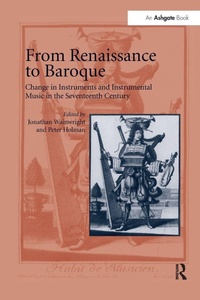
From Renaissance to Baroque
Change in Instruments and Instrumental Music in the Seventeenth Century
1st Edition
Published on 28. November 2016
Book
Paperback/Softback
340 pages
978-1-138-25787-0 (ISBN)
Description
Historians of instruments and instrumental music have long recognised that there was a period of profound change in the seventeenth century, when the consorts or families of instruments developed during the Renaissance were replaced by the new models of the Baroque period. Yet the process is still poorly understood, in part because each instrument has traditionally been considered in isolation, and changes in design have rarely been related to changes in the way instruments were used, or what they played. The essays in this book are by distinguished international authors that include specialists in particular instruments together with those interested in such topics as the early history of the orchestra, iconography, pitch and continuo practice. The book will appeal to instrument makers and academics who have an interest in achieving a better understanding of the process of change in the seventeenth century, but the book also raises questions that any historically aware performer ought to be asking about the performance of Baroque music. What sorts of instruments should be used? At what pitch? In which temperament? In what numbers and/or combinations? For this reason, the book will be invaluable to performers, academics, instrument makers and anyone interested in the fascinating period of change from the 'Renaissance' to the 'Baroque'.
Reviews / Votes
'The 17th century was one of change in instrumental design, confusing nomenclature and varying ensembles. Anyone performing music of that period will benefit from at least dipping into this varied collection of studies.' Early Music Review '...comprehensive in scope...engaging in narrative... One of the most compelling aspects of the collection is the systematic manner in which the contributors (all experts in their fields) present their diverse evidence... a valuable addition to the literature...Essential.' ChoiceMore details
Language
English
Place of publication
London
United Kingdom
Publishing group
Taylor & Francis Ltd
Target group
College/higher education
Dimensions
Height: 234 mm
Width: 156 mm
Thickness: 18 mm
Weight
518 gr
ISBN-13
978-1-138-25787-0 (9781138257870)
Copyright in bibliographic data and cover images is held by Nielsen Book Services Limited or by the publishers or by their respective licensors: all rights reserved.
Schweitzer Classification
Other editions
Additional editions
Jonathan Wainwright
From Renaissance to Baroque
Change in Instruments and Instrumental Music in the Seventeenth Century
E-Book
07/2017
Routledge
€78.99
Available for download
Jonathan Wainwright
From Renaissance to Baroque
Change in Instruments and Instrumental Music in the Seventeenth Century
E-Book
07/2017
Routledge
€78.99
Available for download
Jonathan Wainwright | Peter Holman
From Renaissance to Baroque
Change in Instruments and Instrumental Music in the Seventeenth Century
Book
07/2005
1st Edition
Routledge
€232.40
Shipment within 10-20 days
Persons
Jonathan Wainwright is Senior Lecturer in Music at the University of York, UK. Peter Holman is Reader in Music at the University of Leeds, UK.
Content
Contents: Preface; Introduction: From 'Renaissance' to 'Baroque'?, Jonathan P. Wainwright; Baptiste's Hautbois: the metamorphosis from Shawm to Hautboy in France, 1620-70, Bruce Haynes; A commentary on the letter by Michel de La Barre concerning the history of musettes and hautboys, Marc Ecochard; The woodwind instruments of Richard Haka (1645/6-1705), Jan Bouterse; Basstals or Curtoons: the search for a transitional Fagott, Graham Lyndon-Jones; The iconographic background to the seventeenth-century recorder, Anthony Rowland-Jones; The Renaissance flute in the 17th century, Nancy Hadden; The flute at Dresden: ramifications for 18th-century woodwind performance in Germany, Mary Oleskiewicz; How did 17th-century English violins really sound?, Peter Trevelyan; The development of French lute style 1600-50, Matthew Spring; The early Air de Cour, the Theorbo, and the Continuo principle in France, Jonathan Le Cocq; From stops organical to stops of variety: the English organ from 1630 to 1730, Dominic Gwynn; Upgrading from consorts to orchestra at the WA1/4rttemberg court, Samantha Owens; From violin band to orchestra, Peter Holman; Organological Gruyere, Jeremy Montagu. Workshop Reports: J.S. Bach's Actus tragicus: 'Gottes Zeit ist die allerbeste Zeit' (BWV 106), Andrew Parrott; The French Baroque orchestra: Lully, Charpentier, Couperin, Graham Sadler. Bibliography; Index.