

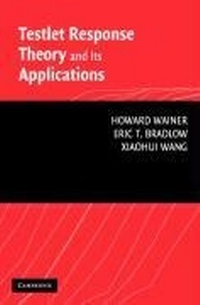
Testlet Response Theory and Its Applications
Published on 19. March 2007
Book
Paperback/Softback
280 pages
978-0-521-68126-1 (ISBN)
Description
The measurement models employed to score tests have been evolving over the past century from those that focus on the entire test (true score theory) to models that focus on individual test items (item response theory) to models that use small groups of items (testlets) as the fungible unit from which tests are constructed and scored (testlet response theory, or TRT). In this book, the inventors of TRT trace the history of this evolution and explain the character of modern TRT. Written for researchers and professionals in statistics, psychometrics, and educational psychology, the first part offers an accessible introduction to TRT and its applications. The second part presents a comprehensive, self-contained discussion of the model couched within a fully Bayesian framework. Its parameters are estimated using Markov chain Monte Carlo procedures, and the resulting posterior distributions of the parameter estimates yield insights into score stability that were previously unsuspected.
Reviews / Votes
'... a very accessible and incredibly delightful book to read. ... an excellent resource ... a valuable addition to the bookshelves of teachers, students and researchers in testing and measurement.' PsychometrikaMore details
Language
English
Place of publication
Cambridge
United Kingdom
Target group
Professional and scholarly
Product notice
Paperback (trade)
Illustrations
Worked examples or Exercises; 22 Tables, unspecified
Dimensions
Height: 230 mm
Width: 154 mm
Thickness: 15 mm
Weight
376 gr
ISBN-13
978-0-521-68126-1 (9780521681261)
Copyright in bibliographic data and cover images is held by Nielsen Book Services Limited or by the publishers or by their respective licensors: all rights reserved.
Schweitzer Classification
Other editions
Additional editions
Howard Wainer | Eric T. Bradlow | Xiaohui Wang
Testlet Response Theory and Its Applications
E-Book
05/2007
1st Edition
Cambridge University Press
€44.49
Available for download
Howard Wainer | Eric T. Bradlow | Xiaohui Wang
Testlet Response Theory and Its Applications
Book
03/2007
Cambridge University Press
€127.60
Shipment within 15-20 days
Persons
Dr Howard Wainer is a Distinguished Research Scientist for the National Board of Medical Examiners and Adjunct Professor of Statistics at the Wharton School of the University of Pennsylvania. Eric T. Bradlow is the K. P. Chao Professor, Professor of Marketing and Statistics, and Academic Director of the Wharton Small Business Development Center, Wharton School of the University of Pennsylvania. Before joining the Wharton faculty, he worked in the Corporate Marketing and Business Research Division at the DuPont Corporation, and in the Statistics and Psychometrics Research Group at the Educational Testing Service. Bradlow was recently named a Fellow of the American Statistical Association. Dr Xiaohui Wang is an Assistant Professor in the Department of Statistics at the University of Virginia. She worked as a Principal Data Analyst for three years in the Division of Data Analysis and Research Technology at the Educational Testing Service. She has twice received the National Council on Measurement in Education Award for Scientific Contribution to a Field of Educational Measurement.
Content
Preface; Part I. Introduction to Testlets: 1. Introduction to testing; 2. Traditional true score theory; 3. Item response theory; 4. Testlet response theory: introduction and preview; 5. The origins of testlet response theory: three alternatives; 6. Fitting testlets with polytomous IRT models: the Law School Admissions Test as an example; Part II. Bayesian Testlet Response Theory: Introduction; 7. A brief history and the basic ideas of modern testlet response theory; 8. The 2-PL Bayesian testlet model; 9. The 3-PL Bayesian testlet model; 10. A Bayesian testlet model for a mixture of binary and polytomous data; 11. A Bayesian testlet model with covariates; 12. Testlet nonresponse theory: dealing with missing data; Part III. Applications and Ancillary Topics: Introduction; 13. Using posterior distributions to evaluate passing scores: The PPoP curve; 14. DIF - Differential Testlet Functioning; 15. Estimation: a Bayesian primer.