

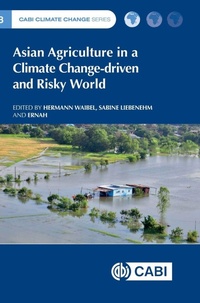
Asian Agriculture in a Climate Change-driven and Risky World
Published on 21. May 2026
Book
Hardback
216 pages
978-1-80062-731-4 (ISBN)
Description
This book synthesizes over forty years of field research in agriculture in developing countries across Asia including China, India, Bangladesh, Thailand, Laos, Vietnam, The Philippines and Indonesia, as well as a chapter on high-tech urban farming in Singapore. It takes stock of agricultural development and transformation in the context of economic growth, offering a comprehensive review of development policies and major events at the country level. The policy-focused chapters feature case studies on vegetable, pepper, rubber, oil palm, and fish farming based on extensive field research. Central themes include the structural transformation of agriculture and rural areas, the implications of declining farm sizes, and the role of emerging technologies. The book also assesses growing global risks, in particular, those related to climate change, and concludes with an outlook on the future of rural Asia.
More details
Series
Language
English
Place of publication
Wallingford
United Kingdom
Target group
College/higher education
Professional and scholarly
Product notice
sewn/stitched
Cloth over boards
Dimensions
Height: 244 mm
Width: 170 mm
Thickness: 19 mm
Weight
699 gr
ISBN-13
978-1-80062-731-4 (9781800627314)
Copyright in bibliographic data and cover images is held by Nielsen Book Services Limited or by the publishers or by their respective licensors: all rights reserved.
Schweitzer Classification
Persons
Hermann Waibel (Edited By)
Hermann Waibel is a Professor of Development and Agricultural Economics (since 2001) and Director of the Institute of Economics in Horticulture (since 1998) Formerly Professor of Economics in Horticulture (1994 - 2001), Faculty of Economics and Business Administration, University of Hannover, Germany; formerly Director of International Programs of the Leibniz University of Hannover and Chairman of the Senate Committee on International Relations of the Leibniz University of Hannover (2000 - 2003). Spend 10 years working in development assistance in Asia with GTZ and in development research and teaching with the Asian Institute of Technology (AIT); Since 2001 member of the Standing Panel on Impact Assessment of the CGIAR, worked extensively as consultant and reviewer for numerous organizations of development assistance, including The World Bank, The Food and Agriculture Organization (FAO),The Asian Development Bank, the European Union, GTZ, , the German Development Bank (KfW) and the CGIAR.
Sabine Liebenehm (Edited By)
Sabine Liebenehm's overall objective of their research program is to improve our understanding of the economic decision-making among households living in rural and remote settings often exposed to an adverse environment with limited access to formal safety net mechanisms. Her focus is on two aspects that determine the risk management decision: (i) the impact of adverse risks, and (ii) the interaction with people's preferences and perceptions. To assess these research questions, she applies empirical microeconomic strategies, leveraging rich data sets obtained from household surveys, lab-in-the-field experiments, social network studies, and climate data observations. Geographically, She works primarily with rural agricultural households in Southeast Asia and West Africa, and more recently with remote First Nation communities in Northern Canada.
Ernah (Edited By)
Ernah is an Associate Professor of Agricultural Economics at the Department of Agricultural Socio-Economics, Faculty of Agriculture, Padjadjaran University, Indonesia, and Chairman of the Indonesian Agricultural Economics Association (PERHEPI) Bandung (2025-2028). She has been a member of the International Society for Southeast Asian Agricultural Sciences (ISSAAS) since 2023 and previously served as Manager of Research, Innovation, Community Service, and Cooperation at the Faculty of Agriculture, Padjadjaran University (2017-2021). Her areas of specialisation include agricultural economics, sustainable development, and bio resource economics. Her research focuses on developing inclusive and sustainable agricultural development models that integrate social, environmental, and economic aspects to improve smallholder farmers' welfare. Her studies explore interactions among traditional market actors in shifting food systems, the distributional impacts of environmental and climate policies on rural households, and the contribution of smallholder oil palm plantations to national SDGs targets. She promotes strategies for a resilient and socially just agricultural sector.
Hermann Waibel is a Professor of Development and Agricultural Economics (since 2001) and Director of the Institute of Economics in Horticulture (since 1998) Formerly Professor of Economics in Horticulture (1994 - 2001), Faculty of Economics and Business Administration, University of Hannover, Germany; formerly Director of International Programs of the Leibniz University of Hannover and Chairman of the Senate Committee on International Relations of the Leibniz University of Hannover (2000 - 2003). Spend 10 years working in development assistance in Asia with GTZ and in development research and teaching with the Asian Institute of Technology (AIT); Since 2001 member of the Standing Panel on Impact Assessment of the CGIAR, worked extensively as consultant and reviewer for numerous organizations of development assistance, including The World Bank, The Food and Agriculture Organization (FAO),The Asian Development Bank, the European Union, GTZ, , the German Development Bank (KfW) and the CGIAR.
Sabine Liebenehm (Edited By)
Sabine Liebenehm's overall objective of their research program is to improve our understanding of the economic decision-making among households living in rural and remote settings often exposed to an adverse environment with limited access to formal safety net mechanisms. Her focus is on two aspects that determine the risk management decision: (i) the impact of adverse risks, and (ii) the interaction with people's preferences and perceptions. To assess these research questions, she applies empirical microeconomic strategies, leveraging rich data sets obtained from household surveys, lab-in-the-field experiments, social network studies, and climate data observations. Geographically, She works primarily with rural agricultural households in Southeast Asia and West Africa, and more recently with remote First Nation communities in Northern Canada.
Ernah (Edited By)
Ernah is an Associate Professor of Agricultural Economics at the Department of Agricultural Socio-Economics, Faculty of Agriculture, Padjadjaran University, Indonesia, and Chairman of the Indonesian Agricultural Economics Association (PERHEPI) Bandung (2025-2028). She has been a member of the International Society for Southeast Asian Agricultural Sciences (ISSAAS) since 2023 and previously served as Manager of Research, Innovation, Community Service, and Cooperation at the Faculty of Agriculture, Padjadjaran University (2017-2021). Her areas of specialisation include agricultural economics, sustainable development, and bio resource economics. Her research focuses on developing inclusive and sustainable agricultural development models that integrate social, environmental, and economic aspects to improve smallholder farmers' welfare. Her studies explore interactions among traditional market actors in shifting food systems, the distributional impacts of environmental and climate policies on rural households, and the contribution of smallholder oil palm plantations to national SDGs targets. She promotes strategies for a resilient and socially just agricultural sector.
Content
Part I: Introduction 1: Introduction and Overview 2: Climate Change and Weather Extremes in Asia 3: A Review of Risk and Risk Preference in Asian Agriculture: Methodology and Empirical Evidence Part II: Country Reviews of Agricultural and Rural Development 4: Agricultural Development and Policy in Thailand - With a Case Study of the Vegetable Subsector 5: Agricultural Development and Policy in Vietnam: Also a Success Story? 6: The Philippines - Increasing Productivity in a Risky Environment 7: Agricultural Development and Policy in China - With Two Case Studies from Southwest China 8: Indian Agricultural Policy Developments: A Review 9: Review of Agricultural Development and Policy with a Case Study on the Role of Homestead Fishponds for Food Security in Bangladesh 10: Agricultural Development and Policy in Indonesia since Independence with a Case Study of the Oil Palm Sector 11: Agricultural Development and Policy in Laos Part III: Special Topics 12: The Role of Biotechnology in Chinese Agriculture with a Case Study of Bt Cotton in Shandong Province 13: The Mekong River and Village Development in Thailand 14: Exploring Differences in Rural Household Debt between Thailand and Vietnam: Economic Environment versus Household Characteristics 15: Food Self-sufficiency and Building-integrated Urban Agriculture: Lessons from Singapore Part IV: Lessons Learned and Outlook 16: Synthesis 17: Outlook