

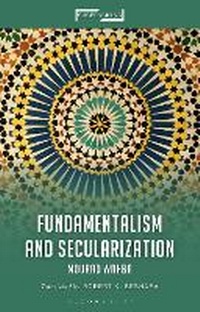
Fundamentalism and Secularization
Published on 13. January 2022
Book
Hardback
176 pages
978-1-350-22868-9 (ISBN)
Description
In Fundamentalism and Secularization, Egyptian philosopher Mourad Wahba traces the historical origins of fundamentalism and secularization as ideas and practices in order to theorize their symbiotic relationship, and how it is impacted by global capitalism and, more recently, postmodernism.
This gives voice to an argument from within the Islamic world that is very different to that given platform in the mainstream, showing that fundamentalism does not arise normally and naturally from Islam but is a complex phenomenon linked to modernization and the development of capitalism in dependent countries, that is, tied to imperialism.
Wahba's central argument concerns the organic relationship between fundamentalism and parasitic capitalism. Wahba is equally critical of religious fundamentalism and global capitalism, which for him are obstructions to secularization and democracy. While the three Abrahamic religions are examined when it comes to fundamentalism, Wahba deconstructs Islamic fundamentalism in particular and in the process reconstructs an Islamic humanism.
Including a new preface by the author and translator, Fundamentalism and Secularism provides invaluable insights into how Middle Eastern philosophies open up new lines of thought in thinking through contemporary crises.
This gives voice to an argument from within the Islamic world that is very different to that given platform in the mainstream, showing that fundamentalism does not arise normally and naturally from Islam but is a complex phenomenon linked to modernization and the development of capitalism in dependent countries, that is, tied to imperialism.
Wahba's central argument concerns the organic relationship between fundamentalism and parasitic capitalism. Wahba is equally critical of religious fundamentalism and global capitalism, which for him are obstructions to secularization and democracy. While the three Abrahamic religions are examined when it comes to fundamentalism, Wahba deconstructs Islamic fundamentalism in particular and in the process reconstructs an Islamic humanism.
Including a new preface by the author and translator, Fundamentalism and Secularism provides invaluable insights into how Middle Eastern philosophies open up new lines of thought in thinking through contemporary crises.
Reviews / Votes
Beshara has rendered a great service to those interested in contemporary Arabic philosophy through his readable and accurate translation of Fundamentalism and Secularization. * Marx and Philosophy Review of Books * Appreciation and praise to Robert K. Beshara for making Mourad Wahba's Fundamentalism and Secularization available to Anglophone readers through this wonderful translation, with an interview and additional essays. A provocative-and in this reader's view insightful-thesis of Wahba's text is that postmodernism is an exemplar of fundamentalisms and their aspirations of a foreclosed and often feared future. This classic work is a testament to the value of epistemic humility, the vitality of creativity, and the courage of taking responsibility for a future to create instead of to block. Its relevance to the contemporary global social and political situation, in which fundamentalisms ranging from the parasitic capitalist forces of neoliberalism and neoconservatism alongside bizarre meetings of neofascism and left pessimism and political nihilism imperil life on our planet, is evident. This voice from the Global South speaks to the world, to humanity, to thinking thought with the love for the spirit of freedom to reach the hearts and minds for generations to come on which, simply put, dignity and life depend. * Lewis R. Gordon, author of Freedom, Justice, and Decolonization * This translation of Mourad Wahba's Fundamentalism and Secularization could not have come at a more opportune time. It is a welcome and most needed intervention, corrective even, by an extremely knowledgeable thinker in contemporary understandings of the history of philosophy, generally, and of the continuing relevance of what we call the Enlightenment Project in our day. The latter, for him, is not a Euro-American possession but a human inheritance to the construction of which Europeans, Africans, Arabs, Christians, Jews, Muslims, and more contributed. One of its abiding products-secularization-Wahba argues is the antidote to the recrudescence of fundamentalisms in our day. We all owe Robert K. Beshara a debt of gratitude for translating it and Professor Wahba an even greater one for his courage and erudition in writing it. * Olufemi Taiwo, author of "How Colonialism Preempted Modernity in Africa" * The post-9/11 flurry in publishing literary translations from Arabic into English proceeded along predictable lines-novels about veils, sex and bombs. Aiming to explode stereotypes about the 'Muslim world', they often, instead, confirmed them. Beshara's impressive translation of an important philosophical treatise is pathbreaking: finally we hear Arabophone intellectuals doing sophisticated theoretical speculation not just as 'voices' describing tokenized experience. * Hussein Omar, Lecturer in Modern Global History, University College Dublin, Ireland *More details
Series
Language
English
Place of publication
London
United Kingdom
Publishing group
Bloomsbury Publishing PLC
Target group
Professional and scholarly
Dimensions
Height: 216 mm
Width: 138 mm
Weight
354 gr
ISBN-13
978-1-350-22868-9 (9781350228689)
Copyright in bibliographic data and cover images is held by Nielsen Book Services Limited or by the publishers or by their respective licensors: all rights reserved.
Schweitzer Classification
Other editions
Additional editions
Mourad Wahba
Fundamentalism and Secularization
E-Book
01/2022
1st Edition
Bloomsbury Academic
€32.99
Available for download
Persons
Mourad Wahba is Emeritus Professor of Philosophy, Ain Shams University, Egypt. He is the author of 22 books and Head and Founder of the Afro-Asian Philosophical Association as well as the Averroes International Association and Enlightenment.
Robert K. Beshara is Assistant Professor of Psychology and Humanities, Northern New Mexico College, USA. He is author of Decolonial Psychoanalysis: Towards Critical Islamophobia Studies (2019) and the editor of A Critical Introduction to Psychology (2019). He is the founder of the Critical Psychology website: www.criticalpsychology.org, and is the director of the Critical Psychology certificate programme at the Center for Global Advanced Studies.
Robert K. Beshara is Assistant Professor of Psychology and Humanities, Northern New Mexico College, USA. He is author of Decolonial Psychoanalysis: Towards Critical Islamophobia Studies (2019) and the editor of A Critical Introduction to Psychology (2019). He is the founder of the Critical Psychology website: www.criticalpsychology.org, and is the director of the Critical Psychology certificate programme at the Center for Global Advanced Studies.
Content
Preface
Acknowledgements
Introductory Dialogue, Mourad Wahba (Ain Shams University, Egypt) and Robert K. Beshara (Northern New Mexico College, USA)
Translator's Preface, Robert K. Beshara (Northern New Mexico College, USA)
Part I: Fundamentalism and Secularization
What is Fundamentalism?
What is Secularization?
Fundamentalism and Secularization in the Middle East
Postmodernism and Fundamentalism
Part II: Essays
Philosophy in North Africa
The Concept of the Good in Islamic Philosophy
Bibliography
Index
Acknowledgements
Introductory Dialogue, Mourad Wahba (Ain Shams University, Egypt) and Robert K. Beshara (Northern New Mexico College, USA)
Translator's Preface, Robert K. Beshara (Northern New Mexico College, USA)
Part I: Fundamentalism and Secularization
What is Fundamentalism?
What is Secularization?
Fundamentalism and Secularization in the Middle East
Postmodernism and Fundamentalism
Part II: Essays
Philosophy in North Africa
The Concept of the Good in Islamic Philosophy
Bibliography
Index