

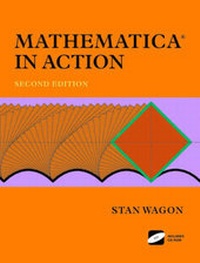
Mathematica® in Action
2nd Edition
Published on 12. November 1999
Book
Mixed media product
XVI, 592 pages
978-0-387-98684-5 (ISBN)
Description
Designed both as a guide to the extraordinary capabilities of Mathematica as well as a detailed tour of modern mathematics by one of its leading expositors, Stan Wagon, this is ideal for teachers, researchers, and Mathematica enthusiasts. This second edition includes an 8 page full color insert and 50% new material all organized around elementary topics, intermediate applications, and advanced projects. In addition, Mathematica 3.0 notebooks with all the programs and examples discussed in the book are available on the TELOS web site, suitable for DOS, Windows, Macintosh and Unix computers.
More details
Edition
2nd ed.
Language
English
Place of publication
NY
United States
Target group
College/higher education
Professional and scholarly
Professional/practitioner
Edition type
Revised edition
Illustrations
15
15 s/w Tabellen
515 black & white illustrations, 8 colour illustrations, 15 black & white tables
Dimensions
Height: 24.4 cm
Width: 17 cm
Weight
1000 gr
ISBN-13
978-0-387-98684-5 (9780387986845)
DOI
10.1007/978-1-4612-1454-0
Schweitzer Classification
Other editions
New editions
Book
06/2010
3rd Edition
Springer
€90.94
Shipment within 5-7 days
Additional editions

Stan Wagon
Mathematica in Action
Book
01/1999
2nd Edition
Springer
€80.20
Article exhausted; check for reprint
Previous edition
Stan Wagon
Mathematica in Action
Book
03/1991
W.H.Freeman & Co Ltd
€68.27
Article exhausted; check for reprint
Content
0 A Brief Introduction.- 0.1 Notational Conventions.- 0.2 Typesetting.- 0.3 Basic Mathematical Functions.- 0.4 Using Functions.- 0.5 Replacements.- 0.6 Lists.- 0.7 Getting Information.- 0.8 Algebraic Manipulations.- 0.9 Customizing Mathematica.- I Basic Concepts.- 1 Plotting.- 1.1 Plot.- 1.2 An ArcSin Curiosity.- 1.3 Adapting and Suppressing.- 1.4 Plotting Tables and Tabling Plots.- 1.5 Dealing with Discontinuities.- 1.6 ListPlot.- 1.7 ParametricPlot.- 2 Prime Numbers.- 2.1 Basic Number Theory Functions.- 2.2 Where the Primes Are.- 2.3 The Prime Number Race.- 2.4 Euclid and Fibonacci.- 2.5 Strong Pseudoprimes.- 3 Rolling Circles.- 3.1 Discovering the Cycloid.- 3.2 The Derivative of the Trochoid.- 3.3 Abe Lincoln's Somersaults.- 3.4 The Cycloid's Intimate Relationship with Gravity.- 3.5 Bicycles, Square Wheels, and Square Drills.- 4 Surfaces.- 4.1 Using Two-Dimensional Tools.- 4.2 Plotting Surfaces.- 4.3 Mixed Partial Derivatives Need Not Be Equal.- 4.4 Failure of the Only-Critical-Point-in-Town Test.- 4.5 Raising Contours to New Heights.- II Graphics Issues and Applications.- 5 The Cantor Set, Real and Complex.- 5.1 The Real Cantor Set.- 5.2 The Cantor Function.- 5.3 Complex Cantor Sets.- 6 The Quadratic Map.- 6.1 Iterating Functions.- 6.2 Numerical Subtleties.- 6.3 Chaos and the Quadratic Map.- 6.4 Bifurcations.- 7 The Recursive Turtle.- 7.1 The Literate Turtle.- 7.2 Space-Filling Curves.- 7.3 A Surprising Application.- 7.4 Trees, Mathematical and Botanical.- 8 Parametric Plotting of Surfaces.- 8.1 Introduction to ParametricPlot3D.- 8.2 Dandelin Spheres.- 8.3 Optimizing a Root Cellar.- 8.4 Adaptive Surface Plotting.- 8.5 A Fractal Tetrahedron.- 9 Penrose Tiles.- 9.1 Nonperiodic Tilings.- 9.2 Penrose Tilings.- 9.3 Penrose Rhombs.- 10 Fractals, Ferns, and Julia Sets.- 10.1 Iterated Function Systems.- 10.2 Biasing the Chaos Game: Barnsley's Fern.- 10.3 Julia Sets.- III Numerical Mathematics.- 11 Custom Curves.- 11.1 Basic Curve Fitting.- 11.2 Applications.- 11.3 Bézier Curves.- 11.4 A Virtual Bicycle Ride.- 11.5 Two-Dimensional Annotation of a Three-Dimensional Image.- 11.6 Stineman Interpolation.- 12 Solving Equations.- 12.1 Solve.- 12.2 LinearSolve.- 12.3 NSolve.- 12.4 FindRoot.- 12.5 Radicals and Beyond.- 12.6 FindAllCrossings.- 12.7 FindAllCrossings2D.- 13 Differential Equations.- 13.1 Solving Differential Equations.- 13.2 Stylish Plots.- 13.3 Pitfalls of Numerical Computing.- 13.4 Basins of Attraction.- IV Number Theory.- 14 Public-Key Encryption.- 14.1 Random Primes.- 14.2 The RSA Scheme.- 14.3 Character Analysis.- 15 Egyptian Fractions.- 15.1 A Greedy Algorithm.- 15.2 A Puzzling Halting Problem.- 15.3 Splitting Fractions.- 16 The Ancient and Modern Euclidean Algorithm.- 16.1 The Oldest Surviving Algorithm.- 16.2 The Extended Euclidean Algorithm.- 16.3 Continuants.- 16.4 Euclid and Diophantus.- 16.5 The Chinese Remainder Theorem.- 16.6 Rationals.- 16.7 Continued Fractions.- 17 Imaginary Primes and Prime Imaginaries.- 17.1 The Gaussian Integers.- 17.2 Residues and Nonresidues.- 17.3 A Surprising Application of Imaginary Primes.- 17.4 The Gaussian Primes.- 17.5 Sums of Two Squares.- 17.6 Primes as Stepping-Stones.- 18 Certifying Primality.- 18.1 P and NP.- 18.2 A New Look at an Old Primality Test.- 18.3 Finding Pratt Certificates.- 18.4 Perrin's Pretty Primality Test.- 18.5 The Lucas Primality Test.- 19 Check Digits and the Pentagon.- 19.1 The Group of the Pentagon.- 19.2 The Perfect Dihedral Method.- V Advanced Projects.- 20 New Directions for ?.- 20.1 The Classical Theory of ?.- 20.2 The Postmodern Theory of ?.- 20.3 A Most Depressing Proof.- 20.4 Variations on the Theme.- 20.5 A Strange Coincidence?.- 21 Rearrangement of Series.- 21.1 Harmonie Preliminaries.- 21.2 The Alternating Harmonic Series.- 22 Escher's Patterns.- 22.1 Escher's Motif.- 22.2 Escher Counts.- 22.3 Programming the Patterns.- 22.4 Subtle Patterns.- 22.5 The Coloring Equations.- 22.6 More Motifs.- 23 Computational Geometry.- 23.1 Basic Computational Geometry.- 23.2 The Art Gallery Theorem.- 23.3 A Very Strange Room.- 23.4 More Euclid.- 24 Coloring Planar Maps and Graphs.- 24.1 Preliminaries: Combinatorica.- 24.2 Planar Maps.- 24.3 Euler's Formula.- 24.4 Displaying Graphs.- 24.5 Kempe's Attempt.- 24.6 The Implementation.- 24.7 Random Ideas.- 25 The Riemann Zeta Function.- 25.1 The Riemann Zeta Function.- 25.2 The Influence of the Zeros of ? on the Distribution of Primes.- 26 The Banach-Tarski Paradox.- 26.1 The Paradoxical Free Product ? 2*? 3.- 26.2 A Hyperbolic Representation of the Group.- 26.3 The Geometrical Paradox.- References.