

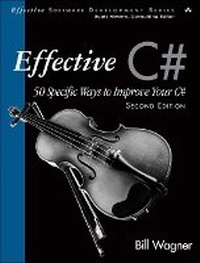
WAGNER
EFFECT C# 50 SPEC WAYS TO_p2
2nd Edition
Published on 18. March 2010
Book
Paperback/Softback
352 pages
978-0-321-65870-8 (ISBN)
Description
C# has matured over the past decade: It's now a rich language with generics, functional programming concepts, and support for both static and dynamic typing. This palette of techniques provides great tools for many different idioms, but there are also many ways to make mistakes. In Effective C#, Second Edition, respected .NET expert Bill Wagner identifies fifty ways you can leverage the full power of the C# 4.0 language to express your designs concisely and clearly.
Effective C#, Second Edition, follows a clear format that makes it indispensable to hundreds of thousands of developers: clear, practical explanations, expert tips, and plenty of realistic code examples. Drawing on his unsurpassed C# experience, Wagner addresses everything from types to resource management to dynamic typing to multicore support in the C# language and the .NET framework. Along the way, he shows how to avoid common pitfalls in the C# language and the .NET environment. You'll learn how to
Use both types of C# constants for efficiency and maintainability (see Item 2)
Employ immutable data types to promote multicore processing (see Item 20)
Minimize garbage collection, boxing, and unboxing (see Items 16 and 45)
Take full advantage of interfaces and delegates (see Items 22 though 25)
Make the most of the parallel framework (see Items 35 through 37)
Use duck typing in C# (see Item 38)
Spot the advantages of the dynamic and Expression types over reflection (see Items 42 and 43)
Assess why query expressions are better than loops (see Item 8)
Understand how generic covariance and contravariance affect your designs (see Item 29)
See how optional parameters can minimize the number of method overloads (see Item 10)
You're already a successful C# programmer-this book will help you become an outstanding one.
Effective C#, Second Edition, follows a clear format that makes it indispensable to hundreds of thousands of developers: clear, practical explanations, expert tips, and plenty of realistic code examples. Drawing on his unsurpassed C# experience, Wagner addresses everything from types to resource management to dynamic typing to multicore support in the C# language and the .NET framework. Along the way, he shows how to avoid common pitfalls in the C# language and the .NET environment. You'll learn how to
Use both types of C# constants for efficiency and maintainability (see Item 2)
Employ immutable data types to promote multicore processing (see Item 20)
Minimize garbage collection, boxing, and unboxing (see Items 16 and 45)
Take full advantage of interfaces and delegates (see Items 22 though 25)
Make the most of the parallel framework (see Items 35 through 37)
Use duck typing in C# (see Item 38)
Spot the advantages of the dynamic and Expression types over reflection (see Items 42 and 43)
Assess why query expressions are better than loops (see Item 8)
Understand how generic covariance and contravariance affect your designs (see Item 29)
See how optional parameters can minimize the number of method overloads (see Item 10)
You're already a successful C# programmer-this book will help you become an outstanding one.
Reviews / Votes
"Being an effective .NET developer requires one to have a deep understanding of the language of their choice. Wagner's book provides the reader with that knowledge via well-reasoned arguments and insight. Whether you're new to C# or you've been using it for years, you'll learn something new when you read this book."-Jason Bock, Principal Consultant, Magenic
"If you're at all like me, you have collected a handful of C# language pearls that have immediately transformed your abilities as a professional developer. What you hold in your hands is quite possibly the best collection of these tips that have ever been assembled. Bill has managed to exceed my wildest expectations with the latest edition in his eponymous Effective C#."
-Bill Craun, Principal Consultant, Ambassador Solutions
"Effective C#, Second Edition, is a must-read for anyone building high performance and/or highly scalable applications. Bill has that rare and awesome ability to take an amazingly complex problem and break it down into human, digestible, and understandable chunks."
-Josh Holmes, Architect Evangelist, Microsoft
"Bill has done it again. This book is a concise collection of invaluable tips for any C# developer. Learn one tip every day, and you'll become a much better C# developer after fifty days!"
-Claudio Lassala, Lead Developer, EPS Software/CODE Magazine
"A fountain of knowledge and understanding of the C# language. Bill gives insight to what happens under the covers of the .NET runtime based on what you write in your code and teaches pragmatic practices that lead to cleaner, easier to write, and more understandable code. A great mix of tips, tricks, and deep understanding-including things true since C# 1.0 up through new capabilities in C# 4.0-that every C# developer should read."
-Brian Noyes, Chief Architect, IDesign Inc. (www.idesign.net)
"Effective C# is a must-have for every C# developer. Period. Its pragmatic advice on code design is invaluable."
-Shawn Wildermuth, Microsoft MVP (C#), Author, Trainer, and Speaker
"In this book Bill Wagner provides practical explanations of how to use the most important features in the C# language. His deep knowledge and sophisticated communication skills illuminate the new features in C# so that you can use them to write programs that are more concise and easier to maintain."
-Charlie Calvert, Microsoft C# Community Program Manager
More details
Other editions
New editions
Book
01/2017
3rd Edition
Addison Wesley
€41.46
Shipment within 10-20 days
Previous edition
Book
12/2004
Addison Wesley
€45.79
Article exhausted; check for reprint
Person
With more than twenty years of experience, Bill Wagner, SRT Solutions cofounder, is a recognized expert in software design and engineering, specializing in C#, .NET, and the Azure platform. He serves as Michigan's Regional Director for Microsoft and is a multiyear winner of Microsoft's MVP award. An internationally recognized writer, Bill is the author of the first edition of this book and More Effective C# (Addison-Wesley, 2009) and currently writes a column on the Microsoft C# Developer Center. Bill earned a B.S. in computer science from the University of Illinois at Champaign-Urbana.
Content
Introduction xiii
Chapter 1: C# Language Idioms 1
Item 1: Use Properties Instead of Accessible Data Members 1
Item 2: Prefer readonly to const 8
Item 3: Prefer the is or as Operators to Casts 12
Item 4: Use Conditional Attributes Instead of #if 20
Item 5: Always Provide ToString() 28
Item 6: Understand the Relationships Among the Many Different Concepts of Equality 36
Item 7: Understand the Pitfalls of GetHashCode() 44
Item 8: Prefer Query Syntax to Loops 51
Item 9: Avoid Conversion Operators in Your APIs 56
Item 10: Use Optional Parameters to Minimize Method Overloads 60
Item 11: Understand the Attraction of Small Functions 64
Chapter 2: .NET Resource Management 69
Item 12: Prefer Member Initializers to Assignment Statements 74
Item 13: Use Proper Initialization for Static Class Members 77
Item 14: Minimize Duplicate Initialization Logic 79
Item 15: Utilize using and try/finally for Resource Cleanup 87
Item 16: Avoid Creating Unnecessary Objects 94
Item 17: Implement the Standard Dispose Pattern 98
Item 18: Distinguish Between Value Types and Reference Types 104
Item 19: Ensure That 0 Is a Valid State for Value Types 110
Item 20: Prefer Immutable Atomic Value Types 114
Chapter 3: Expressing Designs in C# 125
Item 21: Limit Visibility of Your Types 126
Item 22: Prefer Defining and Implementing Interfaces to Inheritance 129
Item 23: Understand How Interface Methods Differ from Virtual Methods 139
Item 24: Express Callbacks with Delegates 143
Item 25: Implement the Event Pattern for Notifications 146
Item 26: Avoid Returning References to Internal Class Objects 154
Item 27: Prefer Making Your Types Serializable 157
Item 28: Create Large-Grain Internet Service APIs 166
Item 29: Support Generic Covariance and Contravariance 171
Chapter 4: Working with the Framework 179
Item 30: Prefer Overrides to Event Handlers 179
Item 31: Implement Ordering Relations with IComparable and IComparer 183
Item 32: Avoid ICloneable 190
Item 33: Use the new Modifier Only to React to Base Class Updates 194
Item 34: Avoid Overloading Methods Defined in Base Classes 198
Item 35: Learn How PLINQ Implements Parallel Algorithms 203
Item 36: Understand How to Use PLINQ for I/O Bound Operations 215
Item 37: Construct Parallel Algorithms with Exceptions in Mind 220
Chapter 5: Dynamic Programming in C# 227
Item 38: Understand the Pros and Cons of Dynamic 227
Item 39: Use Dynamic to Leverage the Runtime Type of Generic Type Parameters 236
Item 40: Use Dynamic for Parameters That Receive Anonymous Types 239
Item 41: Use DynamicObject or IDynamicMetaObjectProvider for Data-Driven Dynamic Types 243
Item 42: Understand How to Make Use of the Expression API 254
Item 43: Use Expressions to Transform Late Binding into Early Binding 261
Item 44: Minimize Dynamic Objects in Public APIs 267
Chapter 6: Miscellaneous 275
Item 45: Minimize Boxing and Unboxing 275
Item 46: Create Complete Application-Specific Exception Classes 279
Item 47: Prefer the Strong Exception Guarantee 284
Item 48: Prefer Safe Code 294
Item 49: Prefer CLS-Compliant Assemblies 298
Item 50: Prefer Smaller, Cohesive Assemblies 303
Index 309
Chapter 1: C# Language Idioms 1
Item 1: Use Properties Instead of Accessible Data Members 1
Item 2: Prefer readonly to const 8
Item 3: Prefer the is or as Operators to Casts 12
Item 4: Use Conditional Attributes Instead of #if 20
Item 5: Always Provide ToString() 28
Item 6: Understand the Relationships Among the Many Different Concepts of Equality 36
Item 7: Understand the Pitfalls of GetHashCode() 44
Item 8: Prefer Query Syntax to Loops 51
Item 9: Avoid Conversion Operators in Your APIs 56
Item 10: Use Optional Parameters to Minimize Method Overloads 60
Item 11: Understand the Attraction of Small Functions 64
Chapter 2: .NET Resource Management 69
Item 12: Prefer Member Initializers to Assignment Statements 74
Item 13: Use Proper Initialization for Static Class Members 77
Item 14: Minimize Duplicate Initialization Logic 79
Item 15: Utilize using and try/finally for Resource Cleanup 87
Item 16: Avoid Creating Unnecessary Objects 94
Item 17: Implement the Standard Dispose Pattern 98
Item 18: Distinguish Between Value Types and Reference Types 104
Item 19: Ensure That 0 Is a Valid State for Value Types 110
Item 20: Prefer Immutable Atomic Value Types 114
Chapter 3: Expressing Designs in C# 125
Item 21: Limit Visibility of Your Types 126
Item 22: Prefer Defining and Implementing Interfaces to Inheritance 129
Item 23: Understand How Interface Methods Differ from Virtual Methods 139
Item 24: Express Callbacks with Delegates 143
Item 25: Implement the Event Pattern for Notifications 146
Item 26: Avoid Returning References to Internal Class Objects 154
Item 27: Prefer Making Your Types Serializable 157
Item 28: Create Large-Grain Internet Service APIs 166
Item 29: Support Generic Covariance and Contravariance 171
Chapter 4: Working with the Framework 179
Item 30: Prefer Overrides to Event Handlers 179
Item 31: Implement Ordering Relations with IComparable and IComparer 183
Item 32: Avoid ICloneable 190
Item 33: Use the new Modifier Only to React to Base Class Updates 194
Item 34: Avoid Overloading Methods Defined in Base Classes 198
Item 35: Learn How PLINQ Implements Parallel Algorithms 203
Item 36: Understand How to Use PLINQ for I/O Bound Operations 215
Item 37: Construct Parallel Algorithms with Exceptions in Mind 220
Chapter 5: Dynamic Programming in C# 227
Item 38: Understand the Pros and Cons of Dynamic 227
Item 39: Use Dynamic to Leverage the Runtime Type of Generic Type Parameters 236
Item 40: Use Dynamic for Parameters That Receive Anonymous Types 239
Item 41: Use DynamicObject or IDynamicMetaObjectProvider for Data-Driven Dynamic Types 243
Item 42: Understand How to Make Use of the Expression API 254
Item 43: Use Expressions to Transform Late Binding into Early Binding 261
Item 44: Minimize Dynamic Objects in Public APIs 267
Chapter 6: Miscellaneous 275
Item 45: Minimize Boxing and Unboxing 275
Item 46: Create Complete Application-Specific Exception Classes 279
Item 47: Prefer the Strong Exception Guarantee 284
Item 48: Prefer Safe Code 294
Item 49: Prefer CLS-Compliant Assemblies 298
Item 50: Prefer Smaller, Cohesive Assemblies 303
Index 309