

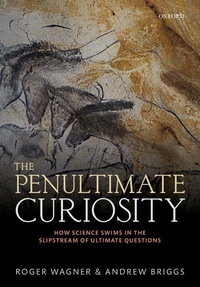
The Penultimate Curiosity
How Science Swims in the Slipstream of Ultimate Questions
Published on 17. April 2019
Book
Paperback/Softback
496 pages
978-0-19-883928-6 (ISBN)
Description
When young children first begin to ask 'why?' they embark on a journey with no final destination. The need to make sense of the world as a whole is an ultimate curiosity that lies at the root of all human religions. It has, in many cultures, shaped and motivated a more down to earth scientific interest in the physical world, which could therefore be described as penultimate curiosity.
These two manifestations of curiosity have a history of connection that goes back deep into the human past. Tracing that history all the way from cave painting to quantum physics, this book (a collaboration between a painter and a physical scientist that uses illustrations throughout the narrative) sets out to explain the nature of the long entanglement between religion and science: the ultimate and the penultimate curiosity.
These two manifestations of curiosity have a history of connection that goes back deep into the human past. Tracing that history all the way from cave painting to quantum physics, this book (a collaboration between a painter and a physical scientist that uses illustrations throughout the narrative) sets out to explain the nature of the long entanglement between religion and science: the ultimate and the penultimate curiosity.
Reviews / Votes
This book offers a fascinating perspective on the perennial human quest for understanding and meaning. Its two distinguished authors - with contrasting backgrounds - have meshed their expertise together to create a thought-provoking and original synthesis. * Sir Martin Rees, University of Cambridge, UK * Our species should be called Homo spiritualis rather than sapiens. Asking "Why?" about the world gave rise to Religion, Philosophy, and Science. The interactions and entanglements are outlined in this book of amazing scope and interest. * Jean Clottes, Senior Scientist of the Chauvet Cave * The achievements of science are breathtaking. At times so breathtaking that they cause us to lose perspective on the wonderful created world of which we, the most 'curious' of animals, are a part. This book is a remarkable achievement in that whilst reaching from prehistory, through ancient Greece to the present day, it draws upon the distinctive intellectual resources of a distinguished artist and art historian and a researcher at the cutting-edge of contemporary science. The resulting, beautifully illustrated volume, is a feast of interdisciplinary thinking at its best. It raises profound questions, The Penultimate Curiosity, posed for millennia by philosophers, religious people and more recently scientists, and points to constructive answers. * Malcolm Jeeves, St Andrews University, UK * Evidence-based scientific rationality is very good at finding answers to the how questions. How did the Universe evolve from the Big Bang? How does matter arrange itself into objects ranging from atomic nuclei to human beings, planets and stars? But when it comes to the why questions, science does not necessarirly have the answers. Instead of putting science and religion in opposition to each other, we should therefore be asking if dialogue can exist between the two, whether they can respect each other and accept each other's points of view. In the Penultimate Curiosity, Andew Briggs and Roger Wagner demonstrate that it is not only possible, but also enriching to follow such a course. * Rolf Heuer, Director General, CERN *More details
Language
English
Place of publication
Oxford
United Kingdom
Target group
College/higher education
Illustrations
190 illustrations
Dimensions
Height: 244 mm
Width: 170 mm
Thickness: 27 mm
Weight
848 gr
ISBN-13
978-0-19-883928-6 (9780198839286)
Copyright in bibliographic data and cover images is held by Nielsen Book Services Limited or by the publishers or by their respective licensors: all rights reserved.
Schweitzer Classification
Other editions
Additional editions
Roger Wagner | Andrew Briggs
The Penultimate Curiosity
How Science Swims in the Slipstream of Ultimate Questions
Book
02/2016
Oxford University Press
€49.00
Shipment within 15-20 days
Persons
Roger Wagner has been described by Charles Moore as the "best religious painter in Britain today". He gained first class honours in English Literature at Oxford, and then studied for three years at the Royal Academy before returning to live in Oxford and paint full time. Both The Ashmolean Museum at Oxford and The Fitzwilliam Museum at Cambridge have his work in their permanent collections. He has produced several books of illustrated poems and translations of the Psalms. Since 2010 he has taught at the Ruskin School of Art. A book about his work Forms of Transcendence The Art of Roger Wagner by Chris Miller was published in 2009. His 2012 Gresham College lecture was published on the web http://www.youtube.com/watch?v=uMb8rIQbTGc. His new stained glass window was installed in St Mary's Iffley in 2012. He was commissioned to paint the first portrait of Justin Welby as Archbishop of Canterbury, which in 2014 was hung in Auckland Castle.
Andrew Briggs was elected in 2002 as the first holder of the newly created Chair in Nanomaterials at the University of Oxford. After studying physics at Oxford he gained a PhD at the Cavendish Laboratory in Cambridge, where the inscription from the Psalms was placed over the entrance of the new laboratory at his initiative. He then studied for a degree in Theology at Cambridge, winning the Chase Prize for Greek, before returning to Oxford in 1980 to pursue an academic career in science. In what is now the Department of Materials he has been successively Royal Society Research Fellow, University Lecturer, Reader, and Professor. His scientific research focuses on materials and techniques for quantum technologies, in which non-classical superposition and entanglement are harnessed for future applications such as computers and information processors. Simultaneously his experiments also probe foundational questions such as the nature of reality in the context of quantum theory.
Andrew Briggs was elected in 2002 as the first holder of the newly created Chair in Nanomaterials at the University of Oxford. After studying physics at Oxford he gained a PhD at the Cavendish Laboratory in Cambridge, where the inscription from the Psalms was placed over the entrance of the new laboratory at his initiative. He then studied for a degree in Theology at Cambridge, winning the Chase Prize for Greek, before returning to Oxford in 1980 to pursue an academic career in science. In what is now the Department of Materials he has been successively Royal Society Research Fellow, University Lecturer, Reader, and Professor. His scientific research focuses on materials and techniques for quantum technologies, in which non-classical superposition and entanglement are harnessed for future applications such as computers and information processors. Simultaneously his experiments also probe foundational questions such as the nature of reality in the context of quantum theory.
Content
PART I: In the Beginning I
1: The First Men
2: Tentasali
3: Watauinawa
4: The Garden of Eden Moment
5: Primate Parallels
6: Horizons of Curiosity
7: Ultimate Curiosity
PART II: God Driven Science
8: The Lions of Miletus
9: The Move to Athens
10: Through the Academy Door
PART III: Encounters in Alexandria
11: Two Students
12: The Divided City
13: Industrious Jack
14: The Creation of the World
PART IV: The Long Argument
15: The Dream of Aristotle
16: Al Ghazali's Pilgrimmage
17: A Tale of Two Cities
18: Imposed Silence
19: Experimental Science
20: The Universal Law
PART V: The Open Book of Heaven
21: Against Aristotle
22: Free Philosophising
23: The Freedom of Intellect
24: Simplicius Reborn
25: The Creation
PART VI: Priests of Nature
26: A New Era
27: A Lutheran Astrologer
28: The Experimental Philosophy
29: The Oxonian Sparkles
PART VII: The Ocean of Truth
30: Le Grand Newton
31: The Beautiful System
32: Mathematical Theologies
33: The Coast of Infinity
PART VIII: Voyages of Discovery
34: Two Journeys
35: The Mystery of Mysteries
36: The Creed of Science
PART IX: In the Beginning II
37: The Literary Inquest
38: Breaking the Seals
39: The Intellectual Picklock
40: In a Strange Land
41: By the waters of Babylon
42: Adan and Adapa
43: Ariadne's Thread
PART X: Through the Laboratory Door
44: Science in a Time of Cholera
45: A Visit to the Museum
46: Experiments of Thought
47: The Unity of Nature
48: The Works of the Lord
PART XI: Epilogue
1: The First Men
2: Tentasali
3: Watauinawa
4: The Garden of Eden Moment
5: Primate Parallels
6: Horizons of Curiosity
7: Ultimate Curiosity
PART II: God Driven Science
8: The Lions of Miletus
9: The Move to Athens
10: Through the Academy Door
PART III: Encounters in Alexandria
11: Two Students
12: The Divided City
13: Industrious Jack
14: The Creation of the World
PART IV: The Long Argument
15: The Dream of Aristotle
16: Al Ghazali's Pilgrimmage
17: A Tale of Two Cities
18: Imposed Silence
19: Experimental Science
20: The Universal Law
PART V: The Open Book of Heaven
21: Against Aristotle
22: Free Philosophising
23: The Freedom of Intellect
24: Simplicius Reborn
25: The Creation
PART VI: Priests of Nature
26: A New Era
27: A Lutheran Astrologer
28: The Experimental Philosophy
29: The Oxonian Sparkles
PART VII: The Ocean of Truth
30: Le Grand Newton
31: The Beautiful System
32: Mathematical Theologies
33: The Coast of Infinity
PART VIII: Voyages of Discovery
34: Two Journeys
35: The Mystery of Mysteries
36: The Creed of Science
PART IX: In the Beginning II
37: The Literary Inquest
38: Breaking the Seals
39: The Intellectual Picklock
40: In a Strange Land
41: By the waters of Babylon
42: Adan and Adapa
43: Ariadne's Thread
PART X: Through the Laboratory Door
44: Science in a Time of Cholera
45: A Visit to the Museum
46: Experiments of Thought
47: The Unity of Nature
48: The Works of the Lord
PART XI: Epilogue