

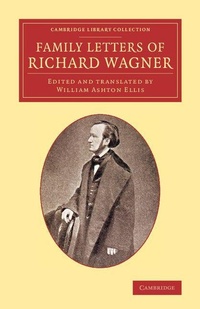
Family Letters of Richard Wagner
Published on 13. November 2014
Book
Paperback/Softback
328 pages
978-1-108-07860-3 (ISBN)
Description
William Ashton Ellis (1852-1919) abandoned his medical career in order to devote himself to his Wagner studies. Best known for his translations of Wagner's prose works and of Carl Friedrich Glasenapp's multi-volume biography of the composer, Ellis published in 1911 this English translation of Wagner's Familienbriefe, spanning the years 1832-74. An inveterate letter writer, Wagner was the youngest-but-one of ten children and Ellis describes the character of these letters to his sisters, his mother, his brother-in-law and his nieces as a reflection of the composer in the 'driest and most neutral of lights', claiming that within the family it is impossible to be pretentious. An appendix by Glasenapp, giving brief biographical details of family members, is also included. Despite the stylistic idiosyncrasies of the translations, these letters remain of importance, capturing something of the tone of Wagner's prose style and shedding light on his extraordinary life.
More details
Series
Language
English
Place of publication
Cambridge
United Kingdom
Target group
Professional and scholarly
Product notice
Paperback (trade)
Dimensions
Height: 216 mm
Width: 140 mm
Thickness: 19 mm
Weight
464 gr
ISBN-13
978-1-108-07860-3 (9781108078603)
Copyright in bibliographic data and cover images is held by Nielsen Book Services Limited or by the publishers or by their respective licensors: all rights reserved.
Schweitzer Classification
Persons
Richard Wagner was a German composer and conductor of the 19th century. He was born in Leipzig in 1813 and began studying music at a young age. He later moved to Dresden, where he worked as a conductor and composer. Wagner is best known for his operas, which include Tristan and Isolde, The Ring of the Nibelung, and Parsifal. He was a controversial figure during his lifetime due to his unorthodox views on music and his involvement in revolutionary politics. Wagner was also a prolific writer and commentator on music, art, and politics. In addition to his autobiography, My Life, he wrote several essays on music theory and aesthetics. He is credited with developing the concept of Gesamtkunstwerk, or "total artwork," which incorporates music, drama, and visual elements into a unified whole.
Content
Translator's preface; Letters 1-124; Appendix; Index.