

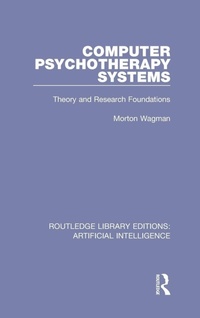
Computer Psychotherapy Systems
Theory and Research Foundations
1st Edition
Published on 14. May 2018
Book
Hardback
282 pages
978-1-138-48040-7 (ISBN)
Description
Originally published in 1988, this was the first book to examine the development, application and evaluation of computer counselling and psychotherapy. Integrating concepts of artificial intelligence and psychotherapy, this book provided extensive research data that compared the human therapist to the computer therapist at the time.
This title was intended for researchers, professionals, and students of psychotherapy and artificial intelligence. By exploring the automation of therapy and the design of empathetic software this book challenges counsellors and computer scientists to look at what may have been the most fascinating topic to arise in their fields for years to come.
This title was intended for researchers, professionals, and students of psychotherapy and artificial intelligence. By exploring the automation of therapy and the design of empathetic software this book challenges counsellors and computer scientists to look at what may have been the most fascinating topic to arise in their fields for years to come.
More details
Series
Language
English
Place of publication
London
United Kingdom
Publishing group
Taylor & Francis Ltd
Target group
College/higher education
Professional and scholarly
Dimensions
Height: 235 mm
Width: 157 mm
Thickness: 20 mm
Weight
563 gr
ISBN-13
978-1-138-48040-7 (9781138480407)
Copyright in bibliographic data and cover images is held by Nielsen Book Services Limited or by the publishers or by their respective licensors: all rights reserved.
Schweitzer Classification
Other editions
Additional editions
Book
05/2020
1st Edition
Routledge
€53.40
Shipment within 10-20 days
E-Book
05/2018
1st Edition
Routledge
€45.99
Available for download
E-Book
05/2018
1st Edition
Routledge
€45.99
Available for download
Person
Morton Wagman
Content
List of Tables and Figures. Preface. Acknowledgements. Part 1: Introduction 1. Orienting Concepts 2. Theoretical Complexities 3. Pragmatic Considerations 4. Ethical Perspectives Part 2: Artificial Intelligence Research 5. Understanding Natural Language 6. The Representation of Knowledge 7. Expert Consultative and Tutorial Systems Part 3: Computer Counseling 8. Computer Models of Personality 9. Examples of Computer Counseling 10. PLATO DCS: An Expert Computer System for Personal Counseling 11. PLATO DCS: Further Development and Evaluation 12. Experimental Comparison of the PLATO DCS Expert System and Human Counselors as Methods of Psychological Counseling 13. Conclusion: Problems and Prospects of Computer Counseling. Appendix. Glossary. Bibliography. Author Index. Subject Index. About the Author.