

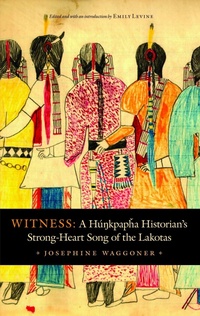
Witness
A Hunkpapha Historian's Strong-Heart Song of the Lakotas
Published on 1. November 2013
Book
Hardback
824 pages
978-0-8032-4564-8 (ISBN)
Description
Winner of the 2015 J. Franklin Jameson Award
Winner of the 2014 Dwight L. Smith (ABC-CLIO) Award
Winner of the 2014 Nebraska Book Award in Nonfiction/Reference
During the 1920s and 1930s, Josephine Waggoner (1871-1943), a Lakota woman who had been educated at Hampton Normal and Agricultural Institute in Virginia, grew increasingly concerned that the history and culture of her people were being lost as elders died without passing along their knowledge. A skilled writer, Waggoner set out to record the lifeways of her people and correct much of the misinformation about them spread by white writers, journalists, and scholars of the day. To accomplish this task, she traveled to several Lakota and Dakota reservations to interview chiefs, elders, traditional tribal historians, and other tribal members, including women.
Published for the first time and augmented by extensive annotations, Witness offers a rare participant's perspective on nineteenth- and early twentieth-century Lakota and Dakota life. The first of Waggoner's two manuscripts presented here includes extraordinary firsthand and as-told-to historical stories by tribal members, such as accounts of life in the Powder River camps and at the agencies in the 1870s, the experiences of a mixed-blood HU?kpap?a girl at the first off-reservation boarding school, and descriptions of traditional beliefs. The second manuscript consists of Waggoner's sixty biographies of Lakota and Dakota chiefs and headmen based on eyewitness accounts and interviews with the men themselves. Together these singular manuscripts provide new and extensive information on the history, culture, and experiences of the Lakota and Dakota peoples.
Winner of the 2014 Dwight L. Smith (ABC-CLIO) Award
Winner of the 2014 Nebraska Book Award in Nonfiction/Reference
During the 1920s and 1930s, Josephine Waggoner (1871-1943), a Lakota woman who had been educated at Hampton Normal and Agricultural Institute in Virginia, grew increasingly concerned that the history and culture of her people were being lost as elders died without passing along their knowledge. A skilled writer, Waggoner set out to record the lifeways of her people and correct much of the misinformation about them spread by white writers, journalists, and scholars of the day. To accomplish this task, she traveled to several Lakota and Dakota reservations to interview chiefs, elders, traditional tribal historians, and other tribal members, including women.
Published for the first time and augmented by extensive annotations, Witness offers a rare participant's perspective on nineteenth- and early twentieth-century Lakota and Dakota life. The first of Waggoner's two manuscripts presented here includes extraordinary firsthand and as-told-to historical stories by tribal members, such as accounts of life in the Powder River camps and at the agencies in the 1870s, the experiences of a mixed-blood HU?kpap?a girl at the first off-reservation boarding school, and descriptions of traditional beliefs. The second manuscript consists of Waggoner's sixty biographies of Lakota and Dakota chiefs and headmen based on eyewitness accounts and interviews with the men themselves. Together these singular manuscripts provide new and extensive information on the history, culture, and experiences of the Lakota and Dakota peoples.
Reviews / Votes
"A book written from a Native person's point of view provides a rare-and therefore much needed-narrative about American society's impact on indigenous peoples."-Edward Valandra, Great Plains Quarterly "This is an unprecedented addition to the field of Dakota/Lakota scholarship."-Shannon D. Smith, Nebraska History "Emily Levine has amassed an essential text for all students, professors, scholars, and general readers interested in the history, culture, and traditions of the Oceti Sakowin Oyate, the Seven Council Fires of the Lakota, Dakota, and Nakota Nations."-Brian J. Twenter, Studies in American Indian Literatures "This book is a pleasure to open and explore."-Bill Markley, Roundup Magazine "In this sensitively edited and translated volume, Emily Levine performs a work of recovery mirroring that of Lakota amateur historian Josephine Waggoner (d. 1943) herself: distilling for scholars a disciplined but wide-ranging gathering of historical materials that might otherwise have been forever lost. The list of archives consulted is impressive, and the attention to Lakota expression and Waggoner's intention extremely conscientious. Well illustrated and annotated, it is a major editorial achievement."-American Historical Association "Josephine Waggoner's writings offer a unique perspective on the Lakota. Witness will become a widely referenced primary source. Emily Levine has meticulously examined all known collections of Waggoner's manuscripts, sometimes comparing handwritten drafts with multiple typed copies to preserve information in full. Levine's extensive notes are well chosen and informative. Witness will interest both specialist and popular audiences."-Raymond J. DeMallie, Chancellors' Professor of Anthropology and American Indian Studies at Indiana UniversityMore details
Language
English
Place of publication
Lincoln
United States
Target group
Professional and scholarly
Product notice
Cloth over boards
Illustrations
26 color illustrations, 115 b&w photographs, 15 b&w illustrations, 1 genealogy, 10 maps, 1 table, 7 appendixes, index
Dimensions
Height: 287 mm
Width: 187 mm
Thickness: 68 mm
Weight
2149 gr
ISBN-13
978-0-8032-4564-8 (9780803245648)
Copyright in bibliographic data and cover images is held by Nielsen Book Services Limited or by the publishers or by their respective licensors: all rights reserved.
Schweitzer Classification
Persons
Emily Levine is an independent scholar and the editor of With My Own Eyes: A Lakota Woman Tells Her People's History, by Susan Bordeaux Bettelyoun and Josephine Waggoner, available in a Bison Books edition.
Content
List of IllustrationsForeword by Lynne AllenAcknowledgmentsEditor's Introduction by Emily LevineEditorial PolicyLakota Phonology and PronunciationJosephine Waggoner's Family Tree Ethnography, History, Her Story Introduction by Josephine WaggonerLife SketchPart 1. Dakota/Lakota Ethnography, Culture, and Society1. Creation as told by MakhUla2. The Origin of Fire by MakhUla3. MakhUla's Dream4. Sioux Legends and Traditions and Their Origins5. Ancient Legends of the Sioux6. The Arrow Makers7. Dakota and Lakota OyAte Band Organization8. Some Cultural Miscellany9. Language10. Meaning of Names11. Some Dakota Geography12. Buffalo Hunt13. The White BuffaloPart 2. Tribal History/Her Life14. The Cramping Death15. The Mackinaw (Mackinac) Attack Near Burnt Wood Creek (Cha?gUyapi)16. The Grattan Massacre17. Fort Laramie and Horse Creek, 186518. The Wagon Box Fight19. Early Life: Grand River--Apple Creek--Standing Rock, c. 1870-7520. West to Powder River, 187521. Standing Rock, Winter 1875-7622. T?ahA?skA T?A?ka, John Bruguier23. Standing Rock and Montana, 1876-7824. The Surrender25. Life on the Reservation26. Hampton Normal and Agricultural Institute, 1881-8827. Hampton and Back to Standing Rock: Working with Missionaries, 1888-8928. After Sitting Bull's Death: Wounded Knee, 1890-9129. Stock Rustling on the Reservation30. Married Life Lives of the Chiefs and Other Biographies Acknowledgments by Josephine WaggonerPart 1. IsA?yathi, Santee Dakota1. TAmahe, the One-Eyed Sioux2. IStA?ba, Sleepy Eye3. I?kpadUta, Scarlet Point4. T?aoyAtedUta, Little Crow5. Thiwak?A?, Holy HousePart 2. IhA?kt?u?wa?/IhA?kt?u?wa?na, Yankton/Yanktonai6. P?alAniyap?Api, Struck by the Ree7. T?at?A?kap?a, Bull Head Sr.8. NasUnat?A?ka, Big Head9. Mat?O GnaSkI?ya?, Mad Bear10. Cha??pIlUta, Red Tomahawk11. T?at?A?kap?a, Lieutenant Henry Bull Head Jr.Part 3. ThIt?u?wa?, Teton LakotaSection 1. SihAsapa, Blackfeet12. WakutemAni, Shoots Walking13. Mat?O Wat?Akpe, John Grass14. Cha?tehi, Goose15. Cha?tE P?Eta, Fire HeartSection 2. OOhenu?pa, Two Kettle16. Mat?O ThuchUhu, Bear Ribs17. MiwAtani HA?ska, Tall Mandan18. Zi?tkAlaki?yA?, Swift Bird19. Mat?O TOpa, Four Bear20. SU?gleSkAsApa, Black Spotted HorseSection 3. ItAzipcho, Sans Arc21. WaAnata?, Charger22. K?a?gI WIyaka, Crow Feather23. HEwa?zIca, One Horn24. Wa?blIgleSkA, Spotted EagleSection 4. Mnik?Owozu, Miniconjou25. MagAska, White Swan II26. T?A?cahuStE, Lame Deer27. U?p?AngleSkA, Spotted Elk (Big Foot)28. Cha??A?ake, Hump29. MagAska, White Swan IV30. Mat?O CIk'ala, Little Bear31. Ki?yA? HiyAya, Flying By32. T?aSU?kezi, Yellow Horse33. MaStI?calagleSkA, Spotted RabbitSection 5. HU?kpap?a, Hunkpapa34. T?at?Oka I?ya?ke, Running Antelope35. WichA?pi MAza, Iron Star36. Mat?O ItE, Bear Face37. T?at?A?ka Iyotake, Sitting Bull38. ChetA? WakI?ya?, Thunder Hawk39. PhizI, Gall40. T?at?A?ka HEgleSkA, Spotted Horn Bull41. HohU Cha??pI, Bone Club42. Mat?O OcI?SIca, Cross Bear43. ItU?kasa? Mat?O, Weasel Bear44. ItEomagAzu, Rain in the Face45. Wa?blI?Ota, Gray Eagle46. HeyOk?ahmi, Real BuffaloSection 6. OglAla, Oglala47. Ma?pIyalUta, Red Cloud48. T?aSU?ke K?okIp?api, They Are Afraid of His Horses49. T?aOpicIk'ala, Little Wound50. WaSIcu T?aSU?ke, American Horse II51. T?aSU?ke WitkO, Crazy HorseSection 7. SichA?gu, BrulE52. ThukImAza, Iron Shell53. Mat?O O?'A?k?o, Swift Bear54. NU?pa Kap?A, Two Strikes55. Si?tE GleSkA, Spotted Tail56. SU?ka BlokA, He Dog57. Mat?O KawI?ge, Turning Bear58. WaglEkSu? T?A?ka, Big Turkey59. Mat?OhE?logeca, Hollow Horn Bear60. T?aSU?ke Wa?kAtuya, High Horse Afterword: History of the Manuscripts Appendix 1: The Chiefs Who Fought and SurrenderedAppendix 2: The Keepers of the Peace Pipe Since Brought by the Buffalo MaidenAppendix 3: Police at Sitting Bull FightAppendix 4: Josephine Waggoner's BibliographyAppendix 5: Winter CountsAppendix 6: PoemsAppendix 7: Lakota Land DispossessionNotesBibliographyIndex