

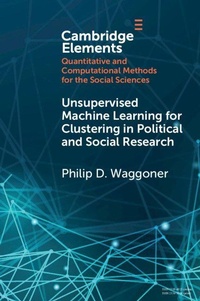
Unsupervised Machine Learning for Clustering in Political and Social Research
Published on 28. January 2021
Book
Paperback/Softback
70 pages
978-1-108-79338-4 (ISBN)
Description
In the age of data-driven problem-solving, applying sophisticated computational tools for explaining substantive phenomena is a valuable skill. Yet, application of methods assumes an understanding of the data, structure, and patterns that influence the broader research program. This Element offers researchers and teachers an introduction to clustering, which is a prominent class of unsupervised machine learning for exploring and understanding latent, non-random structure in data. A suite of widely used clustering techniques is covered in this Element, in addition to R code and real data to facilitate interaction with the concepts. Upon setting the stage for clustering, the following algorithms are detailed: agglomerative hierarchical clustering, k-means clustering, Gaussian mixture models, and at a higher-level, fuzzy C-means clustering, DBSCAN, and partitioning around medoids (k-medoids) clustering.
More details
Series
Language
English
Place of publication
Cambridge
United Kingdom
Product notice
Paperback (trade)
Illustrations
Worked examples or Exercises
Dimensions
Height: 229 mm
Width: 152 mm
Thickness: 4 mm
Weight
104 gr
ISBN-13
978-1-108-79338-4 (9781108793384)
Copyright in bibliographic data and cover images is held by Nielsen Book Services Limited or by the publishers or by their respective licensors: all rights reserved.
Schweitzer Classification
Other editions
Additional editions
E-Book
01/2021
Cambridge University Press
€15.49
Available for download
Person
Content
1. Introduction; 2. Setting the stage for clustering; 3. Agglomerative hierarchical clustering; 4. k-means clustering; 5. Gaussian mixture models; 6. Advanced methods; 7. Conclusion.