

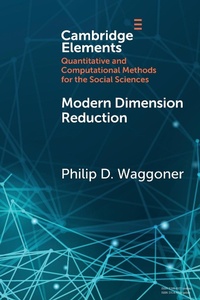
Modern Dimension Reduction
Published on 5. August 2021
Book
Paperback/Softback
98 pages
978-1-108-98689-2 (ISBN)
Description
Data are not only ubiquitous in society, but are increasingly complex both in size and dimensionality. Dimension reduction offers researchers and scholars the ability to make such complex, high dimensional data spaces simpler and more manageable. This Element offers readers a suite of modern unsupervised dimension reduction techniques along with hundreds of lines of R code, to efficiently represent the original high dimensional data space in a simplified, lower dimensional subspace. Launching from the earliest dimension reduction technique principal components analysis and using real social science data, I introduce and walk readers through application of the following techniques: locally linear embedding, t-distributed stochastic neighbor embedding (t-SNE), uniform manifold approximation and projection, self-organizing maps, and deep autoencoders. The result is a well-stocked toolbox of unsupervised algorithms for tackling the complexities of high dimensional data so common in modern society. All code is publicly accessible on Github.
More details
Series
Language
English
Place of publication
Cambridge
United Kingdom
Target group
Professional and scholarly
College/higher education
Product notice
Paperback (trade)
Illustrations
Worked examples or Exercises
Dimensions
Height: 229 mm
Width: 152 mm
Thickness: 6 mm
Weight
156 gr
ISBN-13
978-1-108-98689-2 (9781108986892)
Copyright in bibliographic data and cover images is held by Nielsen Book Services Limited or by the publishers or by their respective licensors: all rights reserved.
Schweitzer Classification
Other editions
Additional editions
Philip D. Waggoner
Modern Dimension Reduction
E-Book
08/2021
Cambridge University Press
€15.49
Available for download
Person
Content
1. Introduction; 2. A Classic Approach to Dimension Reduction; 3. Locally Linear Embedding; 4. Nonlinear Dimension Reduction for Visualization; 5. Neural Network-Based Approaches; 6. Final Thoughts on Dimension Reduction.