

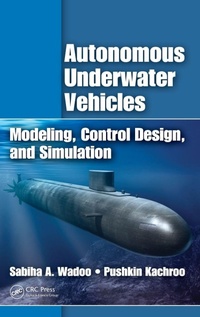
Autonomous Underwater Vehicles
Modeling, Control Design and Simulation
1st Edition
Published on 3. December 2010
Book
Hardback
165 pages
978-1-4398-1831-2 (ISBN)
Description
Underwater vehicles present some difficult and very particular control system design problems. These are often the result of nonlinear dynamics and uncertain models, as well as the presence of sometimes unforeseeable environmental disturbances that are difficult to measure or estimate.
Autonomous Underwater Vehicles: Modeling, Control Design, and Simulation outlines a novel approach to help readers develop models to simulate feedback controllers for motion planning and design. The book combines useful information on both kinematic and dynamic nonlinear feedback control models, providing simulation results and other essential information, giving readers a truly unique and all-encompassing new perspective on design.
Includes MATLAB (R) Simulations to Illustrate Concepts and Enhance Understanding
Starting with an introductory overview, the book offers examples of underwater vehicle construction, exploring kinematic fundamentals, problem formulation, and controllability, among other key topics. Particularly valuable to researchers is the book's detailed coverage of mathematical analysis as it applies to controllability, motion planning, feedback, modeling, and other concepts involved in nonlinear control design. Throughout, the authors reinforce the implicit goal in underwater vehicle design-to stabilize and make the vehicle follow a trajectory precisely.
Fundamentally nonlinear in nature, the dynamics of AUVs present a difficult control system design problem which cannot be easily accommodated by traditional linear design methodologies. The results presented here can be extended to obtain advanced control strategies and design schemes not only for autonomous underwater vehicles but also for other similar problems in the area of nonlinear control.
Autonomous Underwater Vehicles: Modeling, Control Design, and Simulation outlines a novel approach to help readers develop models to simulate feedback controllers for motion planning and design. The book combines useful information on both kinematic and dynamic nonlinear feedback control models, providing simulation results and other essential information, giving readers a truly unique and all-encompassing new perspective on design.
Includes MATLAB (R) Simulations to Illustrate Concepts and Enhance Understanding
Starting with an introductory overview, the book offers examples of underwater vehicle construction, exploring kinematic fundamentals, problem formulation, and controllability, among other key topics. Particularly valuable to researchers is the book's detailed coverage of mathematical analysis as it applies to controllability, motion planning, feedback, modeling, and other concepts involved in nonlinear control design. Throughout, the authors reinforce the implicit goal in underwater vehicle design-to stabilize and make the vehicle follow a trajectory precisely.
Fundamentally nonlinear in nature, the dynamics of AUVs present a difficult control system design problem which cannot be easily accommodated by traditional linear design methodologies. The results presented here can be extended to obtain advanced control strategies and design schemes not only for autonomous underwater vehicles but also for other similar problems in the area of nonlinear control.
More details
Language
English
Place of publication
Bosa Roca
United States
Publishing group
Taylor & Francis Inc
Target group
College/higher education
Researchers and students in intelligent control of AUVs, advanced control strategists and designers for AUVs; those working with dynamics of control, mechanical design; fluid mechanics, and ocean engineering.
Illustrations
63 s/w Abbildungen
63 Illustrations, black and white
Dimensions
Height: 240 mm
Width: 161 mm
Thickness: 14 mm
Weight
420 gr
ISBN-13
978-1-4398-1831-2 (9781439818312)
Copyright in bibliographic data and cover images is held by Nielsen Book Services Limited or by the publishers or by their respective licensors: all rights reserved.
Schweitzer Classification
Other editions
Additional editions
E-Book
12/2017
CRC Press
€251.99
Available for download
E-Book
12/2017
CRC Press
€251.99
Available for download
Person
Sabiha Wadoo, Ph.D, received a BE degree in electrical engineering from the Regional Engineering College, Kashmir, India, in 2001, and an MS degree in electrical engineering, an MS degree in mathematics, and a Ph.D degree in electrical engineering from Virginia Polytechnic Institute and State University (Virginia Tech), Blacksburg, in 2003, 2005, and 2007, respectively. Since 2007, she has been with the New York Institute of Technology, Old Westbury, New York, where she is an assistant professor with the Department of Electrical and Computer Engineering. Her research interests are in the areas of feedback control of nonlinear control systems, nonlinear control system abstraction, and feedback control of distributed parameter systems.
Pushkin Kachroo, Ph.D, received a BTech degree in civil engineering from the Indian Institute of Technology, Bombay, India, in 1988, an MS degree in mechanical engineering from Rice University, Houston, Texas, in 1990, a Ph.D degree in mechanical engineering from the University of California, Berkeley, in 1993, and MS and Ph.D degrees in mathematics from Virginia Polytechnic Institute and State University (Virginia Tech), Blacksburg, in 2004 and 2007, respectively. He is the director of the Transportation Research Center, Harry Reid Center for Environmental Studies, Las Vegas, Nevada, and a professor with the Department of Electrical and Computer Engineering, University of Nevada, Las Vegas.
Pushkin Kachroo, Ph.D, received a BTech degree in civil engineering from the Indian Institute of Technology, Bombay, India, in 1988, an MS degree in mechanical engineering from Rice University, Houston, Texas, in 1990, a Ph.D degree in mechanical engineering from the University of California, Berkeley, in 1993, and MS and Ph.D degrees in mathematics from Virginia Polytechnic Institute and State University (Virginia Tech), Blacksburg, in 2004 and 2007, respectively. He is the director of the Transportation Research Center, Harry Reid Center for Environmental Studies, Las Vegas, Nevada, and a professor with the Department of Electrical and Computer Engineering, University of Nevada, Las Vegas.
Content
Introduction. Problem Formulation and Examples. Mathematical Modeling and Controllability Analysis. Control Design Using the Kinematic Model. Control Design Using the Dynamic Model. Robust Feedback Control Design.