

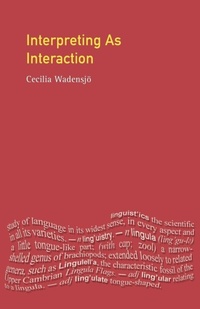
Interpreting As Interaction
1st Edition
Published on 2. October 1998
Book
Paperback/Softback
336 pages
978-0-582-28910-9 (ISBN)
Description
Interpreting in Interaction provides an account of interpreter-mediated communication, exploring the responsibilities of the interpreter and the expectations of both the interpreter and of other participants involved in the interaction. The book examines ways of understanding the distribution of responsibility of content and the progression of talk in interpreter-mediated institutional face-to-face encounters in the community interpreting context.
Bringing attention to discursive and social practices prominent in modern society but largely unexplored in the existing literature, the book describes and explains real-life interpreter-mediated conversations as documented in various public institutions, such as hospitals and police stations. The data show that the interpreter's prescribed role as a non-participating, non-person does not -and cannot - always hold true.
The book convincingly argues that this in one sense exceptional form of communication can be used as a magnifying glass in the grounded study of face-to-face institutional interaction more generally.
Cecilia Wadensjoe explains and applies a Bakhtinian dialogic theory of language and mind, and offers an alternative understanding of the interpreter's task, as one consisting of translating and co-ordinating, and of the interpreter as an engaged actor solving problems of translatability and problems of mutual understanding in situated social interactions.
Teachers and students of translation and interpretation studies, including sign language interpreting, applied linguistics and sociolinguistics will welcome this text. Students and professionals within law, medicine and education will also find the study useful to help them understand the role of the interpreter within these frameworks.
Bringing attention to discursive and social practices prominent in modern society but largely unexplored in the existing literature, the book describes and explains real-life interpreter-mediated conversations as documented in various public institutions, such as hospitals and police stations. The data show that the interpreter's prescribed role as a non-participating, non-person does not -and cannot - always hold true.
The book convincingly argues that this in one sense exceptional form of communication can be used as a magnifying glass in the grounded study of face-to-face institutional interaction more generally.
Cecilia Wadensjoe explains and applies a Bakhtinian dialogic theory of language and mind, and offers an alternative understanding of the interpreter's task, as one consisting of translating and co-ordinating, and of the interpreter as an engaged actor solving problems of translatability and problems of mutual understanding in situated social interactions.
Teachers and students of translation and interpretation studies, including sign language interpreting, applied linguistics and sociolinguistics will welcome this text. Students and professionals within law, medicine and education will also find the study useful to help them understand the role of the interpreter within these frameworks.
More details
Series
Language
English
Place of publication
London
United Kingdom
Publishing group
Taylor & Francis Ltd
Target group
Professional and scholarly
Dimensions
Height: 216 mm
Width: 140 mm
Thickness: 18 mm
Weight
424 gr
ISBN-13
978-0-582-28910-9 (9780582289109)
Copyright in bibliographic data and cover images is held by Nielsen Book Services Limited or by the publishers or by their respective licensors: all rights reserved.
Schweitzer Classification
Other editions
Additional editions
Cecilia Wadensjo
Interpreting As Interaction
Book
04/2016
1st Edition
Routledge
€242.00
Shipment within 10-20 days
Cecilia Wadensjo
Interpreting As Interaction
E-Book
06/2014
1st Edition
Routledge
€69.99
Available for download
Cecilia Wadensjo
Interpreting As Interaction
E-Book
06/2014
1st Edition
Routledge
€69.99
Available for download
Person
Cecilia Wadensjo
Content
General Editor's Preface
Acknowledgements
I. Just an ordinary hearing
1. The themes of this book
2. How this book is organised
II. Talk as text and talk as activity
1. Opposing and interdependent views
2. Translation studies - an inter-discipline
3. In searh for a theory of sense making
4. Monologism, dialogism and studies on interpreting
III. Community interpreting: Going professional
1. Defining community interpreting
2. Education and certification
IV. Interpreters and other intermediaries
1. It takes three to make an intermediary
2. Interpreters in face-to-face interaction
V. Discourse studies - on method and analytical framework
1. Social role - normative, typical and personal standards
2. Collecting data - recording and transcribing
VI. Ideal interpreting in actual performance
1. Textual structures in interpreter-mediated talk
2. "And can you show where?"
3. "She coughs in this way (.) and it is a dry cough"
4. "Just a second"
5. Translating and coordinating - two activities in one
VII. In a communicative pas de trois
1. Exploring interpreter-mediated interaction order
2. "I have to retrain myself"
3. "Say what he says now"
4. "It'll all be hunky-dory"
5. "About four years ago?"
6. Conclusion - challenges and counter measures
VIII. Communication and Miscommunication
1. Problematising 'understanding'
2. "We misunderstood each other..."
3. "Have been divorced"
4. "Me or us?"
5. "You mentioned parasites"
6. "How is this looked upon?"
7. Resource for communication and source of miscommunication
IX. When I say what you mean
1. Problematising 'neutrality'
2. "She says: no, I'm referring to cars"
3. "And they say that..."
4. "Can you ask him to comment"
5. "She goes: yes"
6. "What is this? They say: it's okay"
7. "Would you allow me to add"
8. The analysing aspect of reported speech
X. Bridging gaps and sustaining differences
1. Translating in interpreting - in a dialogical frame
2. Interpreters and professionalism
Bibliography
Index
Acknowledgements
I. Just an ordinary hearing
1. The themes of this book
2. How this book is organised
II. Talk as text and talk as activity
1. Opposing and interdependent views
2. Translation studies - an inter-discipline
3. In searh for a theory of sense making
4. Monologism, dialogism and studies on interpreting
III. Community interpreting: Going professional
1. Defining community interpreting
2. Education and certification
IV. Interpreters and other intermediaries
1. It takes three to make an intermediary
2. Interpreters in face-to-face interaction
V. Discourse studies - on method and analytical framework
1. Social role - normative, typical and personal standards
2. Collecting data - recording and transcribing
VI. Ideal interpreting in actual performance
1. Textual structures in interpreter-mediated talk
2. "And can you show where?"
3. "She coughs in this way (.) and it is a dry cough"
4. "Just a second"
5. Translating and coordinating - two activities in one
VII. In a communicative pas de trois
1. Exploring interpreter-mediated interaction order
2. "I have to retrain myself"
3. "Say what he says now"
4. "It'll all be hunky-dory"
5. "About four years ago?"
6. Conclusion - challenges and counter measures
VIII. Communication and Miscommunication
1. Problematising 'understanding'
2. "We misunderstood each other..."
3. "Have been divorced"
4. "Me or us?"
5. "You mentioned parasites"
6. "How is this looked upon?"
7. Resource for communication and source of miscommunication
IX. When I say what you mean
1. Problematising 'neutrality'
2. "She says: no, I'm referring to cars"
3. "And they say that..."
4. "Can you ask him to comment"
5. "She goes: yes"
6. "What is this? They say: it's okay"
7. "Would you allow me to add"
8. The analysing aspect of reported speech
X. Bridging gaps and sustaining differences
1. Translating in interpreting - in a dialogical frame
2. Interpreters and professionalism
Bibliography
Index