

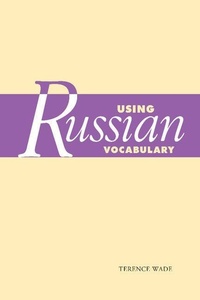
Using Russian Vocabulary
Published on 27. August 2009
Book
Paperback/Softback
636 pages
978-0-521-61236-4 (ISBN)
Description
This book provides the student of Russian with an in-depth, structured approach to the learning of vocabulary. Containing over 5000 words, it can be used for intermediate and advanced undergraduate courses, or as a supplementary manual at all levels - including elementary level - to the study of Russian vocabulary. It is made up of eighteen units covering topics such as the physical world, the human body, leisure, and industry - each unit consisting of words and phrases that are organized thematically and according to levels. Each unit contains approximately sixty graded exercises, encouraging students to practise using the vocabulary in context, and providing a lively and engaging set of self-study tasks. Helping students to acquire a comprehensive control of both concrete and abstract vocabulary, this book will be welcomed by all learners of Russian wishing to improve their competence in essential communicative tasks, and will function as an invaluable teaching resource.
More details
Language
English
Place of publication
Cambridge
United Kingdom
Target group
College/higher education
Professional and scholarly
Product notice
Paperback (trade)
Illustrations
Worked examples or Exercises
Dimensions
Height: 234 mm
Width: 156 mm
Thickness: 34 mm
Weight
951 gr
ISBN-13
978-0-521-61236-4 (9780521612364)
Copyright in bibliographic data and cover images is held by Nielsen Book Services Limited or by the publishers or by their respective licensors: all rights reserved.
Schweitzer Classification
Other editions
Additional editions
Terence Wade
Using Russian Vocabulary
E-Book
11/2009
1st Edition
Cambridge University Press
€52.99
Available for download
Person
Terence Wade (1930-2005) was Professor of Russian and Chairman of the Department of Modern Languages at the University of Strathclyde, Glasgow.
Content
1. Towns and buildings, household, gardens; 2. The physical world; 3. The human body and health; 4. Appearance; 5. Personality and human behaviour; 6. Clothes, footwear and accessories; 7. Perception; 8. Shapes and patterns, size and quantity, containers; 9. Visual and performing arts; 10. Literature and literary criticism; 11. Leisure; 12. Tourism, travel and transport; 13. Family, birth, death and marriage; 14. Education; 15. Agriculture; 16. Business and commerce; 17. The office and computing; 18. Law and finance.