

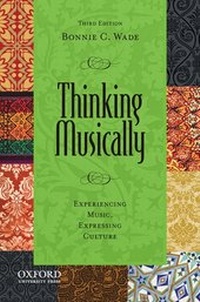
Thinking Musically
Experiencing Music, Expressing Culture
3rd Edition
Published on 14. December 2012
Book
Paperback/Softback
256 pages
978-0-19-984486-9 (ISBN)
Description
As the cornerstone of the Global Music Series, Thinking Musically, Third Edition, explores musical diversity by integrating the sounds and traditions of world cultures. Bonnie C. Wade discusses how various cultural influences-gender, ethnicity, mass media, westernization, nationalism, and acculturation-are shaping music and the ways that we experience it.
WHAT'S NEW TO THE THIRD EDITION?
* Simplified and incorporates recent additions to the Global Music Series
* New charts and diagrams delve into important musical concepts
* Updated companion website includes a new guide to online and print resources, a sample syllabi, and teaching tips
Visit www.oup.com/us/globalmusic for a list of case studies in the Global Music Series. The website also includes instructional material to accompany each study.
WHAT'S NEW TO THE THIRD EDITION?
* Simplified and incorporates recent additions to the Global Music Series
* New charts and diagrams delve into important musical concepts
* Updated companion website includes a new guide to online and print resources, a sample syllabi, and teaching tips
Visit www.oup.com/us/globalmusic for a list of case studies in the Global Music Series. The website also includes instructional material to accompany each study.
Reviews / Votes
"Thinking Musically combines features of a course in musicianship with courses on the introduction to music and music cultures in different parts of the world. There is no other book like this on the market." -Eliot Bates, Cornell University"Thinking Musically will provide students with a strong foundation from which they can shape their own research goals as young scholars."-Ruth Emily Rosenberg, University of Illinois, Chicago "Thinking Musically combines features of a course in musicianship with courses on the introduction to music and music cultures in different parts of the world. There is no other book like this on the market." -Eliot Bates, Cornell University
"Thinking Musically will provide students with a strong foundation from which they can shape their own research goals as young scholars."-Ruth Emily Rosenberg, University of Illinois, Chicago
More details
Series
Edition
Third Edition
Language
English
Place of publication
New York
United States
Target group
College/higher education
Students and scholars of World Music and Ethnomusicology.
Edition type
Revised edition
Dimensions
Height: 210 mm
Width: 142 mm
Thickness: 15 mm
Weight
390 gr
ISBN-13
978-0-19-984486-9 (9780199844869)
Schweitzer Classification
Other editions
Previous edition
Book
11/2008
2nd Edition
Oxford University Press Inc
€27.86
Article exhausted; check for reprint
Person
Bonnie C. Wade is Professor of Music, Chair of the Faculty Group in Asian Studies, and holder of the Richard and Rhoda Goldman Distinguished Chair in Interdisciplinary Studies at the University of California, Berkeley. She has served as President of the Society of Ethnomusicology.
Content
Foreword:
Preface:
CD Track List:
A Note to Readers:
1. Thinking about Music
People
-Music Makers
-Listeners
Music
-In Terms of Sound
-Calling Something "Music"
-Aesthetic Values in Music
Meaning
-Music and Textual Meaning
-Music as Text
Use
Transmission of Musical Knowledge
-Oral and Aural Transmission
-Visual Transmission in the form of notation
2. Thinking about Instruments
Instruments as Objects
-Ideas about Instrument Types
-Ideas about Particular Instruments
--Associations of Sexuality and Gender
--Spiritual Associations
--Cultural Status
--Aesthetic Value
--Item of Technology
--Item of Commodity
--Timbre and Aesthetics of Sound
Instruments in Musical Practice
-Instrumental Capacity
-Ideas about Ensemble
--Heterogeneous and Homogeneous
-- Sound Ideals
--Musical Roles
--Aesthetics of Ensembles
3. Thinking about Time
Rhythm
-Free Rhythm
-Rhythm for the Text Alone
--From free rhythm to relatively more organized time
-Pulse/Beat
Organizing Time into Units
--At the lever of a Single Beat
--Metric Structures with Flexible Means of Articulation
--Duple and Triple Meters
--Some Other Meters
--South Indian T?la
--Metric Structures with Given Means of Articulation
--Southeast Asian Colotomic Meter
--North Indian T?la
--Middle Eastern Rhythmic Modes
--Rhythmic Groupings
--Korean Changdan
--Polyrhythm
Speed
4. Thinking about Pitch
Pitch
-Pitch Names
--Syllables
--Numbers
--Letters
Setting the Pitch
-Who Sets the Pitch
-Pitch Placement
Pitches in Succession
-Intervals
--Naming Intervals
--Microtones
-Scale
--The Chromatic Scale
--Diatonic Scales
--The "Oriental" Scale
-Number of Pitches in an Octave
-Pitch Functions
-Melodic Mode
Simultaneous Pitches
-Naming "Vertical" Intervals
-Dissonance and Consonance
-Western Functional Harmony
-Tone Clusters
Interplay Among Melodic and Harmonic Parts
-Performing One Melody
--Solo and in Unison
--Interlocking Parts
--Rounds
--Heterophony
-Performing One Melody with Another Part
--Melody and Drone
--Melody and Chords
-Performing Multiple Melodies
--Polyphony
--Melody and Ostinato
5. Thinking about Structuring
Improvising and Composing
-Persons Who Compose
Putting Something Significant First
-Sonata Form
-North Indian Instrumental Form
Coming to an End
Telling the Story
-Music for the Moment
-Through-composed Music
-Contrasting Instrumentation
-Strophic Form
Responding to the Context
-Audience-Performer Interaction
-Intra-ensemble Interaction
-Music and Movement
Social Values
6. Thinking Critically about Issues
Encounters and Identities
-A Focus on Influences
-A Focus on Boundaries
--The National Community
--Regional Identity
--Gender
--Multiple Identities
Authenticity
Transcending Boundaries
-The Mass Media
-Globalization
-The Local
7. Thinking about Fieldwork
Picking a Project
Planning the Project
Doing the Project
Finishing the Project
Glossary of Musical Terms:
References:
Index:
Preface:
CD Track List:
A Note to Readers:
1. Thinking about Music
People
-Music Makers
-Listeners
Music
-In Terms of Sound
-Calling Something "Music"
-Aesthetic Values in Music
Meaning
-Music and Textual Meaning
-Music as Text
Use
Transmission of Musical Knowledge
-Oral and Aural Transmission
-Visual Transmission in the form of notation
2. Thinking about Instruments
Instruments as Objects
-Ideas about Instrument Types
-Ideas about Particular Instruments
--Associations of Sexuality and Gender
--Spiritual Associations
--Cultural Status
--Aesthetic Value
--Item of Technology
--Item of Commodity
--Timbre and Aesthetics of Sound
Instruments in Musical Practice
-Instrumental Capacity
-Ideas about Ensemble
--Heterogeneous and Homogeneous
-- Sound Ideals
--Musical Roles
--Aesthetics of Ensembles
3. Thinking about Time
Rhythm
-Free Rhythm
-Rhythm for the Text Alone
--From free rhythm to relatively more organized time
-Pulse/Beat
Organizing Time into Units
--At the lever of a Single Beat
--Metric Structures with Flexible Means of Articulation
--Duple and Triple Meters
--Some Other Meters
--South Indian T?la
--Metric Structures with Given Means of Articulation
--Southeast Asian Colotomic Meter
--North Indian T?la
--Middle Eastern Rhythmic Modes
--Rhythmic Groupings
--Korean Changdan
--Polyrhythm
Speed
4. Thinking about Pitch
Pitch
-Pitch Names
--Syllables
--Numbers
--Letters
Setting the Pitch
-Who Sets the Pitch
-Pitch Placement
Pitches in Succession
-Intervals
--Naming Intervals
--Microtones
-Scale
--The Chromatic Scale
--Diatonic Scales
--The "Oriental" Scale
-Number of Pitches in an Octave
-Pitch Functions
-Melodic Mode
Simultaneous Pitches
-Naming "Vertical" Intervals
-Dissonance and Consonance
-Western Functional Harmony
-Tone Clusters
Interplay Among Melodic and Harmonic Parts
-Performing One Melody
--Solo and in Unison
--Interlocking Parts
--Rounds
--Heterophony
-Performing One Melody with Another Part
--Melody and Drone
--Melody and Chords
-Performing Multiple Melodies
--Polyphony
--Melody and Ostinato
5. Thinking about Structuring
Improvising and Composing
-Persons Who Compose
Putting Something Significant First
-Sonata Form
-North Indian Instrumental Form
Coming to an End
Telling the Story
-Music for the Moment
-Through-composed Music
-Contrasting Instrumentation
-Strophic Form
Responding to the Context
-Audience-Performer Interaction
-Intra-ensemble Interaction
-Music and Movement
Social Values
6. Thinking Critically about Issues
Encounters and Identities
-A Focus on Influences
-A Focus on Boundaries
--The National Community
--Regional Identity
--Gender
--Multiple Identities
Authenticity
Transcending Boundaries
-The Mass Media
-Globalization
-The Local
7. Thinking about Fieldwork
Picking a Project
Planning the Project
Doing the Project
Finishing the Project
Glossary of Musical Terms:
References:
Index: