

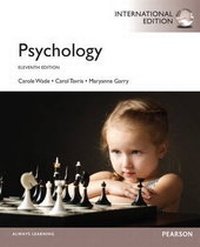
Psychology, plus MyPsychLab with Pearson eText
11th Edition
Published on 16. August 2013
Book
Mixed media product
978-1-4479-5361-6 (ISBN)
Description
This package includes a physical copy of Psychology, eleventh edition by Carole Wade, Carol Tavris and Maryanne Garry, as well as access to the eText and MyPsychLab. Your instructor will need to provide you with a course ID in order for you to access the eText and MyPsychLab.
Emphasizes the importance of critical thinking and the integration of culture and gender in the science of psychology.
A comprehensive introduction to the field, Psychology, 11/e emphasizes the importance of critical thinking skills crucial to students' success in college and later in life. Written with liveliness, warmth, and clarity, the updated edition continues its tradition of integrating gender, culture, and ethnicity throughout the text.
MyPsychLab is an integral part of the Wade / Tavris / Garry program. Key learning applications include writing assessment, MyPsychLab video series, and simulations.
MyPsychLab is an integral part of the Lilienfeld / Lynn / Namy / Woolf program. Key learning applications include writing assessment, MyPsychLab video series, and simulations.
MyLab and Mastering from Pearson improve results for students and educators. Used by over ten million students around the world, they engage learners effectively at every stage.
MyPsychLab delivers proven results in helping individual students succeed in their studies. It provides engaging experiences that personalise their learning and cement their understanding of topics covered in the lecture theatre. And, it comes from a trusted partner with educational expertise and a deep commitment to providing the best content and learning tools that help students, instructors and departments to achieve their goals.
In a survey of over 700 students, more than 85% recommended MyPsychLab's continued use.
For students
The Pearson eText lets students access their textbook anytime, anywhere, and any way they want - including downloading to iPad.
A personalised study plan arranges content around the key steps of learning, from remembering and understanding core concepts, to more complex tasks that encourage deeper analysis and greater critical thinking.
Multimedia resources, including videos and simulations tied to every chapter, encourage students to interact with what they're learning and practise in a more enjoyable way.
For educators
Online assignments, tests, quizzes can be easily created and assigned to students.
An assignment calendar allows instructors to assign graded activities, with specific deadlines, and measure student progress.
Gradebook allows assignments to be automatically graded and visible at a glance, helping instructors identify student challenges early - and find the best resources with which to help them.
Register now to benefit from these resources.
A student access code card may have been included with your textbook at a reduced cost. If you do not have an access code, you can buy access to MyPyschLab and the eText - an online version of the book - at www.mypsychlab.com.
To buy access or register with your code, visit www.mypsychlab.com
For educator access, contact your Pearson account manager. To find out who your account manager is, visit www.pearsoned.co.uk/replocator
For more instructor resources available with this title, visit www.pearsoned.co.uk
Emphasizes the importance of critical thinking and the integration of culture and gender in the science of psychology.
A comprehensive introduction to the field, Psychology, 11/e emphasizes the importance of critical thinking skills crucial to students' success in college and later in life. Written with liveliness, warmth, and clarity, the updated edition continues its tradition of integrating gender, culture, and ethnicity throughout the text.
MyPsychLab is an integral part of the Wade / Tavris / Garry program. Key learning applications include writing assessment, MyPsychLab video series, and simulations.
MyPsychLab is an integral part of the Lilienfeld / Lynn / Namy / Woolf program. Key learning applications include writing assessment, MyPsychLab video series, and simulations.
MyLab and Mastering from Pearson improve results for students and educators. Used by over ten million students around the world, they engage learners effectively at every stage.
MyPsychLab delivers proven results in helping individual students succeed in their studies. It provides engaging experiences that personalise their learning and cement their understanding of topics covered in the lecture theatre. And, it comes from a trusted partner with educational expertise and a deep commitment to providing the best content and learning tools that help students, instructors and departments to achieve their goals.
In a survey of over 700 students, more than 85% recommended MyPsychLab's continued use.
For students
The Pearson eText lets students access their textbook anytime, anywhere, and any way they want - including downloading to iPad.
A personalised study plan arranges content around the key steps of learning, from remembering and understanding core concepts, to more complex tasks that encourage deeper analysis and greater critical thinking.
Multimedia resources, including videos and simulations tied to every chapter, encourage students to interact with what they're learning and practise in a more enjoyable way.
For educators
Online assignments, tests, quizzes can be easily created and assigned to students.
An assignment calendar allows instructors to assign graded activities, with specific deadlines, and measure student progress.
Gradebook allows assignments to be automatically graded and visible at a glance, helping instructors identify student challenges early - and find the best resources with which to help them.
Register now to benefit from these resources.
A student access code card may have been included with your textbook at a reduced cost. If you do not have an access code, you can buy access to MyPyschLab and the eText - an online version of the book - at www.mypsychlab.com.
To buy access or register with your code, visit www.mypsychlab.com
For educator access, contact your Pearson account manager. To find out who your account manager is, visit www.pearsoned.co.uk/replocator
For more instructor resources available with this title, visit www.pearsoned.co.uk
More details
Edition
11th edition
Language
English
Place of publication
Harlow
United Kingdom
Target group
College/higher education
Dimensions
Height: 275 mm
Width: 228 mm
Thickness: 24 mm
Weight
1440 gr
ISBN-13
978-1-4479-5361-6 (9781447953616)
Copyright in bibliographic data and cover images is held by Nielsen Book Services Limited or by the publishers or by their respective licensors: all rights reserved.
Schweitzer Classification
Persons
Carole Wade earned her Ph.D. in cognitive psychology at Stanford University. She began her academic career at the University of New Mexico, where she taught courses in psycholinguistics and developed the first course at the university on the psychology of gender. She was professor of psychology for ten years at San Diego Mesa College, then taught at College of Marin and Dominican University of California. In addition to this text, she and Carol Tavris have written Invitation to Psychology; Psychology in Perspective;and The Longest War: Sex Differences in Perspective. Dr. Wade has a long-standing interest in making psychology accessible to students and the general public. In particular, she has focused her efforts on the teaching and promotion of critical-thinking skills, diversity issues, and the enhancement of undergraduate education in psychology. She chaired the APA Board of Educational Affairs's Task Force on Diversity Issues at the Precollege and Undergraduate Levels of Education in Psychology, as well as the APA's Public Information Committee; has been a G. Stanley Hall lecturer at the APA convention; and served on the steering committee for the National Institute on the Teaching of Psychology. Dr. Wade is a Fellow of the American Psychological Association and a charter member of the Association for Psychological Science. When she isn't busy with her professional activities, she can be found riding the trails of northern California on her Morgan horse, McGregor, or one of his Arabian stablemates, Conde or Ricochet.
Carol Tavris earned her Ph.D. in the interdisciplinary program in social psychology at the University of Michigan, and as a writer and lecturer she has sought to educate the public about the importance of critical and scientific thinking in psychology. In addition to this text, she and Carole Wade have written Invitation to Psychology; Psychology in Perspective; and The Longest War: Sex Differences in Perspective. Dr. Tavris is also coauthor, with Elliot Aronson, of Mistakes Were Made (But Not by Me): Why We Justify Foolish Beliefs, Bad Decisions, and Hurtful Acts; and author of The Mismeasure of Woman and Anger: The Misunderstood Emotion. She has written on psychological topics for a wide variety of magazines, journals, edited books, and newspapers. Many of her book reviews and opinion essays for the Los Angeles Times, The New York Times Book Review, the TLS, Scientific American, and other publications have been collected in Psychobabble and Biobunk: Using Psychology to Think Critically About Issues in the News. Dr. Tavris lectures widely on topics involving science vs. pseudoscience in psychology and psychiatry, on writing about science for the public, and many other subjects of contemporary interest. She has taught in the psychology department at UCLA and at the Human Relations Center of the New School for Social Research in New York. She is a Fellow of the American Psychological Association and a charter Fellow of the Association for Psychological Science; and a member of the editorial board of the APS journal Psychological Science in the Public Interest. When she is not writing or lecturing, she can be found walking the trails of the Hollywood Hills with her border collie, Sophie.
Carol Tavris earned her Ph.D. in the interdisciplinary program in social psychology at the University of Michigan, and as a writer and lecturer she has sought to educate the public about the importance of critical and scientific thinking in psychology. In addition to this text, she and Carole Wade have written Invitation to Psychology; Psychology in Perspective; and The Longest War: Sex Differences in Perspective. Dr. Tavris is also coauthor, with Elliot Aronson, of Mistakes Were Made (But Not by Me): Why We Justify Foolish Beliefs, Bad Decisions, and Hurtful Acts; and author of The Mismeasure of Woman and Anger: The Misunderstood Emotion. She has written on psychological topics for a wide variety of magazines, journals, edited books, and newspapers. Many of her book reviews and opinion essays for the Los Angeles Times, The New York Times Book Review, the TLS, Scientific American, and other publications have been collected in Psychobabble and Biobunk: Using Psychology to Think Critically About Issues in the News. Dr. Tavris lectures widely on topics involving science vs. pseudoscience in psychology and psychiatry, on writing about science for the public, and many other subjects of contemporary interest. She has taught in the psychology department at UCLA and at the Human Relations Center of the New School for Social Research in New York. She is a Fellow of the American Psychological Association and a charter Fellow of the Association for Psychological Science; and a member of the editorial board of the APS journal Psychological Science in the Public Interest. When she is not writing or lecturing, she can be found walking the trails of the Hollywood Hills with her border collie, Sophie.
Content
Brief Table of Contents
Chapter 1: Psychology and Scientific Thinking: A Framework for Everyday Life
Chapter 2: Research Methods: Safeguards against Error
Chapter 3: Biological Psychology: Bridging the Levels of Analysis
Chapter 4: Sensation and Perception: How We Sense and Conceptualize the World
Chapter 5: Consciousness: Expanding the Boundaries of Psychological Inquiry
Chapter 6: Learning: How Nurture Changes Us
Chapter 7: Memory: Constructing and Reconstructing Our Pasts
Chapter 8: Language, Thinking, and Reasoning: Getting Inside Our Talking Heads
Chapter 9: Intelligence and IQ Testing: Controversy and Consensus
Chapter 10: Human Development: How and Why We Change
Chapter 11: Emotion and Motivation: What Moves Us
Chapter 12: Stress, Coping, and Health: The Mind-Body Interconnection
Chapter 13: Social Psychology: How Others Affect Us
Chapter 14: Personality: Who We Are
Chapter 15: Psychological Disorders: When Adaptation Breaks Down
Chapter 16: Psychological and Biomedical Treatments: Helping People Change
Chapter 1: Psychology and Scientific Thinking: A Framework for Everyday Life
Chapter 2: Research Methods: Safeguards against Error
Chapter 3: Biological Psychology: Bridging the Levels of Analysis
Chapter 4: Sensation and Perception: How We Sense and Conceptualize the World
Chapter 5: Consciousness: Expanding the Boundaries of Psychological Inquiry
Chapter 6: Learning: How Nurture Changes Us
Chapter 7: Memory: Constructing and Reconstructing Our Pasts
Chapter 8: Language, Thinking, and Reasoning: Getting Inside Our Talking Heads
Chapter 9: Intelligence and IQ Testing: Controversy and Consensus
Chapter 10: Human Development: How and Why We Change
Chapter 11: Emotion and Motivation: What Moves Us
Chapter 12: Stress, Coping, and Health: The Mind-Body Interconnection
Chapter 13: Social Psychology: How Others Affect Us
Chapter 14: Personality: Who We Are
Chapter 15: Psychological Disorders: When Adaptation Breaks Down
Chapter 16: Psychological and Biomedical Treatments: Helping People Change