

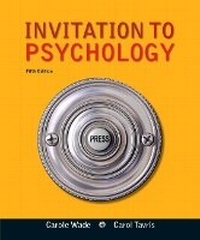
Invitation to Psychology
5th Edition
Published on 23. February 2011
Book
Paperback/Softback
624 pages
978-0-205-03519-9 (ISBN)
Description
Emphasizes critical thinking, culture, and gender
Invitation to Psychology, 5/e, shows students why scientific and critical thinking is so important in the decisions they make. In clear, lively, warm prose, this edition continues the title's integration of gender, culture, and ethnicity. By the end, readers will learn how to interpret research and to address and resolve controversies.
MyPsychLab is an integral part of the Wade/Tavris/Garry program. Engaging activities and assessments provide a teaching and learning system that helps students think like a psychologist. With MyPsychLab, students can watch videos on psychological research and applications, participate in virtual classic experiments, and develop critical thinking skills through writing.
Invitation to Psychology, 5/e is available in a new DSM-5 Updated edition. To learn more, click here.
This title is available in a variety of formats - digital and print. Pearson offers its titles on the devices students love through Pearson's MyLab products, CourseSmart, Amazon, and more.
Invitation to Psychology, 5/e, shows students why scientific and critical thinking is so important in the decisions they make. In clear, lively, warm prose, this edition continues the title's integration of gender, culture, and ethnicity. By the end, readers will learn how to interpret research and to address and resolve controversies.
MyPsychLab is an integral part of the Wade/Tavris/Garry program. Engaging activities and assessments provide a teaching and learning system that helps students think like a psychologist. With MyPsychLab, students can watch videos on psychological research and applications, participate in virtual classic experiments, and develop critical thinking skills through writing.
Invitation to Psychology, 5/e is available in a new DSM-5 Updated edition. To learn more, click here.
This title is available in a variety of formats - digital and print. Pearson offers its titles on the devices students love through Pearson's MyLab products, CourseSmart, Amazon, and more.
More details
Edition
5th edition
Language
English
Place of publication
United States
Publishing group
Pearson Education (US)
Target group
Professional and scholarly
Dimensions
Height: 275 mm
Width: 230 mm
Thickness: 20 mm
Weight
1190 gr
ISBN-13
978-0-205-03519-9 (9780205035199)
Copyright in bibliographic data and cover images is held by Nielsen Book Services Limited or by the publishers or by their respective licensors: all rights reserved.
Schweitzer Classification
Other editions
New editions

Carole Wade | Carol Tavris | Maryanne Garry
Invitation to Psychology
Book
08/2014
6th Edition
Pearson
€220.21
Article is exhausted; no reprint
Previous edition
Book
03/2007
4th Edition
Pearson
€73.38
Article exhausted; check for reprint
Persons
CAROLE WADE earned her Ph.D. in cognitive psychology at Stanford University. She began her academic career at the University of New Mexico, where she taught courses in psycholinguistics and developed the first course at the university on the psychology of gender. She was professor of psychology for ten years at San Diego Mesa College, then taught at College of Marin and Dominican University of California. In addition to this text, she and Carol Tavris have written Psychology; Psychology in Perspective; andThe Longest War: Sex Differences in Perspective. Dr. Wade has a long-standing interest in making psychology accessible to students and the general public. In particular, she has focused her efforts on the teaching and promotion of critical-thinking skills, diversity issues, and the enhancement of undergraduate education in psychology. She chaired the APA Board of Educational Affairs' Task Force on Diversity Issues at the Precollege and Undergraduate Levels of Education in Psychology, as well as the APA's Public Information Committee; has been a G. Stanley Hall lecturer at the APA convention; and served on the steering committee for the National Institute on the Teaching of Psychology. Dr. Wade is a Fellow of the American Psychological Association and of the Association for Psychological Science. When she isn't busy with her professional activities, she can be found riding the trails of northern California on her Morgan horse, McGregor, or one of his Arabian stable mates, Conde or Ricochet.
Carol Tavris earned her Ph.D. in the interdisciplinary program in social psychology at the University of Michigan, and as a writer and lecturer she has sought to educate the public about the importance of critical and scientific thinking in psychology. In addition to this text, she and Carole Wade have written Psychology; Psychology in Perspective; and The Longest War: Sex Differences in Perspective. Dr. Tavris is also coauthor, with Elliot Aronson, of Mistakes Were Made (But Not by Me): Why We Justify Foolish Beliefs, Bad Decisions, and Hurtful Acts; and author of The Mismeasure of Woman andAnger: The Misunderstood Emotion. She has written on psychological topics for a wide variety of magazines, journals, edited books, and newspapers, some of which have been collected in Psychobabble and Biobunk: Using psychological science to think critically about popular psychology. Dr. Tavris lectures widely on topics involving science vs. pseudoscience in psychology and psychiatry, on writing about science for the public, and many other subjects of contemporary interest. She has taught in the psychology department at UCLA and at the Human Relations Center of the New School for Social Research in New York. She is a Fellow of the American Psychological Association and a charter Fellow of the Association for Psychological Science; a member of the editorial board of the APS journal Psychological Science in the Public Interest; and a member of the international advisory board of the Institute for Science and Human Values.
Carol Tavris earned her Ph.D. in the interdisciplinary program in social psychology at the University of Michigan, and as a writer and lecturer she has sought to educate the public about the importance of critical and scientific thinking in psychology. In addition to this text, she and Carole Wade have written Psychology; Psychology in Perspective; and The Longest War: Sex Differences in Perspective. Dr. Tavris is also coauthor, with Elliot Aronson, of Mistakes Were Made (But Not by Me): Why We Justify Foolish Beliefs, Bad Decisions, and Hurtful Acts; and author of The Mismeasure of Woman andAnger: The Misunderstood Emotion. She has written on psychological topics for a wide variety of magazines, journals, edited books, and newspapers, some of which have been collected in Psychobabble and Biobunk: Using psychological science to think critically about popular psychology. Dr. Tavris lectures widely on topics involving science vs. pseudoscience in psychology and psychiatry, on writing about science for the public, and many other subjects of contemporary interest. She has taught in the psychology department at UCLA and at the Human Relations Center of the New School for Social Research in New York. She is a Fellow of the American Psychological Association and a charter Fellow of the Association for Psychological Science; a member of the editorial board of the APS journal Psychological Science in the Public Interest; and a member of the international advisory board of the Institute for Science and Human Values.
Content
Brief Table of Contents
Chapter 1: What is Psychology?
Part One: Your Self
Chapter 2: Theories of Personality
Chapter 3: Development Over the Life Span
Part Two: Your Body
Chapter 4: Neurons, Hormones, and the Brain
Chapter 5: Body Rhythms and Mental States
Chapter 6: Sensation and Perception
Part Three: Your Mind
Chapter 7: Thinking and Intelligence
Chapter 8: Memory
Part Four: Your Environment
Chapter 9: Learning and Conditioning
Chapter 10: Behavior in Social and Cultural Context
Part Five: Your Mental Health
Chapter 11: Psychological Disorders
Chapter 12: Approaches to Treatment and Therapy
Part Six: Your Life
Chapter 13: Emotion, Stress, and Health
Chapter 14: The Major Motives of Life: Food, Love, Sex, and Work
Chapter 1: What is Psychology?
Part One: Your Self
Chapter 2: Theories of Personality
Chapter 3: Development Over the Life Span
Part Two: Your Body
Chapter 4: Neurons, Hormones, and the Brain
Chapter 5: Body Rhythms and Mental States
Chapter 6: Sensation and Perception
Part Three: Your Mind
Chapter 7: Thinking and Intelligence
Chapter 8: Memory
Part Four: Your Environment
Chapter 9: Learning and Conditioning
Chapter 10: Behavior in Social and Cultural Context
Part Five: Your Mental Health
Chapter 11: Psychological Disorders
Chapter 12: Approaches to Treatment and Therapy
Part Six: Your Life
Chapter 13: Emotion, Stress, and Health
Chapter 14: The Major Motives of Life: Food, Love, Sex, and Work