


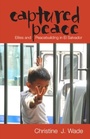
Captured Peace
Elites and Peacebuilding in El Salvador
Published on 15. January 2016
Book
Hardback
304 pages
978-0-89680-297-1 (ISBN)
Description
El Salvador is widely considered one of the most successful United Nations peacebuilding efforts, but record homicide rates, political polarization, socioeconomic exclusion, and corruption have diminished the quality of peace for many of its citizens. In Captured Peace: Elites and Peacebuilding in El Salvador, Christine J. Wade adapts the concept of elite capture to expand on the idea of "captured peace," explaining how local elites commandeered political, social, and economic affairs before war's end and then used the peace accords to deepen their control in these spheres.
While much scholarship has focused on the role of gangs in Salvadoran unrest, Wade draws on an exhaustive range of sources to demonstrate how day-to-day violence is inextricable from the economic and political dimensions. In this in-depth analysis of postwar politics in El Salvador, she highlights the local actors' primary role in peacebuilding and demonstrates the political advantage an incumbent party-in this case, the Nationalist Republican Alliance (ARENA-has throughout the peace process and the consequences of this to the quality of peace that results.
While much scholarship has focused on the role of gangs in Salvadoran unrest, Wade draws on an exhaustive range of sources to demonstrate how day-to-day violence is inextricable from the economic and political dimensions. In this in-depth analysis of postwar politics in El Salvador, she highlights the local actors' primary role in peacebuilding and demonstrates the political advantage an incumbent party-in this case, the Nationalist Republican Alliance (ARENA-has throughout the peace process and the consequences of this to the quality of peace that results.
Reviews / Votes
"Those who study El Salvador closely recognize more deeply the limitations of the peace accords in transforming its politics, economics, and society. This book does a fabulous job explaining how the peace accords failed in several important ways primarily because of the intransigence of local elites...Christine Wade has produced the most comprehensive, up-to-date book on Salvadoran politics of the last twenty-five years." "[Wade] effectively uses the concept of 'compromised peacebuilding' from the work of Michael Barnett and Christoph Zu?rcher1 to guide her analysis of how 'state and local elites are able to redirect the distribution of assistance so that it maximizes their interests'...Could the elite capture of the Salvadoran peace process have been otherwise? Wade draws several important lessons." (Latin American Research Review) "There is no other book like this on the market...It would not surprise me if, after reading this book, scholars working on postwar El Salvador adopted the phrase 'captured peace' to refer to the period."More details
Series
Language
English
Place of publication
Athens
United States
Target group
Professional and scholarly
Product notice
Paper over boards
Dimensions
Height: 216 mm
Width: 140 mm
ISBN-13
978-0-89680-297-1 (9780896802971)
Copyright in bibliographic data and cover images is held by Nielsen Book Services Limited or by the publishers or by their respective licensors: all rights reserved.
Schweitzer Classification
Other editions
Additional editions
E-Book
01/2016
1st Edition
Ohio University Press
€33.99
Available for download
Person
Christine J. Wade is associate professor of political science and international studies at Washington College. She is the coauthor of Understanding Central America: Global Forces, Rebellion, and Change and Nicaragua: Living in the Shadow of the Eagle.