

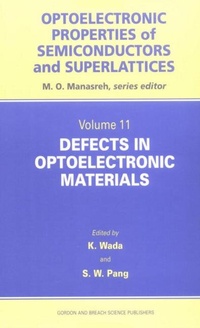
Defects in Optoelectronic Materials
1st Edition
Published on 6. November 2001
Book
Hardback
426 pages
978-90-5699-714-4 (ISBN)
Description
Defects in Optoelectronic Materials bridges the gap between device process engineers and defect physicists by describing current problems in device processing and current understanding of these defects based on defect physics. The volume covers defects and their behaviors in epitaxial growth, in various processes such as plasma processing, deposition and implantation, and in device degradation. This book also provides graduate students cutting-edge information on devices and materials interaction.
More details
Language
English
Place of publication
Amsterdam
Netherlands
Publishing group
Gordon and Breach
Target group
College/higher education
Professional and scholarly
Dimensions
Height: 229 mm
Width: 152 mm
Weight
748 gr
ISBN-13
978-90-5699-714-4 (9789056997144)
Copyright in bibliographic data and cover images is held by Nielsen Book Services Limited or by the publishers or by their respective licensors: all rights reserved.
Schweitzer Classification
Other editions
Additional editions
Kazumi Wada
Defects in Optoelectronic Materials
E-Book
09/2022
1st Edition
CRC Press
€211.99
Available for download
Kazumi Wada
Defects in Optoelectronic Materials
E-Book
09/2022
1st Edition
CRC Press
€211.99
Available for download
Person
Wada, Kazumi
Content
Saturation of Free Carrier Concentration in Semiconductors
The Amphoteric Defect Model
Maximum Doping Limits in GaAs
Other Group III-V Semiconductors
Group III-Nitrides
Group II-VI Semiconductors
Group I-III-VI2 Ternaries
Other Semiconductors
Unintentional Doping
Amphoteric Dopants
Point Defect Formation Near Surfaces
Point Defect Equilibria near the Semiconductor Surfaces
Point Defect Formation Kinetics in the Sub-Surface Layer - Bottleneck Effect
Bottleneck Related Phenomena
Optical Characterization of Plasma Etching Induced Damage
Ion-assisted Etching: Understanding the Problem
Optical Damage Assessment Techniques: Choosing a Method
The Range of Ion-Induced Damage
Dry Etch Damage in Widegap Semiconductor Materials
Damage in the InGaA1N System
Damage in SiC
Damage in II-VI Compounds
Generation, Removal, and Passivation of Plasma Process Induced Defects
Dry Etching Systems
Plasma Process Indu
The Amphoteric Defect Model
Maximum Doping Limits in GaAs
Other Group III-V Semiconductors
Group III-Nitrides
Group II-VI Semiconductors
Group I-III-VI2 Ternaries
Other Semiconductors
Unintentional Doping
Amphoteric Dopants
Point Defect Formation Near Surfaces
Point Defect Equilibria near the Semiconductor Surfaces
Point Defect Formation Kinetics in the Sub-Surface Layer - Bottleneck Effect
Bottleneck Related Phenomena
Optical Characterization of Plasma Etching Induced Damage
Ion-assisted Etching: Understanding the Problem
Optical Damage Assessment Techniques: Choosing a Method
The Range of Ion-Induced Damage
Dry Etch Damage in Widegap Semiconductor Materials
Damage in the InGaA1N System
Damage in SiC
Damage in II-VI Compounds
Generation, Removal, and Passivation of Plasma Process Induced Defects
Dry Etching Systems
Plasma Process Indu