

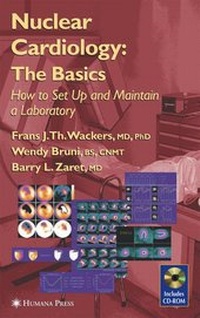
Nuclear Cardiology: The Basics
How to Set Up and Maintain a Laboratory
Published on 1. January 2004
Book
Mixed media product
XIII, 298 pages
978-0-89603-983-4 (ISBN)
Description
In the United States the performance of nuclear cardiology studies continues to increase. As an example, in 1998, 4,160,739 myocardial perfusion imaging st- ies were done. In 2001 this number increased to 5,679,258. The nonhospital performance of perfusion imaging increased over the same time period from 1,188,731 to 1,789,207 studies (Arlington Medical Resources data). In 1999, there were approximately 1300 nonhospital sites with nuclear imaging capabi- ties, of which 600 were in physician's offices. By 2001, there were approximately 1700 nonhospital sites, of which 780 were in physician's offices (from IMV, LTD: http://www.imvlimited.com/mid/). The growth of nuclear cardiology as an expanded outpatient laboratory ent- prise is readily apparent. In the United States, as well as in other parts of the world, this growth has been linked to the recognition of the ability of cardiologists to perform these studies. The certification examination in nuclear cardiology is now well established in the United States. Accreditation of laboratories is also well established. Over the years, some of the most frequent questions asked by our former trainees relate to practical issues involved in the establishment of a nuclear cardiology laboratory. In view of the growth of the field, this is certainly not surprising.
Reviews / Votes
this book delivers a concise, well organized collection of information which is necessary to start a nuclear cardiology laboratory. Anyone interested in starting a laboratory would have difficulty finding a more encompassing source of information than this book. - Doody's Health Sciences Book Review JournalMore details
Series
Edition
Second and 2003. Corr. 2nd Printing ed.
Language
English
Place of publication
NJ
United States
Target group
College/higher education
Professional and scholarly
Illustrations
196
196 s/w Abbildungen
Dimensions
Height: 22.9 cm
Width: 15.2 cm
Thickness: 19 mm
Weight
1 gr
ISBN-13
978-0-89603-983-4 (9780896039834)
DOI
10.1007/978-1-59259-426-9
Schweitzer Classification
Other editions
New editions
Frans J. Th Wackers | Wendy Bruni | Barry Zaret
Nuclear Cardiology, The Basics
How to Set Up and Maintain a Laboratory
Book
11/2007
2nd Edition
Humana Press Inc.
€106.99
Shipment within 15-20 days
Content
How to Use the CD
Getting Started
Laboratory Logistics
Radiation Safety
Patient Preparation
Stress Procedures
SPECT Myocardial Perfusion Imaging Acquisition and Processing Protocols
Planar Myocardial Perfusion Imaging Acquisition and Processing Protocols
Planar Equilibrium Radionuclide Angiocardiography Acquisition and Processing Protocols
SPECT Equilibrium Radionuclide Angiocardiography Acquisition and Processing Protocols
Display and Analysis of SPECT Myocardial Perfusion Images
Display and Analysis of Planar Myocardial Perfusion Images
Display and Analysis of Planar Equilibrium Angiocardiography
Display and Analysis of SPECT Equilibrium Radionuclide Angiocardiography
Artifacts and Technical Problems in Cardiac Imaging
Nuclear Cardiology Reports
Remote Reading and Networking: Tele-Nuclear Cardiology
Quality Assurance
Miscellaneous Additional Laboratory Protocols and Policies
Emergency Department Chest-Pain Center Imaging
Coding and Billing
Laboratory Accreditation
Index
Getting Started
Laboratory Logistics
Radiation Safety
Patient Preparation
Stress Procedures
SPECT Myocardial Perfusion Imaging Acquisition and Processing Protocols
Planar Myocardial Perfusion Imaging Acquisition and Processing Protocols
Planar Equilibrium Radionuclide Angiocardiography Acquisition and Processing Protocols
SPECT Equilibrium Radionuclide Angiocardiography Acquisition and Processing Protocols
Display and Analysis of SPECT Myocardial Perfusion Images
Display and Analysis of Planar Myocardial Perfusion Images
Display and Analysis of Planar Equilibrium Angiocardiography
Display and Analysis of SPECT Equilibrium Radionuclide Angiocardiography
Artifacts and Technical Problems in Cardiac Imaging
Nuclear Cardiology Reports
Remote Reading and Networking: Tele-Nuclear Cardiology
Quality Assurance
Miscellaneous Additional Laboratory Protocols and Policies
Emergency Department Chest-Pain Center Imaging
Coding and Billing
Laboratory Accreditation
Index