

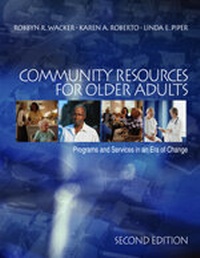
Community Resources for Older Adults
Programs and Services in an Era of Change
2nd Edition
Published on 3. December 2002
Book
Hardback
496 pages
978-0-7619-8770-3 (ISBN)
Description
By the year 2030, older Americans will make up nearly one quarter of the population. The rapid growth of this population segment puts increased importance on the analysis of existing social policy regarding the responsibilities of caring for older adults. This book provides a comprehensive overview of current community resources available to elderly Americans, including both public and private programs.
While knowledge of the community resources that are available is vital, the authors also stress the importance of the theoretical knowledge that will assist in understanding the social and psychological dynamics of help seeking behavior. Deeper understanding of the social and psychological needs of the elderly and their families, as well as the services that are available them, will better prepare students and practitioners to take advantage of resources available to their clients.
New to this Edition
The Second Edition includes updated information about various programs and services, including the newly authorized Older Americans Act and changes in Social Security and Medicare. In addition, new information about health care for retired veterans, updated best practices, and Web resources are provided.
Features and Benefits
Provides an overview of legislation that provides the foundation for the aging network
A discussion of theories that help predict service use, thus offering readers a framework for understanding why older adults do or do not use services
Provides case studies that encourage critical thinking about the delivery and use of community resources
Chapters that contain descriptions of both public and private programs and services available to older adults, in-depth reviews of the current body of empirical literature in each program area, and discussions of the challenges programs and services will face in the future
Includes Best practice examples of community programs from around the country that illustrate unique ways to meet the needs of older adults
Lists national organizations and Internet resources for each topic area
Includes learning activities that challenge students to explore the community resources that exist in the reader's locale
While knowledge of the community resources that are available is vital, the authors also stress the importance of the theoretical knowledge that will assist in understanding the social and psychological dynamics of help seeking behavior. Deeper understanding of the social and psychological needs of the elderly and their families, as well as the services that are available them, will better prepare students and practitioners to take advantage of resources available to their clients.
New to this Edition
The Second Edition includes updated information about various programs and services, including the newly authorized Older Americans Act and changes in Social Security and Medicare. In addition, new information about health care for retired veterans, updated best practices, and Web resources are provided.
Features and Benefits
Provides an overview of legislation that provides the foundation for the aging network
A discussion of theories that help predict service use, thus offering readers a framework for understanding why older adults do or do not use services
Provides case studies that encourage critical thinking about the delivery and use of community resources
Chapters that contain descriptions of both public and private programs and services available to older adults, in-depth reviews of the current body of empirical literature in each program area, and discussions of the challenges programs and services will face in the future
Includes Best practice examples of community programs from around the country that illustrate unique ways to meet the needs of older adults
Lists national organizations and Internet resources for each topic area
Includes learning activities that challenge students to explore the community resources that exist in the reader's locale
Reviews / Votes
"This book is designed for an audience of American students and practitioners. However, readers from other countries might also appreciate the discussion on the continuum of services and the excellent examples of best practices, which provide many ideas for program development and delivery." -- Fran Racher * Canadian Journal on Aging, 23 (3), pgs. 299-300 *More details
Edition
2nd Revised edition
Language
English
Place of publication
Thousand Oaks
United States
Target group
College/higher education
Edition type
Revised edition
Dimensions
Height: 232 mm
Width: 187 mm
Weight
1009 gr
ISBN-13
978-0-7619-8770-3 (9780761987703)
Copyright in bibliographic data and cover images is held by Nielsen Book Services Limited or by the publishers or by their respective licensors: all rights reserved.
Schweitzer Classification
Other editions
New editions
Robbyn R. Wacker | Karen A. Roberto
Community Resources for Older Adults
Programs and Services in an Era of Change
Book
02/2008
3rd Edition
SAGE Publications Inc
€106.80
Article exhausted; check different version
Previous edition
Robbyn R. Wacker | Karen A. Roberto | Linda E. Piper
Community Resources for Older Adults
Programs and Services in an Era of Change
Book
03/1998
1st Edition
SAGE Publications Inc
€89.44
Article exhausted; check for reprint
Persons
Robbyn R. Wacker, Ph.D., is the Provost and Senior Vice President and Professor of Gerontology at the University of Northern Colorado. Her research interests include international aging social policy and psychosocial predictors of community service use among older adults. She has published over 65 refereed presentations, scholarly articles, books, and conference proceedings and has earned numerous university and professional awards, including UNC's Academic Leadership Excellence Award. Karen A. Roberto, Ph.D., is the Director of the Center for Gerontology, Founding Director of the Institute of Society, Culture, and Environment, and Professor of Human Development at Virginia Polytechnic Institute and State University. She also holds adjunct appointments in the Departments of Internal Medicine and Psychiatry and Behavioral Medicine at the Virginia Tech Carilion School of Medicine. She has published over 150 scholarly articles and book chapters, is the editor/author of ten books, and has earned numerous university and professional awards, including the Gerontological Society of America Behavioral and Social Science Distinguished Mentorship in Gerontology Award
Linda E. Piper, M.Ed., was Director of the Weld County Area Agency on Aging for 17 years. Prior to that, she served as the Director of the Weld County Senior Meals Program for 2 years. She has a wide range of experience developing, coordinating, and implementing community-based programs. She served on the statewide advisory committee to implement the Home and Community-Based Long-Term Care Program for the state of Colorado and has been active with numerous other state and local policy planning committees. Under her leadership, the Weld County Area Agency on Aging was one of the four pilot projects through a federal Long-Term Care Systems Development Grant to determine a home and community-based services model for Colorado. Since 1988, she has been an adjunct instructor with the University of Northern Colorado Gerontology Program, teaching graduate-level management and personnel management courses, as well as classes in planning and community resources.
Linda E. Piper, M.Ed., was Director of the Weld County Area Agency on Aging for 17 years. Prior to that, she served as the Director of the Weld County Senior Meals Program for 2 years. She has a wide range of experience developing, coordinating, and implementing community-based programs. She served on the statewide advisory committee to implement the Home and Community-Based Long-Term Care Program for the state of Colorado and has been active with numerous other state and local policy planning committees. Under her leadership, the Weld County Area Agency on Aging was one of the four pilot projects through a federal Long-Term Care Systems Development Grant to determine a home and community-based services model for Colorado. Since 1988, she has been an adjunct instructor with the University of Northern Colorado Gerontology Program, teaching graduate-level management and personnel management courses, as well as classes in planning and community resources.
Content
The Social Context of Community Resource Delivery
On the Threshold of a New Era
Legislative Foundations for Programs, Services, and Benefits Supporting Older Adults
Patterns of Service Use and Theories of Help-Seeking Behavior
Community, Support, and Long-Term Care Services
Information and Referral
Volunteer and Intergenerational Programs
Education Programs
Senior Centers and Recreation
Employment Programs
Income Programs
Nutrition and Meal Programs
Health Care and Wellness
Mental Health Services
Legal Services
Transportation
Housing
Case Management
Home Care Services
Respite Services
Long-Term Care Services
Preparing for the Future
Programs and Services in an Era of Change
Appendix: State Units on Aging
References
Index
On the Threshold of a New Era
Legislative Foundations for Programs, Services, and Benefits Supporting Older Adults
Patterns of Service Use and Theories of Help-Seeking Behavior
Community, Support, and Long-Term Care Services
Information and Referral
Volunteer and Intergenerational Programs
Education Programs
Senior Centers and Recreation
Employment Programs
Income Programs
Nutrition and Meal Programs
Health Care and Wellness
Mental Health Services
Legal Services
Transportation
Housing
Case Management
Home Care Services
Respite Services
Long-Term Care Services
Preparing for the Future
Programs and Services in an Era of Change
Appendix: State Units on Aging
References
Index