

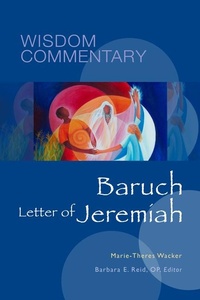
Baruch and the Letter of Jeremiah
Volume 31
Published on 1. April 2016
Book
Hardback
208 pages
978-0-8146-8155-8 (ISBN)
Description
Baruch and the Letter of Jeremiah are among the so-called deuterocanonical books of the Bible, part of the larger Catholic biblical canon. Except for a short article in the Women's Bible Commentary, no detailed or comprehensive feminist commentary on these books is available so far. Marie-Theres Wacker reads both books with an approach that is sensitive to gender and identity issues. The book of Baruch-with its reflections on guilt of the fathers, with its transformation of wisdom into the Book of God's commandments, and with its strong symbol of mother and queen Jerusalem-offers a new and creative digest of Torah, writings, and prophets but seems to address primarily learned men. The so-called Letter of Jeremiah is an impressive document that unmasks pseudo-deities but at the same draws sharp lines between the group's identity and the "others," using women of the "others" as boundary markers.
Reviews / Votes
"Marie-Theres Wacker deals with two short biblical books that are relatively unknown to most readers and little studied within academic and church circles, and she discovers in them important gems of wisdom for our day. In her commentary, the close reading of the Greek text is brought into dialogue with feminist, postcolonial, and interreligious concerns. The supplementary contributors make these concerns concrete as they relate, for instance, the failures of the `fathers and rulers' (Bar 2:1) to the crisis of sexual abuse in the church, or place the mockery of idols in the Epistle of Jeremiah in dialogue with the voice of Dalit women from India today. This commentary will certainly lead many of us to pay much more attention to these short but challenging books."Eileen Schuller, McMaster University, Hamilton, Ontario, Canada "Marie-Theres Wacker's commentary combines philological-historical study of Baruch and the Epistle of Jeremiah with an engaging quest for how these texts might be read today. It both explores the ongoing relevance of these books and encourages critical examination of their rhetoric and ideology. This is a powerful commentary stimulating interaction with these texts from a variety of perspectives, including feminism, gender sensitivity, and postcolonial criticism."Lutz Doering, University of Muenster "The combined accessibility of the writing and the depth of the reflections on the text make this volume an excellent resource for all those approaching the text of Baruch and the Letter of Jeremiah as catalysts for theological reflection in the modern world."Nicholas R. Werse, Catholic Books Review "The commentary is written at a level that should be accessible to most readers and is well footnoted for those who would want to pursue further study of these books. Among its strengths is its identification of a great many intertextual relationships with biblical literature, while it argues clearly Baruch's identification with Torah. Discussion of gendered language and other feminist concerns does not obtrude and the commentary may be recommended as a useful guide to these texts, helpful not least to those whose tradition does not regard Baruch of the Letter of Jeremiah as scripture."George Nicol, Journal for the Study of the Old Testament "Wacker's careful scholarship and accessible writing, along with the pluralistic viewpoints of the `Contributing voices,' invite the reader to ponder Israel's struggle for identity without oppressive harmonizing. May we embrace such a model in our own identity struggles today."Interpretation: A Journal of Bible and TheologyMore details
Series
Language
English
Place of publication
Collegeville, MN
United States
Target group
Professional and scholarly
College/higher education
Product notice
With dust jacket
Dimensions
Height: 195 mm
Width: 150 mm
Thickness: 17 mm
Weight
206 gr
ISBN-13
978-0-8146-8155-8 (9780814681558)
Copyright in bibliographic data and cover images is held by Nielsen Book Services Limited or by the publishers or by their respective licensors: all rights reserved.
Schweitzer Classification
Other editions
Additional editions
Marie-Theres Wacker | Barbara E. Reid
Baruch and the Letter of Jeremiah
E-Book
04/2016
1st Edition
Liturgical Press
from
€77.99
Available for download
Persons
Marie-Theres Wacker is professor of Old Testament and women's research at the Faculty of Catholic Theology, University of Muenster, Germany. She is director of the Seminar for Old Testament Exegesis and runs a research unit for gender studies in theology. Her fields of teaching, research, and publication include feminist biblical hermeneutics, biblical monotheism, early Jewish writings from Hellenistic times, and reception history of the Bible. Together with Luise Schottroff, she edited Feminist Biblical Interpretation: A Compendium, a feminist commentary on the Christian Bible and selected noncanonical writings. Barbara E. Reid, general editor of the Wisdom Commentary series, is a Dominican Sister of Grand Rapids, Michigan. She is the Carroll Stuhlmueller, CP Distinguished Professor of New Testament Studies, and president emerita of Catholic Theological Union (the first woman who held the position). She has been a member of the CTU faculty since 1988 and also served as vice president and academic dean from 2009 to 2018. She holds a PhD in biblical studies from The Catholic University of America and was president of the Catholic Biblical Association in 2014-2015. Her most recent publications are Luke 1-9 and Luke 10-24, co-authored with Shelly Matthews (WCS 43A, 43B; Liturgical Press, 2021); and At the Table of Holy Wisdom: Global Hungers and Feminist Biblical Interpretation (Paulist, 2023).
Carol J. Dempsey, OP is professor of biblical studies at the University of Portland, Oregon, with special expertise in Old Testament and prophets. She holds a PhD in biblical studies from The Catholic University of America, and has authored several books including Jeremiah: Preacher of Grace, Poet of Truth (Liturgical Press, 2007) and Reading the Bible, Transforming Conflict.
Carol J. Dempsey, OP is professor of biblical studies at the University of Portland, Oregon, with special expertise in Old Testament and prophets. She holds a PhD in biblical studies from The Catholic University of America, and has authored several books including Jeremiah: Preacher of Grace, Poet of Truth (Liturgical Press, 2007) and Reading the Bible, Transforming Conflict.
Content
Contents
List of Abbreviations vii
List of Contributors ix
Foreword: "Tell It on the Mountain"-or, "And You Shall Tell Your Daughter [as Well]" xi
Athalya Brenner-Idan
Editor's Introduction to Wisdom Commentary: "She Is a Breath of the Power of God" (Wis 7:25) xv
Barbara E. Reid, OP
Author's Introduction xxxv
Baruch: Introduction 1
Baruch 1:1-15a Connecting Babylon and Jerusalem 5
Baruch 1:15b-3:8 The Exiles' Prayer 15
Baruch 3:9-4:4 Where Wisdom Is to Be Found 39
Baruch 4:5-5:9 Jerusalem, Woman-City and Mother of Israel 67
Baruch 1-5 Looking Back as a Feminist Reader 91
The Letter (Epistle) of Jeremiah (Bar 6:1-73) A Deconstruction of Images 97
A Personal Final Conclusion 133
Works Cited 135
Index of Scripture References and Other Ancient Writings 145
Index of Subjects 153
List of Abbreviations vii
List of Contributors ix
Foreword: "Tell It on the Mountain"-or, "And You Shall Tell Your Daughter [as Well]" xi
Athalya Brenner-Idan
Editor's Introduction to Wisdom Commentary: "She Is a Breath of the Power of God" (Wis 7:25) xv
Barbara E. Reid, OP
Author's Introduction xxxv
Baruch: Introduction 1
Baruch 1:1-15a Connecting Babylon and Jerusalem 5
Baruch 1:15b-3:8 The Exiles' Prayer 15
Baruch 3:9-4:4 Where Wisdom Is to Be Found 39
Baruch 4:5-5:9 Jerusalem, Woman-City and Mother of Israel 67
Baruch 1-5 Looking Back as a Feminist Reader 91
The Letter (Epistle) of Jeremiah (Bar 6:1-73) A Deconstruction of Images 97
A Personal Final Conclusion 133
Works Cited 135
Index of Scripture References and Other Ancient Writings 145
Index of Subjects 153